
What is Agentic AI? We show how companies can automate complex processes using autonomous AI agents.
Agentic AI is considered to be one of the most important developments in the field of artificial intelligence to date. Unlike traditional AI systems, which primarily respond to individual requests, agentic AI systems can plan tasks independently, make decisions and execute processes automatically. This creates new opportunities to make complex processes in companies more efficient.
Agentic AI is becoming increasingly important, especially in the area of process automation. Companies are using the technology to reduce repetitive tasks, speed up workflows and relieve employees in a targeted manner.
But what exactly is behind the term Agentic AI? How do autonomous AI agents differ from conventional AI applications and in which business areas are they already being used today? In this article, you will get an overview of the functions, advantages and possible applications of agentic AI in a corporate context.
This article is aimed at corporate decision-makers and IT managers who want to find out how they can optimize their business processes with Agentic AI.
What is agentic AI?
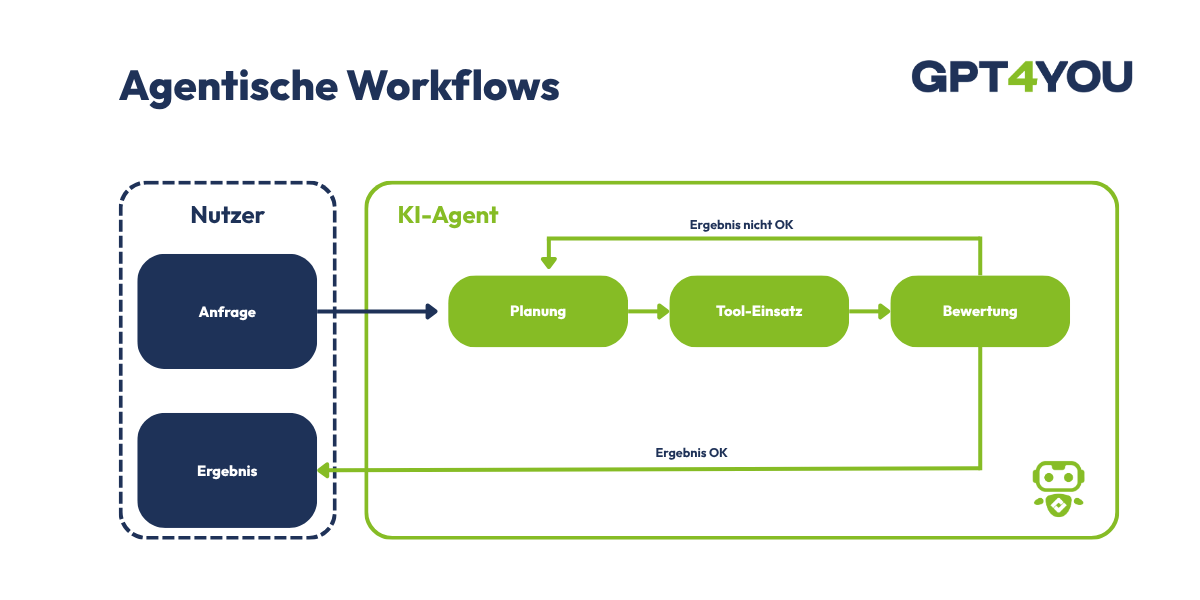
Agentic AI is an advanced form of artificial intelligence that enables autonomous decision-making and independent action and thus differs clearly from conventional AI, which usually reacts to specific commands or primarily analyzes data. The technology is based on so-called AI agents that analyze information and make decisions based on defined rules and goals. They not only react to individual inputs, but also plan several action steps and adapt their behavior to new information.
In contrast to traditional AI applications, agentic AI works much more autonomously. While conventional systems usually respond to specific user requests (prompts), agentic AI systems can control complex processes independently and link different tasks with one another. This includes, for example, collecting and evaluating data, prioritizing tasks or automatically triggering further processes.
Comprehensive agentic AI systems are designed to act much more autonomously and often use several AI agents to orchestrate and execute complex tasks; the focus is not on the pure automation of individual steps, but on independent problem solving and the targeted execution of complete tasks.
Agentic AI combines various technologies such as large language models (LLMs), automation systems, machine learning and external data sources. This results in intelligent systems that not only generate content, but can also actively support decisions and take on operational tasks.
For companies, this opens up new opportunities to make processes more efficient, deploy resources in a more targeted manner and automate workflows to a greater extent.
AI agents based on GPT4YOU
FIDA relies on its own GPT4YOU platform for the development of agent-based AI solutions. The solution enables companies to use modern AI technologies securely and in compliance with the GDPR in the corporate environment.
Based on GPT4YOU, FIDA develops individual AI agents that are specifically tailored to existing processes, data sources and requirements. This results in intelligent assistance systems that can analyze information, automate tasks and independently support or execute complex workflows.
The platform can be connected to internal company data, knowledge databases and existing applications. This allows agent-based AI solutions to be seamlessly integrated into existing system landscapes - such as CRM, ERP or document management systems.
There is a particular focus on data protection, security and compliance. Companies retain control over sensitive data at all times and can use AI applications securely within their own processes.
The platform is designed to be provider-independent. This means that companies are not tied to a single AI provider, but can flexibly integrate different language models and AI technologies. As a result, the AI architecture remains open, scalable and can be adapted to individual requirements and future technological developments.
Through the combination of its own AI platform, individual development and strategic consulting, FIDA supports companies from the initial process analysis to the productive use of powerful AI agents.
Agentic AI and Generative AI: what's the difference?
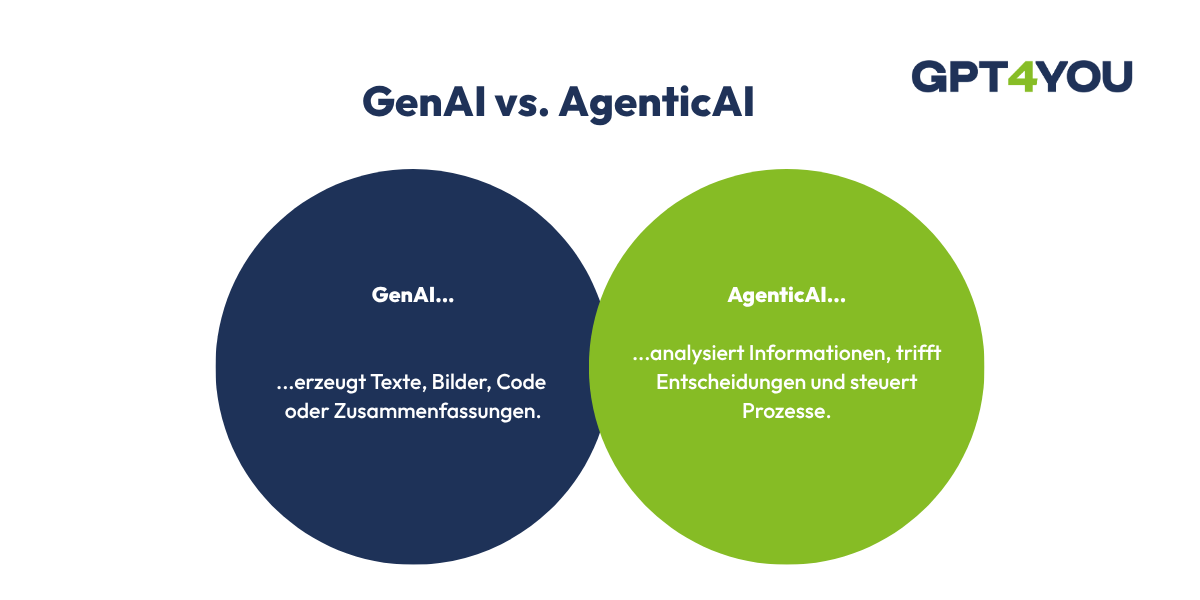
Agentic AI and Generative AI are both based on artificial intelligence, but take different approaches. Generative AI, such as Large Language Models (LLMs), creates content based on input. Agentic AI, on the other hand, uses such models as a basis for planning, orchestrating and executing complex tasks independently. AI agents also have other predefined tools at their disposal, such as a Google search interface.
The most important differences at a glance:
Generative AI creates content
Generative AI creates texts, images, code or summaries based on a user request.Agentic AI performs tasks independently
Agentic AI systems analyze information, make decisions and control processes autonomously.Generative AI reacts to input
The systems mainly work reactively and require specific prompts or instructions.Agentic AI pursues goals independently
AI agents can plan several action steps and coordinate different systems with each other.Generative AI supports communication and content creation
Typical areas of application are text generation, translations or summaries.Agentic AI automates entire processes
These include research, scheduling, workflow control and data-based decisions.
The difference is particularly evident in day-to-day business: a generative AI can, for example, formulate an email or summarize a report. An agentic AI system, on the other hand, can independently research information, coordinate appointments, ask questions and automate entire processes.
In practice, both technologies are often combined. Generative AI takes care of communication and content creation, while agentic AI makes decisions and controls workflows.
What role do AI agents play in companies?
AI agents can help companies to make processes more efficient and automate recurring tasks. They not only take over individual work steps, but can also coordinate and control entire processes independently. This reduces the workload on employees and allows resources to be deployed in a more targeted manner.
Depending on the area of application, AI agents take on different tasks. In customer service, they can analyze inquiries, provide information and process requests automatically. In data analysis, they help to evaluate large volumes of data and make relevant findings available more quickly. Agent-based systems are also increasingly being used in areas such as IT support, sales, knowledge management and process automation.
The ability to connect different systems and data sources is particularly relevant here. AI agents can retrieve information from multiple applications, make decisions based on defined rules and automatically initiate follow-up processes. This creates digital assistance systems that actively support and accelerate workflows.
For companies, this primarily means greater efficiency and greater scalability of processes. At the same time, employees can concentrate more on strategic and value-adding tasks, while repetitive activities are automated.
Where is Agentic AI already being used?
Agentic AI is already being used in various areas of companies - especially where processes need to be automated, decisions supported or large volumes of data processed. Many companies are combining generative AI with autonomous AI agents to make workflows more efficient.
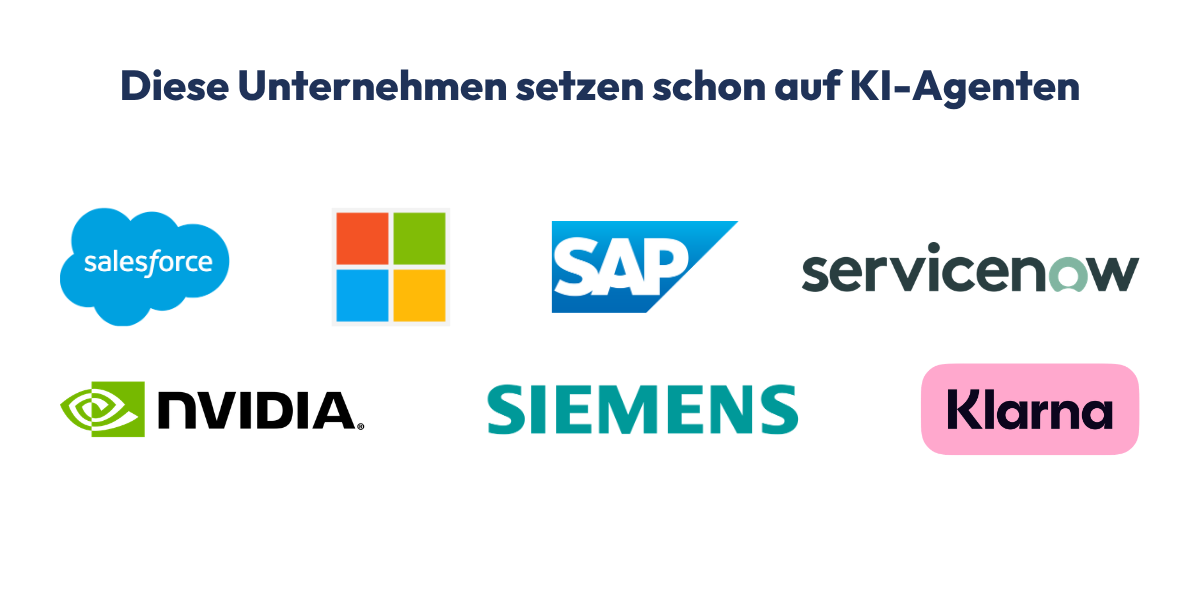
One well-known example is Salesforce with its Agentforce platform. Companies can use AI agents to independently process customer inquiries, support sales processes or prioritize service tickets. According to Salesforce, thousands of companies are already using the platform for automated business processes.
Microsoft is also increasingly integrating agent-based AI into its business solutions. With Microsoft Copilot and AI agents within Microsoft 365, tasks such as scheduling, document summaries or workflow automation can be carried out partially autonomously.
SAP also relies on agent-based AI in the area of business software. The company is developing AI-supported systems for areas such as finance, HR management, purchasing and supply chain management. The aim is to control business processes in a more automated and data-based manner.
Another practical example is provided by payment service provider Klarna. There, AI agents are used in customer service to automatically process support requests and speed up processes. The systems independently take over large parts of the communication with customers.
Industrial and logistics companies are also increasingly investing in agent-based AI. Companies such as Siemens, ServiceNow and NVIDIA are working on AI agents to automate and optimize processes in production, IT operations and supply chain management.
These examples show that agentic AI is already being used productively in many companies today - especially in areas with high automation and data potential. At the same time, the technology is still at an early stage of development in many sectors. Many companies are currently testing the first concrete use cases before agentic systems are integrated more broadly.
10 possible uses of Agentic AI in your company
Agentic AI can support companies in many areas - especially where processes are recurring, data-based or time-consuming. The combination of automation and autonomous decision-making can make numerous processes more efficient.
Automating customer service
AI agents can process customer inquiries independently, provide information or coordinate support processes. This shortens response times and reduces the workload of service teams.
Supporting IT support
In the IT sector, agent-based systems can analyse faults, prioritize tickets or provide automated solution proposals. Recurring support tasks can therefore be processed more quickly.
Analyze and evaluate data
Agentic AI can merge and analyze large amounts of data from various sources and automatically process relevant findings. This provides companies with a faster basis for decision-making.
Improve knowledge management
AI agents help to structure internal information, search documents and provide employees with relevant content. This makes knowledge more easily accessible.
Optimize sales processes
In sales, AI agents can evaluate leads, analyze customer data and control follow-up processes automatically. This allows sales activities to be organized more efficiently.
Automating marketing processes
Agent-based systems can monitor campaigns, prepare content or analyze performance data. This supports companies in making data-based marketing decisions.
Coordinating appointments and tasks
AI agents can plan meetings, prioritize tasks and coordinate workflows between teams. This reduces organizational processes.
Supporting processes in human resources
In HR, Agentic AI can pre-sort (not evaluate) applications, answer internal inquiries or provide automated support for onboarding processes.
Simplify compliance and documentation processes
AI agents can check documents, monitor guidelines and automatically document relevant information. This reduces manual effort for regulatory requirements.
Linking company processes intelligently
Agentic AI can connect different systems and control entire workflows automatically. This creates end-to-end processes without manual transfers between individual applications.
Can AI agents be operated locally in the company?
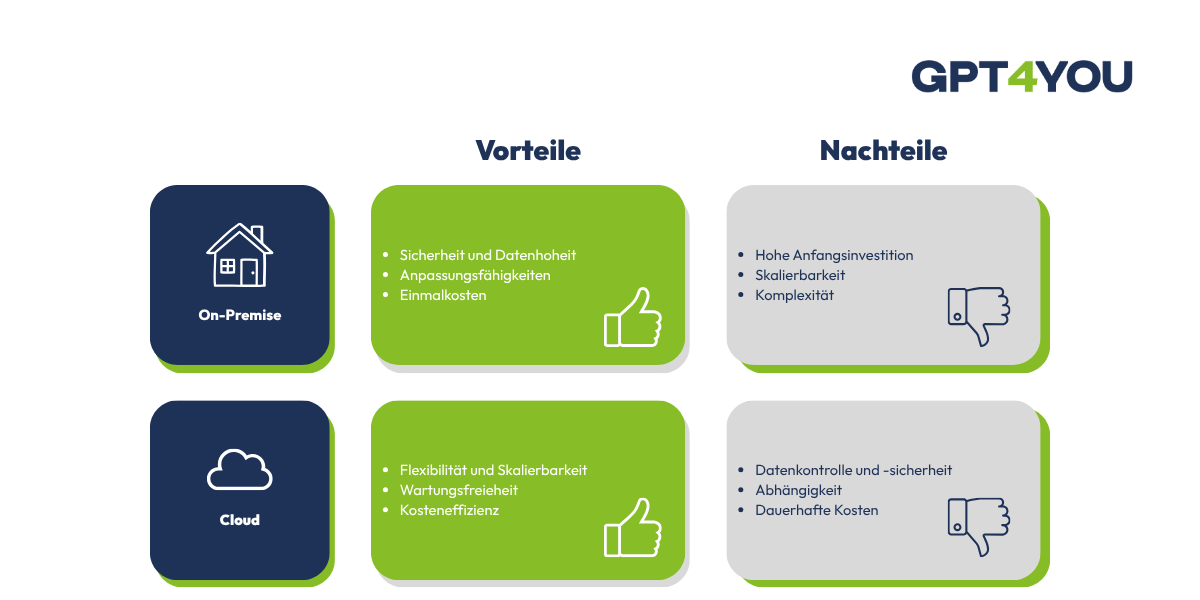
Companies can not only use AI agents via cloud services, but also operate them locally in their own IT infrastructure. This approach is particularly important for sensitive data, high data protection requirements or regulatory requirements. By operating locally, companies retain complete control over data, systems and access rights. At the same time, agent-based AI solutions can be specifically adapted to internal processes and security requirements.
We support companies in setting up the necessary infrastructure!
Which LLMs are best suited for AI agents?
The choice of a suitable Large Language Model (LLM) is a key factor for the performance of AI agents. This is because agentic AI has special requirements: In addition to pure language processing, tool usage, reliability in multi-level tasks, contextual understanding and decision-making ability are particularly crucial.
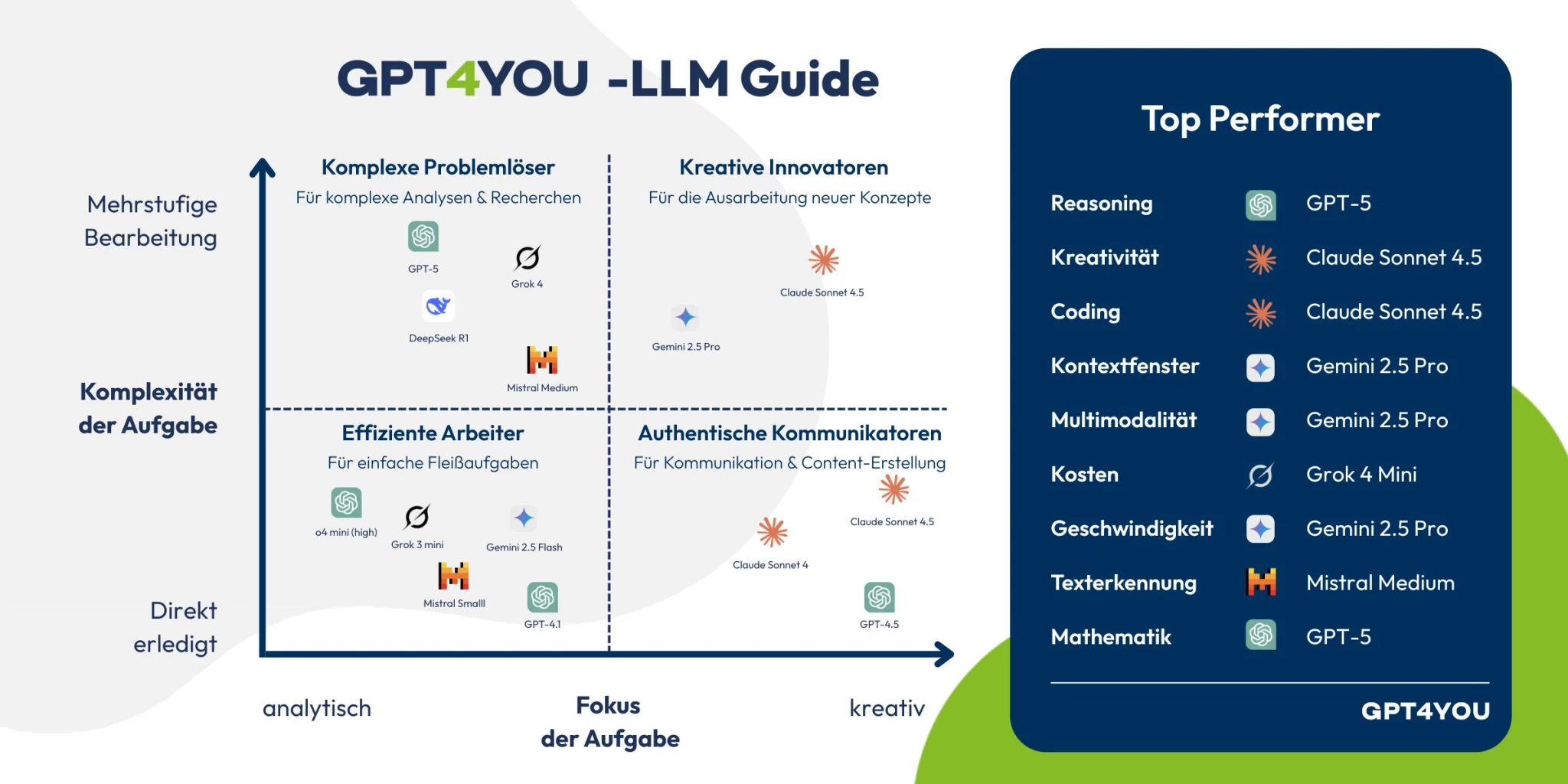
In principle, there is no "one best model", but rather several leading LLMs that are suited to different degrees depending on the application scenario.
1. frontier models for complex agents
Models such as OpenAI GPT-4o or newer GPT-5-based variants are considered very strong for general agent tasks. They offer a good balance of reasoning capability, tool integration and speed and are often used for productive enterprise agents.
Anthropic models such as Claude Opus are also particularly strong for complex reasoning, long contexts and structured task processing - an advantage for demanding workflows and document processes.
2. multimodal and scalable models
Google Gemini models are particularly strong when agents have to process large amounts of data or work multimodally (text, images, audio and video analysis). In addition, they often score points with very large context windows, which is relevant for data-intensive agent systems.
3. open source models for maximum flexibility
Open source models such as Llama or Qwen (depending on the version and provider) are increasingly being used in agent architectures, especially when companies value data sovereignty, adaptability and on-premise operation, as they often form the underlying AI models for targeted agents. These models are often cost-efficient and flexible to integrate, and their customizability also makes them easier to manage in-house, but they require more technical setup.
4 Decisive selection criteria for AI agents
When selecting an LLM for Agentic AI, the focus is less on "benchmarks" and more on practical criteria:
Reliability for multi-step tasks
Ability to use tools (APIs, systems, databases)
Context length and memory capacity
Costs and scalability
Data protection and hosting requirements
There is no one "best" large language model for AI agents. Rather, it is crucial that the model fits the task at hand - be it for complex reasoning processes, large amounts of data, high data protection requirements or cost-efficient automation. In practice, a combined approach of different LLMs has therefore often established itself in order to achieve maximum flexibility and performance.
This is precisely where GPT4YOU comes in. The platform enables companies to use different language models flexibly and develop individual AI agents based on them - regardless of the individual provider. This creates a future-proof basis for the use of agentic AI in the company.
What advantages and disadvantages does Agentic AI offer companies?
Agentic AI offers companies numerous opportunities to make processes more efficient and automate workflows to a greater extent. At the same time, the use of autonomous AI systems also brings challenges that should be taken into account when introducing them.
Advantages of Agentic AI
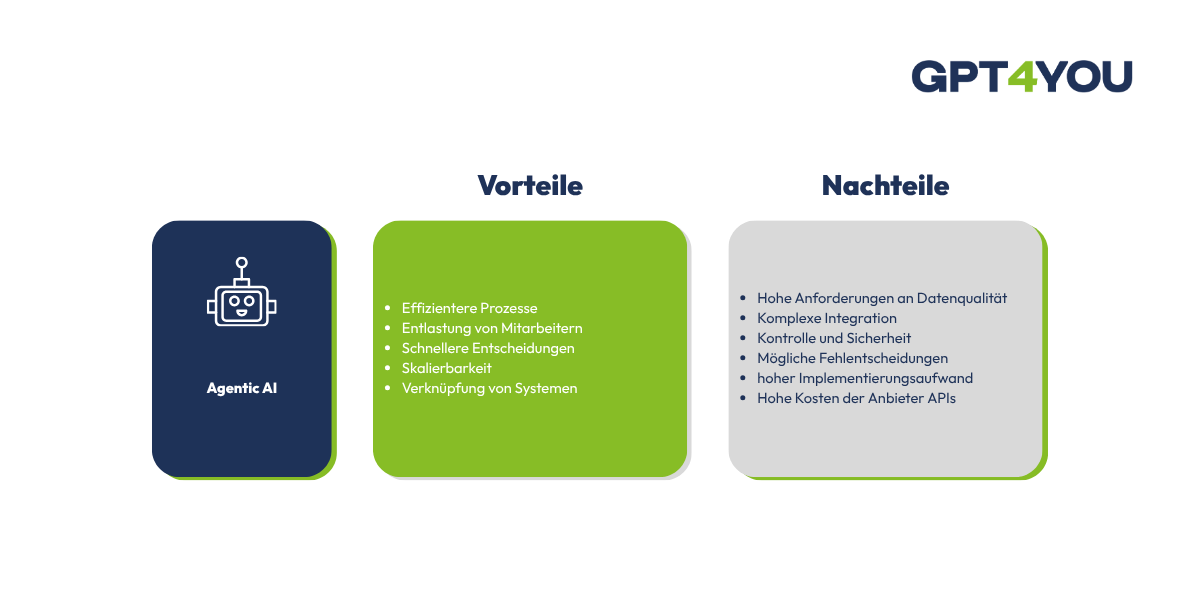
More efficient processes
AI agents can take over recurring tasks automatically and coordinate several process steps independently. This speeds up processes and reduces manual activities.
Relief for employees
By automating standardized tasks, employees can focus more on strategic, creative or customer-related activities.
Faster decisions
Agent-based systems analyze large volumes of data in a short space of time and can derive recommendations for action or initiate follow-up processes directly.
Scalability
AI agents can work around the clock and support processes efficiently, even when requirements increase. This enables companies to process tasks faster and on a larger scale.
Linking different systems
Agentic AI can combine information from different applications and automate processes across systems. This creates more efficient digital workflows.
Disadvantages and challenges of Agentic AI
High data quality requirements
For AI agents to work reliably, they need structured and high-quality data. Incorrect or incomplete information can lead to incorrect decisions.
Complex integration
Integrating agentic AI into existing IT systems can be technically complex. Integration challenges often arise, particularly in companies with established system landscapes.
Control and security issues
As agentic AI can make decisions independently, companies need to define clear rules and control mechanisms. Issues such as data protection, compliance and IT security play an important role here.
Wrong decisions by AI systems
Even autonomous AI agents can make mistakes or misinterpret situations. Human control therefore remains necessary in many areas of application.
High implementation costs
The introduction of agent-based AI not only requires technological adjustments, but often also changes to processes and working methods within the company.
High costs of the provider APIs
AI agents quickly consume millions of tokens for complex tasks, which quickly becomes cost-intensive when using SotA models.
What challenges do companies face when implementing Agentic AI?
The introduction of agentic AI offers companies great potential, but is often associated with technical, organizational and strategic challenges. Various requirements must be met in order for agentic AI systems to work reliably.
Data quality and data access
One of the most important foundations for agentic AI is high-quality and structured data. AI agents make decisions based on existing information and often access several systems simultaneously. If data is incomplete, outdated or poorly structured, this can significantly impair the quality of the results.
Integration into existing systems
Many companies work with complex IT landscapes and different software solutions. Agentic AI often has to be integrated into existing systems such as CRM, ERP or document management solutions. This technical connection can be complex and often requires individual interfaces and adaptations.
Data protection and compliance
As AI agents process data and make decisions independently, data protection and regulatory requirements play a key role. Companies must ensure that sensitive information remains protected and that legal requirements are complied with. Clear security and authorization concepts are particularly necessary for personal data.
Transparency and control mechanisms
Agentic AI works partially autonomously. It is therefore important to make it clear how decisions are made and which processes are carried out automatically. Companies need clear control mechanisms to identify wrong decisions at an early stage and minimize risks. The "human in the loop" is therefore still necessary at critical points!
Changes to existing work processes
The introduction of agent-based AI often changes existing processes and working methods. Companies need to redefine processes and prepare employees for working with AI-supported systems. In addition to technical issues, change management therefore also plays an important role because this change often means a genuine transformation of existing work processes.
Expertise and resources
The implementation of Agentic AI requires technical expertise in areas such as AI, data management, software development and process automation. Many companies face the challenge of building up the relevant expertise internally or bringing in external support.
Despite these challenges, more and more companies are investing in agentic AI systems. A step-by-step approach with clearly defined use cases and realistic goals is usually crucial for a successful introduction.
How does FIDA support companies with the introduction of Agentic AI?
The successful introduction of Agentic AI requires not only the right technology, but also a clear strategy, structured processes and a deep understanding of the company's requirements. This is precisely where FIDA supports companies throughout the entire introduction and development process - from the initial analysis to the productive integration of agentic AI systems.
Process analysis and identification of suitable use cases
To begin with, FIDA analyses existing business processes and identifies areas with high automation and optimization potential. This involves examining which processes are suitable for the use of agentic AI and where companies can achieve the greatest added value, with use cases serving as a concrete prioritization level.

Development of individual AI agents
Based on the requirements, FIDA develops individual AI agents and intelligent automation solutions. The systems are specifically tailored to existing processes, data sources and company goals. These include AI agents for knowledge management, customer service, process automation, internal assistance systems and coding.
Integration into existing IT systems
In order for Agentic AI to work efficiently, various applications and data sources need to be connected with each other. FIDA supports companies with the technical integration into existing system landscapes - such as CRM, ERP or document management systems.

Data protection, compliance and security
Data protection and regulatory requirements play a central role, especially for autonomous AI systems. FIDA supports companies in the development of secure and compliant AI solutions and assists with issues such as access rights, data security and governance structures.
Training and enablement
In addition to technical implementation, FIDA also supports the development of internal skills. Through workshops and training courses, employees learn how agent-based AI systems can be used sensibly and integrated into existing workflows.
Agentic AI as the next step in intelligent business processes
Agentic AI is increasingly becoming an important part of modern business processes, promoting not only efficiency but also innovation. Autonomous AI agents not only automate tasks, but also control and coordinate them intelligently. As a result, companies benefit from more efficient processes, faster decisions and a targeted reduction in the workload of employees.
At the same time, it is clear that the successful introduction of agent-based AI requires a clear strategy, suitable processes and technical expertise. Topics such as integration, data protection, compliance and change management in particular play a decisive role here.
With FIDA, companies have an experienced partner for the development and introduction of individual AI solutions. From process analysis and the development of intelligent AI agents to training and compliance support, FIDA accompanies companies throughout the entire transformation process.
Would you like to find out how Agentic AI can be used in your company? Then arrange your free and non-binding initial consultation now.
FAQ: Frequently asked questions about Agentic AI
Agentic AI describes AI systems that can perform tasks and make decisions independently. Unlike traditional AI applications, agentic systems not only react to individual inputs, but also pursue defined goals autonomously. To do this, they analyze information, plan several action steps and execute processes autonomously.
Agentic AI often combines technologies such as large language models (LLMs), machine learning, automation and external data sources. This results in intelligent AI agents that can support or fully automate complex workflows.
Not directly. ChatGPT primarily belongs to the category of generative AI. The system creates texts, answers questions or generates content based on user input. It acts reactively and does not normally carry out any independent processes.
However, ChatGPT can be part of an agentic AI system. If the language model is combined with other tools, data sources or automation functions, it can be used to create AI agents that plan and execute tasks independently. In such cases, ChatGPT serves as a communication or analysis component within a larger agentic AI solution, for example.
Generative AI specializes in creating content. This includes texts, images, code or summaries. The systems react to specific inputs and generate suitable results.
Agentic AI goes much further. The focus here is not purely on content creation, but on autonomous action. Agentic AI systems can analyze processes, make decisions and coordinate multiple tasks independently.
A simple example:
A generative AI creates an email on request.
An agentic AI also analyses the context, researches information, prioritizes tasks and automatically sends the email to the right recipients.
In companies, both technologies are often combined to generate content intelligently and control processes automatically at the same time.
Agentic AI can help companies to make processes more efficient, automate repetitive tasks and make data-based decisions. This results in time and cost benefits, particularly in areas such as customer service, IT support, knowledge management and process automation.
In addition, AI agents can work around the clock and coordinate several systems simultaneously. This increases scalability and reduces manual process steps.
Agentic AI is already being used in many areas of the company. Typical fields of application are
Customer service and support
Sales and marketing automation
Data analysis and reporting
knowledge management
IT and helpdesk processes
Human resources and recruiting
Document and compliance management
Supply chain and logistics
Companies with complex and data-intensive processes in particular benefit from agent-based AI systems.
In most cases, Agentic AI is used to support employees and automate repetitive tasks. The technology can speed up processes and reduce workload, but it does not completely replace human decision-making and expertise.
Human control remains particularly important for strategic tasks, creative processes or sensitive decisions. Many companies therefore rely on a combination of human expertise and AI-supported automation.
The biggest challenges include integration into existing systems, data protection and compliance requirements and the quality of existing data. In addition, companies need clear governance structures and control mechanisms so that AI agents can work reliably and securely.
Employee training and the adaptation of existing processes also play an important role in the introduction.
FIDA supports companies from the initial strategy development to the technical implementation of agent-based AI solutions. This includes process analyses, the development of individual AI agents, integration into existing systems as well as training and compliance consulting.
This provides companies with holistic support for the introduction of modern AI technologies and the automation of complex business processes.


