
AI for companies: Free webinar and guide
Free webinar
AI in the company: What you should know!
Artificial intelligence (AI) is no longer a future scenario, but the key driver of the fourth industrial revolution. While the global economy is being transformed, German companies are also facing the challenge of optimizing their processes with AI. Recent studies paint a clear picture: AI tools are on the rise and are increasingly being recognized as a lever for growth and innovation.
The importance of AI for companies is constantly increasing. Forecasts predict that the global AI market will grow by around 37.3% per year until 2030. This massive increase is driving the transformation of business processes worldwide - a trend that is undoubtedly also reflected in the German corporate landscape.
In this guide, you will find out how your business can benefit from AI, which use cases are standard today and how to overcome hurdles during implementation.
Status quo: Where does the German economy stand in terms of AI use?
Are you wondering how, where and why companies are using AI applications? The figures speak for themselves. According to a recent study by the Federal Statistical Office, one in five companies was already using AI technologies in 2024 - an increase of 8% in just one year.
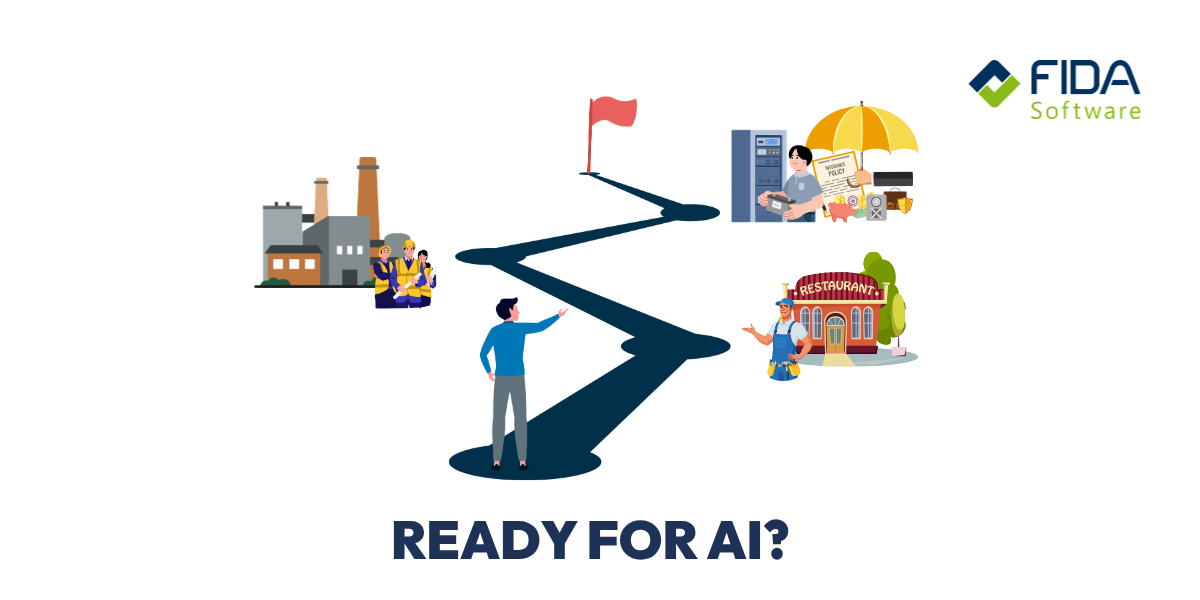
A comparison of sectors
There are clear differences between the sectors:
Pioneers: IT service providers, electrical engineering and the insurance industry are leading the field.
Catching up: Mechanical engineering, vehicle manufacturing and the construction industry are increasingly integrating AI solutions to counter the shortage of skilled workers and global cost pressure.
Laggards: The hospitality industry and small craft businesses are slowly getting to grips with the topic.
As a medium-sized software and consulting company, we see every day that the scalability of AI is the key to success. We not only offer innovative AI products such as GPT4YOU, but also support companies with strategic AI consulting.
Is AI the future for every company?
The answer is yes, but with a plan. In our AI consulting, we often see the mistake that companies want to introduce "AI for AI's sake". In the worst case scenario, this leads to processes becoming slower and more error-prone.
Not every process needs to be supported by AI. A well-founded analysis of business processes is absolutely essential. According to EY, 94 % of technology leaders see innovation as the key to emerging stronger from economic uncertainty. In the USA, 80% of managers are already planning to massively increase their investments in AI. Germany is now following suit.
Important: A well thought-out concept is the basis. Those who blindly buy tools produce digital ruins. However, those who integrate strategically will achieve a real increase in efficiency.
Introduction to AI: more than just chatbots
Artificial intelligence is a key driver of competitiveness today. Companies that are early adopters of modern AI platforms will gain an unassailable market advantage. The implementation of requires intelligent integration in three strategic core areas: Database, Workflows and Human Resources, in order to increase efficiency and competitiveness.
What does AI actually mean in the corporate context?
It's not about replacing people, but about complementing them. The integration of AI makes it possible
Automate processes: Routine tasks are completed in seconds.
Use resources more efficiently: Time and budget flow into strategic projects instead of data maintenance.
Sustainably increase operational efficiency: predictive analyses prevent errors before they occur.
Platforms such as OpenAI, Microsoft Copilot, DeepSeek or Google Gemini in particular offer innovative interfaces to revolutionize existing workflows. Choosing the right platform is a strategic milestone: it determines how agile a company can react to market changes.
Practical check: How does AI increase business efficiency?
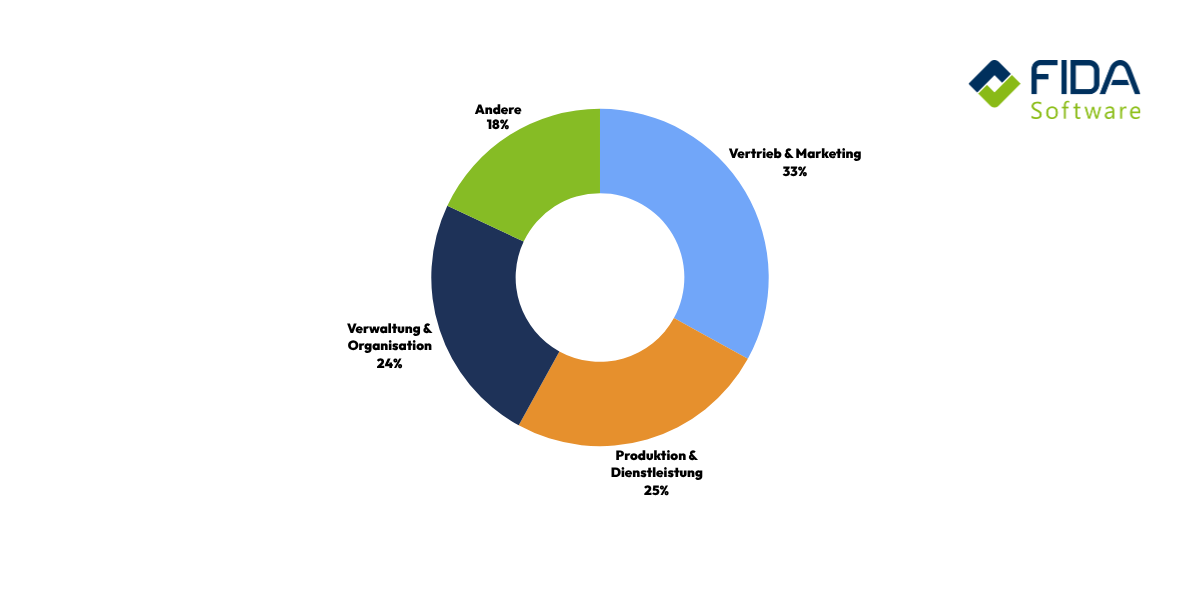
AI is no longer just a corporate issue. SMEs are also recognizing its enormous potential. The most important areas of application according to current data:
Sales & marketing (33%): Personalization and lead generation.
Production & services (25 %): Quality control and resource planning.
Administration & organization (24 %): Document management and HR.
Despite the growth (61% of companies plan to increase their AI budget in 2025), there are obstacles. A lack of knowledge and data protection concerns often stand in the way. This is where we come in as a partner: As a consulting firm with many years of experience in the development of AI technologies, we support companies in the introduction of artificial intelligence and also offer AI training courses.
Deep Dive: 5 practical use cases for AI in everyday corporate life
Use case 1: Driving innovation with AI at BMW
Innovation processes often extend over years and often just the one last inspiration is missing to round off a new development! Such cycles can be shortened with the help of AI applications. Generative AI in particular makes it possible to visualize new ideas or product designs within a few seconds - a typical use case for innovative companies.
Practical example BMW
One example of the use of AI in product design is provided by car manufacturer BMW. BMW is certain: "Artificial intelligence is opening up new avenues and is only at the beginning of its career in the design process. It is already part of our daily communication and is becoming increasingly important." In addition to its use in product design, AI is already playing a role in purchasing, production and sales at BMW!
Use case 2: Document management with GPT4YOU
A typical symptom of SMEs. Long processes, a lack of digitalization and a mountain of paper files. Here, too, AI applications can help and relieve you of routine tasks!
What does this look like in practice? We're sure you're familiar with situations like this: You receive a large number of different documents, have handwritten notes and possibly also voice messages. This information needs to be structured in some way. This is exactly the process that AI takes over for you!
Our GPT4YOU tool, a GDPR-compliant alternative to ChatGPT, is suitable for processing texts in this way!
Practical example recruitment agency
We were commissioned by a nationally and internationally active recruitment agency that specializes in recruiting for leadership and management positions. Our task was to optimize a central process: the creation of structured, high-quality CVs with the help of AI. Until now, candidate profiles were mainly created manually on the basis of CVs, questionnaires and interview notes. This process was time-consuming, error-prone and offered hardly any opportunities for scaling. Following a detailed process and requirements analysis, our GPT4YOU framework was implemented. At the heart of the solution are specially designed system instructions that enable the precise and automated creation of candidate profiles. .... Learn more about the project
Use Case 3: Qualification of employees
Employee training is an essential part of every company - whether for new team members or for the further training of existing staff.
Thanks to AI-supported tools such as Coursebox, EdApp or Courseau, training processes can now be made more efficient and simpler, allowing companies to train their employees in a targeted manner and with little effort.
Use case 4: Knowledge management
The ability of AI to process large amounts of data and make it accessible is revolutionizing knowledge management in companies. AI tools can help to consolidate, organize and process information from various sources. This makes relevant knowledge available to employees more quickly and effectively.
With our GDPR-compliant AI solution GPT4YOU, we provide an application that can be fed with company data and information without any data protection concerns! GPT4YOU is the best alternative to ChatGPT!
Use Case 5: Personalized customer service
We've all been there: you're in an online store or using any software, but you have a problem and want to contact customer service. Real employees are often overloaded and it takes forever to get an answer to your problem.
AI-powered chatbots and virtual assistants offer round-the-clock support and improve customer satisfaction by responding to queries immediately. Companies can now design individual customer approaches and customized offers, which significantly increases customer loyalty and conversion rates. AI-supported chatbots and virtual assistants also offer round-the-clock support and increase customer satisfaction by providing immediate responses to inquiries.

What advantages do AI applications offer companies?
Through the targeted use of powerful algorithms, companies can analyze massive amounts of data in real time, make informed decisions and automate complex processes.
Choosing the right platform is a strategic decision. It must be precisely tailored to the individual requirements and goals of your company in order to ensure long-term competitiveness. Those who rely on modern AI platforms benefit from
Greater agility: faster response to market changes.
Innovative business models: Development of completely new services.
Optimized collaboration: Tools such as Microsoft Copilot in particular support teams in making their day-to-day work more efficient.
Artificial intelligence makes everyday work noticeably easier by taking over time-consuming routine tasks. This frees up valuable time for your employees, allowing them to concentrate on strategic and creative core tasks. From the automated creation of marketing content to process optimization in administration - somewhere in every company there is a process that can be made better, faster or cheaper with AI. AI systems detect irregularities and minimize human errors in production or administration.
1. fast and precise data analysis
Data is the most valuable asset of modern companies, but its potential often remains untapped. AI-powered big data analytics transforms raw numbers into valuable insights. By analyzing large amounts of data, AI delivers more precise forecasts and predictions for sales, marketing and inventory management.
Pattern recognition: Identification of trends in sales and inventory management.
Precise forecasts: Better planning reliability for marketing and logistics.
Optimization: AI analyses consumer behaviour and proactively optimizes supply chains.
2. automation of recurring tasks
Nobody likes monotonous work. Since most routine tasks follow clear patterns, AI algorithms are an excellent way to automate them.
Finance: More efficient design of invoicing and accounts payable processes.
Error minimization: Reduction of human errors in production and administration.
Productivity boost: AI-controlled chatbots take over scheduling and data entry. Our GPT4YOU tool is the ideal, legally compliant solution for this.
3. excellent customer experience
Modern voice models enable real-time customer interaction that is almost indistinguishable from human communication.
24/7 support: Immediate answers through intelligent chatbots.
Personalization: Creation of tailored content and multilingual communication.
Quality: Online store and website providers use tools such as GPT4YOU to take the user experience to a new level.
4. cost reduction and fast ROI
It is a widespread misconception that AI is permanently expensive. Although the introduction requires an initial investment, the return on investment (ROI) is usually achieved very quickly thanks to the massive reduction in process costs.
Resource efficiency: less time spent on manual processes.
Scalability: Processes grow with the company without causing costs to increase linearly.
Long-term savings: By comparing different tools, we identify the most strategically suitable and cost-efficient solution for you.
Which AI model is best for companies?
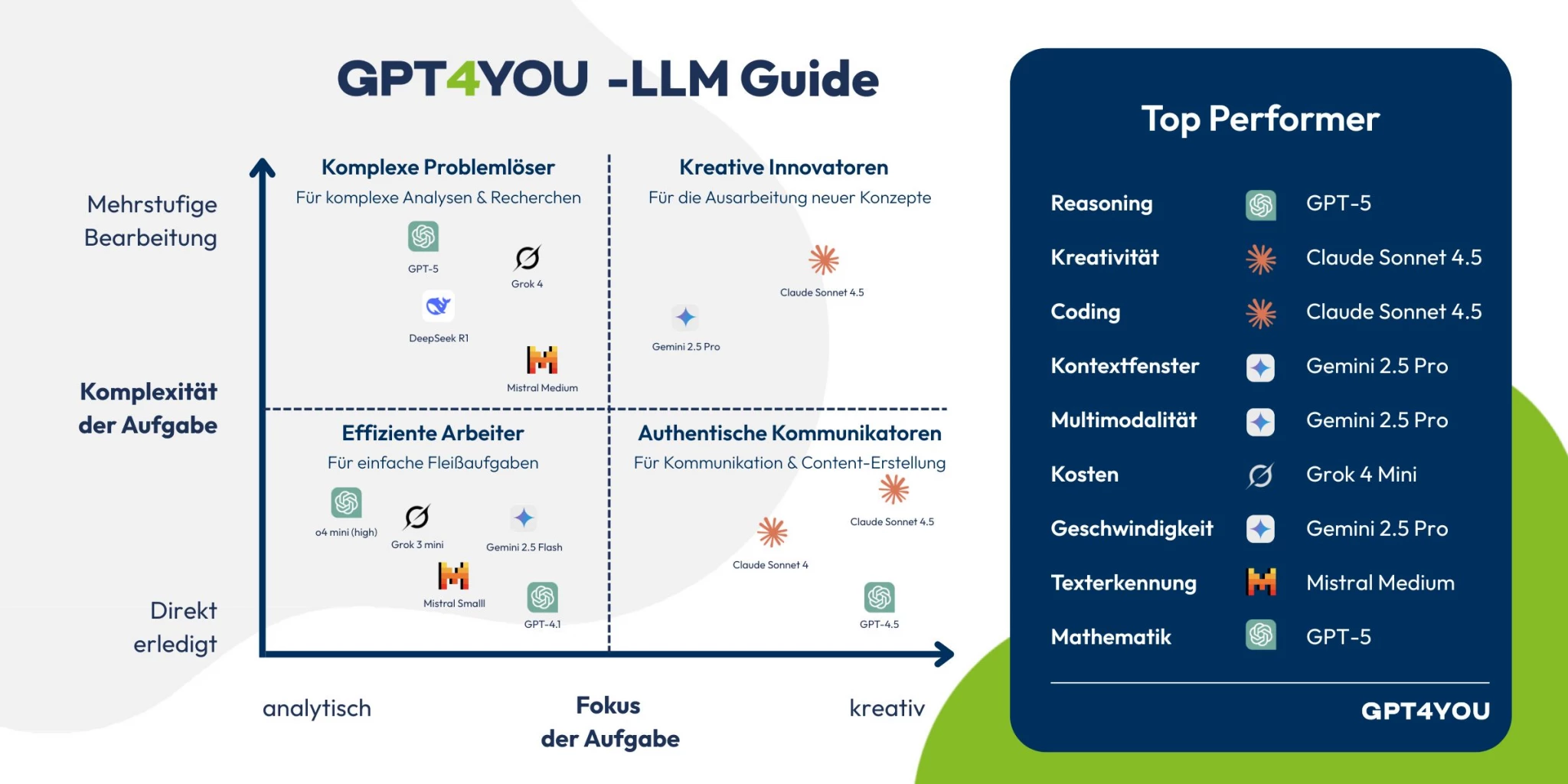
As soon as the decision for AI in the company is made, critical questions follow: Which model really fits my business goals? Which AI delivers factually correct results? And the most important hurdle: How can data protection and GDPR be fully guaranteed?
This is where many standard solutions reach their limits. As most providers are based in the USA and process data outside the EU, this creates a massive compliance risk for responsible companies. GPT4YOU closes precisely this gap: our application allows you to use the full power of modern AI models in a secure, European infrastructure. To make your decision easier, we have compared the most important large language models (LLMs) with their specific strengths and weaknesses below.
What ethical issues should companies consider when using AI?
With the increasing use of AI technologies in companies, ethical issues are also coming into focus. It is important to take responsibility for the decisions made by AI systems and to ensure the security of sensitive data. Companies must ensure that the use of AI platforms and systems is transparent, comprehensible and in line with applicable regulations.
The EU AI Act sets clear framework conditions here and obliges companies to comply with ethical standards and data protection requirements. This ensures that AI technologies not only increase efficiency and competitiveness, but are also used responsibly and safely. Integrating ethical aspects into AI implementation from the outset creates trust among customers, partners and employees - and thus lays the foundation for sustainable corporate success in the age of artificial intelligence.
What challenges do companies face when dealing with AI applications?
Marketing promises often sound simple: install an AI and your processes will run themselves, the results will be perfect and costs will fall overnight. But the reality of AI implementation is more complex. Before companies can harness the full power of this technology, they need to overcome strategic, legal and cultural hurdles.
In our AI consulting work, we repeatedly encounter six key challenges:
1. data protection and legal uncertainties
Security is the be-all and end-all. Nobody wants sensitive business secrets or personal data to end up unfiltered in public AI models or freely accessible online.
The risk: Many international solutions (such as the standard version of ChatGPT) process data on US servers. This is often in conflict with the GDPR.
The solution: Companies need shielded environments that are compliant and guarantee the protection of the database.
EU-AI Act: Regulatory requirements such as the EU AI Act must be taken into account when integrating AI in order to avoid legal risks and potential fines.
2. high implementation costs vs. budget pressure
SMEs and start-ups in particular often find the initial costs for licenses, adaptations and infrastructure to be a hurdle. While corporations have large budgets at their disposal, smaller companies have to keep a close eye on the return on investment (ROI).
FIDA-Check: We focus on use cases where the investment usually pays for itself within twelve months.
3. integration into existing IT infrastructures
"Never change a running system" - this guiding principle slows many companies down. Integrating AI into established legacy systems is technically challenging. Especially in the manufacturing industry and in large organizations with a low level of AI maturity, the interface problem is a real time waster. The implementation of AI requires a solid technical infrastructure, as many companies struggle to create the necessary technical requirements for mass data processing. We accompany this process step by step in order to avoid system failures.
4. skills shortage and lack of AI expertise
AI is only as good as the people who use it. According to recent studies, many departments lack the necessary expertise to use AI tools efficiently. Employee training is crucial for the acceptance of new technologies and processes in a company.
Important since 2025: The EU AI Act makes training mandatory for employees who work with AI systems!
Tip: A lack of expertise, legal uncertainties and concerns about data protection are common hurdles that hold many companies back when introducing AI systems. In our FIDAcademy, we offer certified AI training courses that close precisely these knowledge gaps and fulfill the legal requirements.
5. lack of proof of added value (KPIs)
AI must not be a "nice-to-have" project. Without the definition of clear key performance indicators (KPIs), the benefits often remain invisible. Many companies find it difficult to make the success of AI measurable compared to conventional methods. We support you in defining metrics for time savings, error reduction and cost savings so that the success of your AI strategy can be proven in black and white.
6. lack of data quality
Data quality often becomes a bottleneck in AI integration, underlining the importance of "garbage in, garbage out".
7 The human factor in AI transformation
The introduction of AI is not just an IT project - it is a cultural change. Technological excellence alone does not guarantee success if the workforce does not accept the tools or even fears them. Well thought-out change management is therefore the backbone of any successful implementation.
Three pillars have proven their worth in practice for successfully shaping this change:
Early involvement: Involve key users from various specialist departments as early as the test phase. When employees directly experience the benefits for their own day-to-day work, they become internal ambassadors.
Break down barriers: Create a culture of error in which experimentation with AI is expressly encouraged. Fear of making mistakes is the biggest brake on innovation.
Continuous training: Offer regular formats such as "prompt workshops" or AI lunch-and-learns.
Conclusion: Companies should see AI as an opportunity but use it with caution.
Artificial intelligence has long been more than just a trend - it is permanently changing the way companies work, make decisions and drive innovation. Whether in product design, process management, customer service or knowledge management - AI offers enormous opportunities to increase efficiency and automation.
However, the use of AI needs to be well thought out. Not every application automatically brings added value, and challenges such as data protection, high implementation costs and a lack of employee skills should not be underestimated. Companies should therefore specifically address the question of where AI can be meaningfully integrated in order to actually optimize processes instead of making them more complicated.
One thing is clear: those who use AI strategically can secure decisive competitive advantages. For SMEs in particular, it is important to address the opportunities and challenges at an early stage in order to strengthen their own future viability. With the right strategy and the right know-how, nothing stands in the way of a successful AI transformation!
Are you looking for a partner who can provide you with strategic and operational support in the development and implementation of an AI strategy? We will accompany you on the path to a digitalized future!
FAQ - What should companies know about AI?
Today, AI is relevant for companies of all sizes. While corporations often develop their own language models, SMEs (small and medium-sized enterprises) benefit from scalable platforms such as GPT4YOU. These make it possible to use AI power without a huge IT department and with a manageable budget. SMEs can use AI to counteract the shortage of skilled workers in particular by automating routine tasks.
This depends heavily on the tool selected. Public versions of US tools often use entered data to train their models. This is a security risk for companies. A GDPR-compliant solution processes data in encrypted, European instances. With GPT4YOU, we ensure that your business secrets stay where they belong: in your company.
Standard tools (such as ChatGPT) offer a broad knowledge base, but do not know your internal processes. A customized AI solution is linked to your specific company data (e.g. manuals, documentation, customer history). This provides precise answers that are tailored exactly to your business.
AI is not a replacement for humans, but an assistant (co-pilot). It relieves employees of monotonous, repetitive tasks. This creates more space for creative, strategic and customer-oriented activities. Companies that introduce AI often report higher employee satisfaction, as the workload caused by tedious routines is reduced.
The EU AI Act has been in force since 2025. It divides AI systems into risk classes and lays down strict rules for transparency and safety. Particularly important: companies are now legally obliged to ensure that their employees have a certain level of AI literacy (AI competence). Training is therefore no longer optional, but mandatory for many users.
Don't start with a huge project. Choose a "low-hanging-fruit" use case:
Identify a time-consuming process (e.g. email response or document analysis).
Carry out a pilot project with a secure platform.
Train the employees involved.
Measure success using KPIs and then scale up.


