
FIDAcademy Prompt Engineering Guide - Our tips from the field
Artificial intelligence is currently changing the way content is created, data is analyzed and processes are automated. Applications such as ChatGPT, Gemini or other AI-supported systems deliver texts, evaluations, concepts or code within a few seconds. But in practice, it quickly becomes clear that the quality of the results is no coincidence. It largely depends on how precise and structured you formulate your query.
Many users find that although AI tools are powerful, they often provide answers that are too general or not directly usable. The reason rarely lies in the system itself, but almost always in the prompt. An unclearly formulated task leads to fuzzy results. A strategically structured prompt, on the other hand, ensures relevant, structured and targeted output.
This is exactly where prompt engineering comes in. It describes the systematic development and optimization of inputs that you use to control AI systems. It's not just about the right choice of words, but also about context, target definition, role assignment, format specifications and iterative refinement. Used correctly, prompt engineering becomes a productive tool in your day-to-day work - regardless of whether you work in marketing, IT, sales or management.
This guide provides you with a structured overview of the basics of prompt engineering. You will learn how good prompts are structured, which techniques have proven themselves in practice and which mistakes you should avoid. The aim is to give you a clear understanding of how to efficiently control AI systems and sustainably improve the quality of results.
That's not enough for you? Then take a look at the FIDAcademy and secure a place on one of our AI training courses!
The definition: What is prompt engineering?
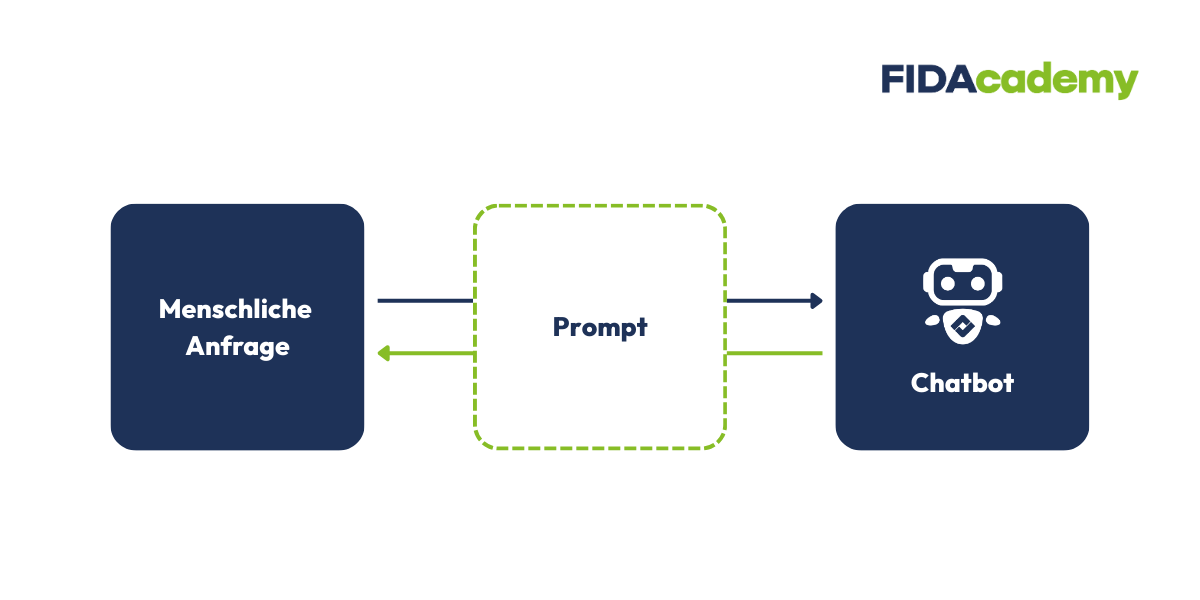
Prompt engineering refers to the structured and targeted formulation of input (prompts) for AI systems. The aim is to obtain high-quality, relevant and directly usable results through precise instructions. Instead of a simple question, prompt engineering is about consciously designing the context, objective, framework conditions and output format.
A prompt is more than just an input line. It defines
what role the AI should play,
what goal is to be achieved,
what information must be taken into account,
which restrictions or criteria apply,
and the format in which the result is to be output.
Especially with powerful language models such as ChatGPT, it can be seen that small adjustments in the wording can make a big difference to the quality of the response. An unspecific prompt often leads to general results. A clearly structured prompt, on the other hand, generates precise, technically appropriate and targeted content.
Prompt engineering is therefore not a purely technical discipline, but a methodical skill. It combines analytical thinking, specialist knowledge and communicative clarity. This skill is becoming increasingly important in companies because it determines how efficiently AI tools can be used in day-to-day work.
In short, prompt engineering means consciously controlling AI systems instead of leaving the results to chance.
Why good prompts determine the quality of AI results
The performance of modern AI systems is high - yet they only deliver results as good as the underlying input allows. A prompt acts as a control instrument. It defines the goal, context and expectations. If this information is missing or unclear, the result is often general, superficial or not directly usable answers.
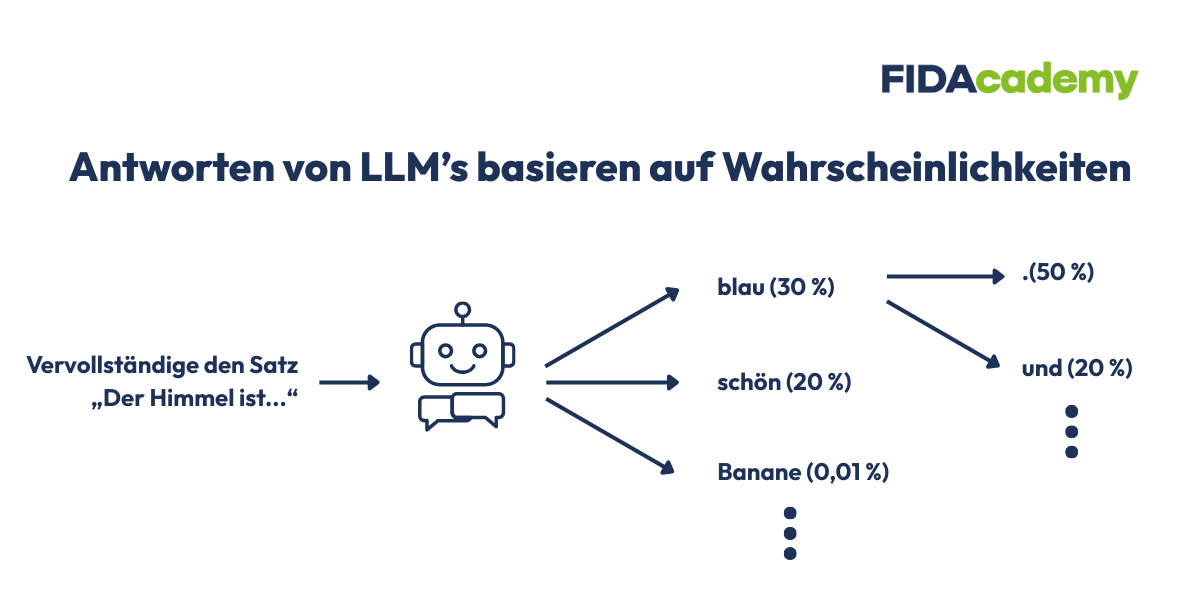
Language models such as ChatGPT work probabilistically. This means that they calculate the most likely answer based on training data. Without clear instructions, they fall back on general patterns. With precise instructions, on the other hand, they can output content in a more structured, technically in-depth and target group-specific way.
In practice, this is particularly evident:
Unclear target definition leads to fuzzy results
Lack of context generates generic answers
No format specification makes direct further use difficult
Overly complex or contradictory instructions reduce quality
A good prompt reduces room for interpretation. It gives the system a clear direction and thus significantly increases efficiency and quality of results. In a corporate context in particular, this means less reworking, faster processes and more consistent results. Learn how to use AI correctly in the FIDAcademy!
The most important components of a good prompt
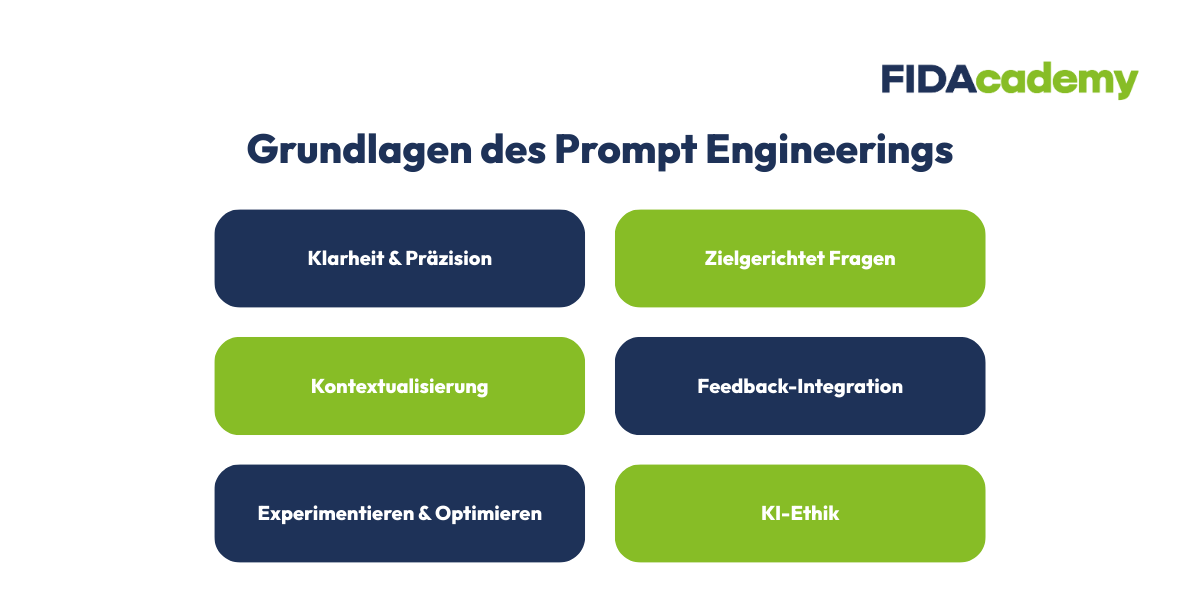
A structured prompt usually follows a clear structure. Depending on the application, individual elements can be weighted differently, but certain components have proven to be particularly effective in practice.
1. role definition
Define the perspective from which the AI should respond.
Example: "You are an experienced SEO editor" or "You act as an IT security consultant".
The role specification influences the tonality, level of detail and technicality.
2. target definition
Describe precisely what result you expect.
Instead of "Write something about AI", "Create a structured blog section about the advantages of AI in SMEs with approx. 300 words" is much more effective.
3. context
Provide relevant background information. This includes the target group, industry, level of knowledge or specific framework conditions. The more relevant context there is, the more accurate the result will be.
4. specific task
Clearly formulate what exactly is to be done: explain, analyze, compare, structure, summarize or optimize.
5. format and structure specifications
Define what the result should look like. For example:
Enumeration or continuous text
certain number of words
subheadings
Table or checklist
6. restrictions or criteria
Determine what should be avoided or given special consideration. For example, factual language, direct address with "Du" or avoidance of technical jargon.
Prompt techniques from practice
Daily work with AI systems has shown that certain methods significantly improve the quality of results. This is less about complex formulations and more about structured procedures. The following techniques have proven their worth in practice.
1. role-based prompts
Assign a clear role to the AI. This allows you to control the technicality, perspective and tone.
Example: "You are an IT project manager in a medium-sized company and explain the benefits of AI-supported process automation."
This technique ensures more consistent and targeted answers.
2. step-by-step instructions
Break down complex tasks into individual steps.
Instead of asking for a comprehensive analysis in one sentence, you can formulate:
Analyze the initial situation.
Identify weak points.
Develop specific recommendations for action.
This structure significantly improves the quality of more complex tasks in particular.
3. iterative prompting
A good prompt is often not created at the first attempt. Refine the result step by step.
You can follow up with:
"Deepen point 3."
"Formulate more factually."
"Add concrete practical examples."
This is how you develop a precise end result from a solid basic framework.
4. format specifications and structuring
Clearly define what the answer should look like:
Number of paragraphs
Use of subheadings
bullet points or continuous text
Maximum number of words
This technique reduces post-processing and increases direct usability.
5. use examples in the prompt
If you expect a certain result, you can include an example.
Example: "The structure should be similar to: Introduction - Problem - Solution - Conclusion."
Specific examples help the model to better interpret your expectation.
Our practical tips for better prompts
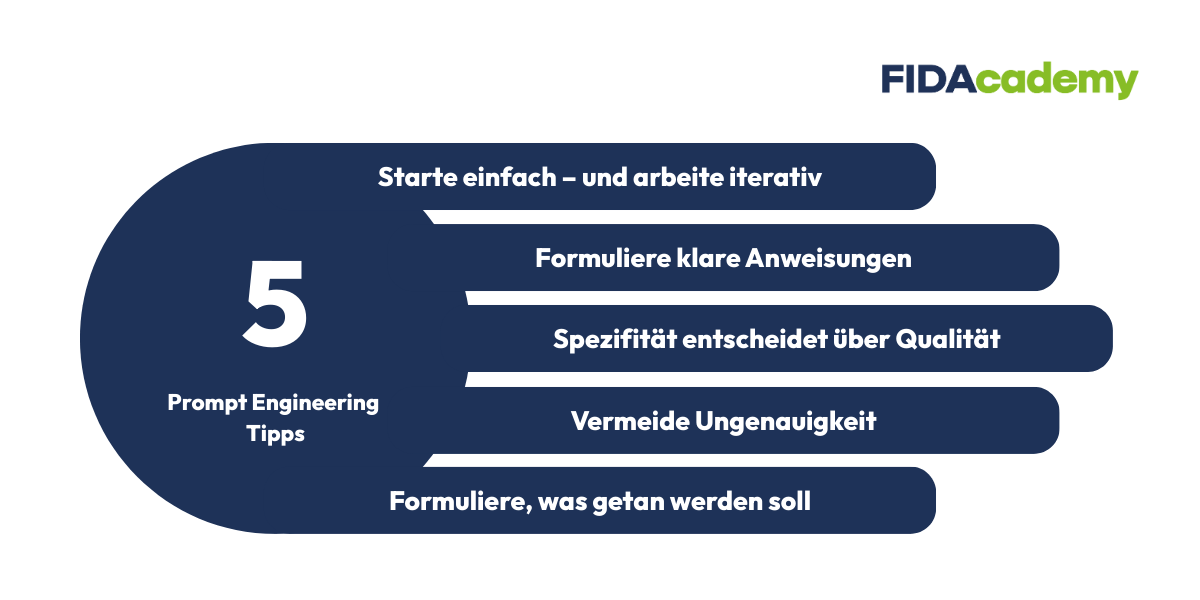
In day-to-day work, it quickly becomes clear that there are often only a few adjustments in the prompt between an average and a really good AI result. The decisive factor is not the length of the input, but the structure, clarity and goal orientation.
The following tips are based on practical experience from projects, workshops and the daily use of AI systems. They will help you to proceed more systematically, avoid typical mistakes and improve the quality of your results step by step.
Do not regard these tips as rigid rules, but as proven guidelines. Prompt engineering is a learning process. The more consciously you formulate and the more specifically you iterate, the more efficiently you can use AI tools in your work context.
Tip #1: Start simple - and work iteratively
When you start with prompt engineering, you should be aware of one thing: Good prompts are rarely created on the first attempt. The process is iterative and thrives on trial and error, adaptation and optimization.
Start with a simple, clearly formulated instruction and gradually expand it with additional context, format specifications or restrictions. Even small adjustments often lead to significantly better results. In practice, precision, clarity and a clean structure are more important than complex formulations.
If your task is extensive, break it down into several subtasks. Instead of mapping everything in a single prompt, you can define individual steps one after the other and build on each other. This reduces complexity and increases the controllability of the results.
Tip #2: Formulate clear instructions
An effective prompt contains clear instructions for action. Typical formulations are, for example:
"Write ..."
"Analyze ..."
"Summarize ..."
"Classify ..."
"Translate ..."
"Structure ..."
Such direct commands help the model to recognize what kind of task you want to solve.
Experiment with different formulations, keywords and contextual information. The more specific and relevant the context is, the more targeted the result will be.
It can also be helpful to clearly separate instructions and context, for example by using subheadings or visible separators. This ensures a better structure within the prompt.
Example:
Instruction:
Translate the following text into Spanish.
Text:
"Hello!"
Output:
¡Hola!
Tip #3: Specificity determines quality
The more specific your task description is, the better the result will usually be. If you expect a certain format, a defined length or a specific style, you should formulate this clearly.
A clearly structured prompt with a comprehensible structure is more important than individual keywords. It is particularly effective to specify the desired output formats directly.
Example:
Extract the names of places from the following text.
Desired format:
Place: <comma separated list>
Input:
"... Henrique Veiga-Fernandes, a neuroimmunologist at the Champalimaud Center for the Unknown in Lisbon ..."
Output:
Location: Champalimaud Center for the Unknown, Lisbon
Pay attention to the length of your prompt. Too many irrelevant details increase complexity without improving quality. It is crucial that all the information contained contributes to solving the task.
Tip #4: Avoid inaccuracy
It's easy to fall into the trap of being too vague or contradictory. Statements like "Briefly write something about prompt engineering" leave a lot of room for interpretation.
It would be more precise, for example:
"Explain the concept of prompt engineering in 2-3 sentences for a high school student."
The clearer your expectation is formulated, the better the model can respond to it. Good prompts work in a similar way to clear communication in everyday working life: direct, unambiguous and without unnecessary ambiguity.
Tip #5: Formulate what should be done - not what should be avoided
A common mistake is to focus on prohibitions in the prompt. Statements such as "Don't ask for personal information" can trigger unintended reactions because the linguistic focus is precisely on this point.
It is better to actively formulate what the model should specifically do.
Less effective:
"Don't ask about interests."
Better:
"Recommend a movie from the current global top trending movies without asking questions."
Positive, action-oriented instructions are more clearly structured and generally lead to more stable results.
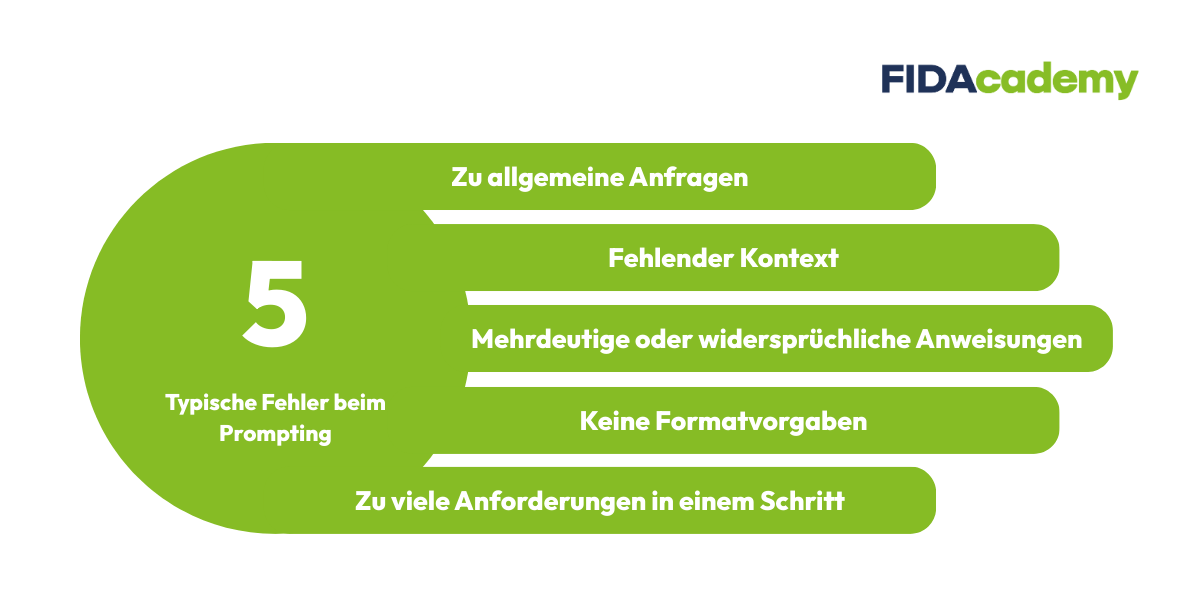
Typical mistakes in prompting - and how to avoid them
In addition to tried-and-tested techniques, there are recurring mistakes that have a negative impact on the quality of results. If you know these, you can avoid them.
1. requests that are too general
"Write something about digitalization" inevitably leads to superficial answers.
Better: Define the target group, scope and perspective.
2. lack of context
Without background information, the AI cannot assess what level or details are required.
Solution: Specify the industry, target group and purpose of the text.
3 Ambiguous or contradictory instructions
If you ask for "short and detailed" at the same time, you will get inconsistent results.
Solution: Prioritize your requirements clearly.
4. no format specifications
Without structural specifications, you may end up with a format that is not directly reusable.
Solution: Define the structure and display format in the prompt.
5 Too many requirements in one step
An overloaded prompt with numerous constraints can reduce the response quality.
Solution: Divide complex tasks into several steps or prompts.
Prompt engineering means proceeding systematically and reducing typical sources of error. With clear structures, concrete context and targeted iteration, you can sustainably increase the quality of AI results while reducing the time spent on reworking. In our AI training courses, you will learn how to work safely with AI!
Advanced prompt techniques at a glance
In addition to the basic methods, there are a number of advanced prompt techniques that are primarily used for complex tasks, data-driven analyses or in the development environment. Below you will find a structured overview of the most important approaches and their practical classification.
Zero-shot prompting
With zero-shot prompting, the AI is only given a task - without examples or additional demonstrations.
Example: "Create a SWOT analysis for a medium-sized IT company."
This technique is suitable for clearly defined standard tasks. The prerequisite is that the instruction is precisely formulated.
Few-shot prompting
Here you add one or more examples to your task. This allows the model to better understand which pattern or format is required.
Example:
Example 1: Input → Output
Example 2: Input → Output
New task
Few-shot prompting significantly improves consistency and format accuracy.
Chain-of-Thought Prompting (CoT)
With chain-of-thought prompting, you explicitly ask the AI to reveal its thought steps.
Example: "Explain step by step how you arrived at this result."
This technique is particularly helpful for logical, mathematical or analytical questions.
Self-consistency
Self-consistency extends the CoT approach. This involves generating several solution paths and selecting the result that is most likely to be consistent. The aim is to achieve greater reliability in complex tasks.
Generated knowledge prompting
Here you let the AI first generate relevant background knowledge before it processes the actual task.
Example:
"List important factors for cybersecurity in SMEs."
"Create a recommendation for action based on this."
This improves the quality of the final answer.
Prompt chaining
In prompt chaining, several prompts are logically linked together. The result of one step serves as the basis for the next. This technique is suitable for multi-stage processes, such as content creation, analysis or strategy development.
Tree of Thoughts
Tree of Thoughts extends the linear thought process. Instead of pursuing just one solution, several possible trains of thought are considered and evaluated in parallel. This increases the quality of complex decisions.
Retrieval Augmented Generation (RAG)
Retrieval Augmented Generation combines a language model with an external knowledge database. The system specifically accesses current or internal company data and integrates it into the answer.
This technology is particularly relevant in the corporate context, as it reduces hallucinations and enables fact-based answers.
Automatic reasoning and tool use
Here, the model is enabled to use external tools, such as calculation functions, APIs or databases. This extends the range of functions beyond pure text generation.
Automatic Prompt Engineer
With the Automatic Prompt Engineer, the AI independently optimizes prompts in order to achieve better results. This approach is primarily used in the research and development environment.
Active prompt
Active prompting identifies particularly difficult questions and focuses training or optimization specifically on these areas in order to increase performance.
Directional stimulus prompting
Targeted impulses or hints are integrated into the prompt in order to steer the model in a specific direction without completely predefining the solution.
Program-Aided Language Models (PAL)
Program-Aided Language Models combine language models with executable code. For example, the model generates Python code to solve a calculation task and then executes it.
ReAct (Reasoning and Acting)
ReAct combines logical thinking with concrete actions. The model analyzes a situation, decides on an action (e.g. information retrieval) and then processes the result.
Reflection
Reflection enables the model to check and improve its own answers. It is an iterative self-correction process to improve quality.
Multimodal Chain-of-Thought
Multimodal CoT approaches link text, image or other data types within a step-by-step analysis. This technique is becoming increasingly important, particularly in the field of image interpretation and document analysis.
Graph prompting
Graph prompting structures information in the form of networks or relationships. This makes it easier to model and analyze complex relationships.
Meta-prompting
In meta-prompting, the AI is instructed to develop an optimal prompt for a specific task itself. The aim is to systematically generate better inputs.
Classification for practical use
Not every technology is equally relevant in everyday work. For most business applications, the following methods are particularly relevant in practice:
Few-shot prompting
Chain-of-Thought
Prompt Chaining
Retrieval Augmented Generation
ReAct
More complex approaches such as Tree of Thoughts or Automatic Prompt Engineer are primarily found in the research environment.
For you, this means: start with structured prompts, work iteratively and expand your methods as required. Prompt engineering is not a rigid set of rules, but a toolbox that you can use in a targeted manner depending on your requirements.

Structure beats chance
Prompt engineering is not a gimmick, but a key skill in the professional handling of AI systems. The quality of the results depends largely on how clearly you formulate your requirements, how precisely you specify the context and how consistently you optimize iteratively.
In practice, it has been shown that those who prompt in a structured way work more efficiently. Good prompts reduce rework, increase the technical quality of the answers and make the use of AI plannable and reproducible. This is particularly crucial in the corporate environment if processes, content or analyses are to be reliably supported.
At the same time, prompt engineering is not a scheme that is learned once, but a skill that evolves with experience. New models, new use cases and new integrations - for example in connection with internal company data or automation solutions - continuously expand the possibilities.
This is precisely why we also address the topic in our AI training courses at the FIDAcademy. Among other things, we teach you how to systematically set up prompts, avoid typical mistakes and use AI tools safely and efficiently in your day-to-day work. The aim is to turn theoretical knowledge into concrete skills.
If you don't just want to try out AI, but want to use it strategically, structured prompting is a decisive lever. With the right methodology, you can control systems in a targeted manner - instead of leaving the outcome to chance.
FAQ - Frequently asked questions about Prompt Engineering
Prompt engineering refers to the structured and targeted formulation of input for AI systems. The aim is to obtain high-quality and usable results through clear instructions, precise context and defined format specifications. It is not just about the right choice of words, but also about systematic control of the model.
AI models such as ChatGPT react strongly to the type of input. Unclear or general prompts often lead to superficial results. Precisely formulated prompts, on the other hand, provide structured, relevant and directly applicable answers. Good prompts save time and reduce the need for corrections.
A prompt should be as long as necessary and as short as possible. The decisive factor is not the length, but the relevance of the information it contains. All information should offer concrete added value for the task solution. Unnecessary details increase complexity without improving quality.
Yes, especially with specific formats or recurring tasks, Few-Shot Prompting is very effective. With one or more examples, the model understands better which structure or form of presentation you expect. This increases the consistency of the results.
The most common errors include
tasks that are too general
lack of context
contradictory requirements
missing format specifications
too many requirements in a single prompt
A clear structure and a step-by-step approach help to avoid these errors.
Yes, prompt engineering is a skill that can be developed through practice, feedback and a methodical approach. Structured training is particularly recommended in a corporate context in order to avoid typical mistakes and exploit the full potential of AI systems.
In our AI training courses at the FIDAcademy, we teach you in a practical way how to set up prompts professionally and use AI tools safely in your day-to-day work.
No. Prompt engineering is not just a developer discipline. It is relevant for everyone who works with AI - for example in marketing, sales, HR, IT or management. Those who prompt in a structured way achieve better results - regardless of their specialist background.


