
How you can use AI in the office - our webinar and guide to AI agents in the office
Free webinar
In recent years, artificial intelligence (AI) has evolved from a technology of the future to a practical tool for everyday work. More and more companies are using AI applications to optimize processes, automate recurring tasks and support employees in their daily work.
Artificial intelligence also offers numerous potential applications in the office. Whether creating emails, organizing appointments, evaluating data or researching information - AI can help to make work processes more efficient and save time. The aim is not to replace people, but to relieve them of routine tasks and free up time for more important tasks.
In this article, you will find out what AI in the office means, what advantages it offers and in which areas it can already be used today. We also show you what you should look out for when using AI and how you can start working with AI-supported tools step by step.
What does AI mean in the office?
Artificial intelligence refers to technologies that are able to process information, recognize patterns and perform tasks that previously required human thought or human decisions. In everyday office life, AI is primarily used to analyze data, create content or support recurring work processes.
Modern AI applications can, for example, compose texts, summarize emails, coordinate appointments, evaluate data or filter information from large volumes of documents. Many systems learn from existing data and continuously improve their results.
In contrast to traditional automation solutions, AI does not just work according to fixed rules. It can recognize correlations, understand content and react flexibly to different requirements. As a result, numerous office tasks can be made more efficient without completely changing existing processes.
For companies of all sizes, AI opens up new opportunities to simplify administrative tasks and support employees in their daily work. At the same time, humans remain an important part of the processes, as the results of AI systems should always be checked and evaluated.
How intensively is AI already being used in the office?
The studies show a clear picture: artificial intelligence has already arrived in everyday office life and is actively used by many employees. According to a study by the Boston Consulting Group, around 67% of employees in Germany use generative AI in a work context. The Microsoft Work Trend Index also shows that AI is particularly widespread in knowledge work and that many employees are already using AI tools independently in their day-to-day work. At the same time, Microsoft points out that many companies do not yet have fully developed strategies for the use of AI and that employees often use AI without official guidelines. Overall, McKinsey also shows that AI can already increase productivity today, but that many organizations are still at an early stage of structured introduction. This also shows the need for training and further education measures to make teams confident in using AI tools.
To ensure that the introduction of AI in your company is a success, we will guide you step by step through the entire process. From analyzing suitable use cases to training your employees, we are at your side as experts.
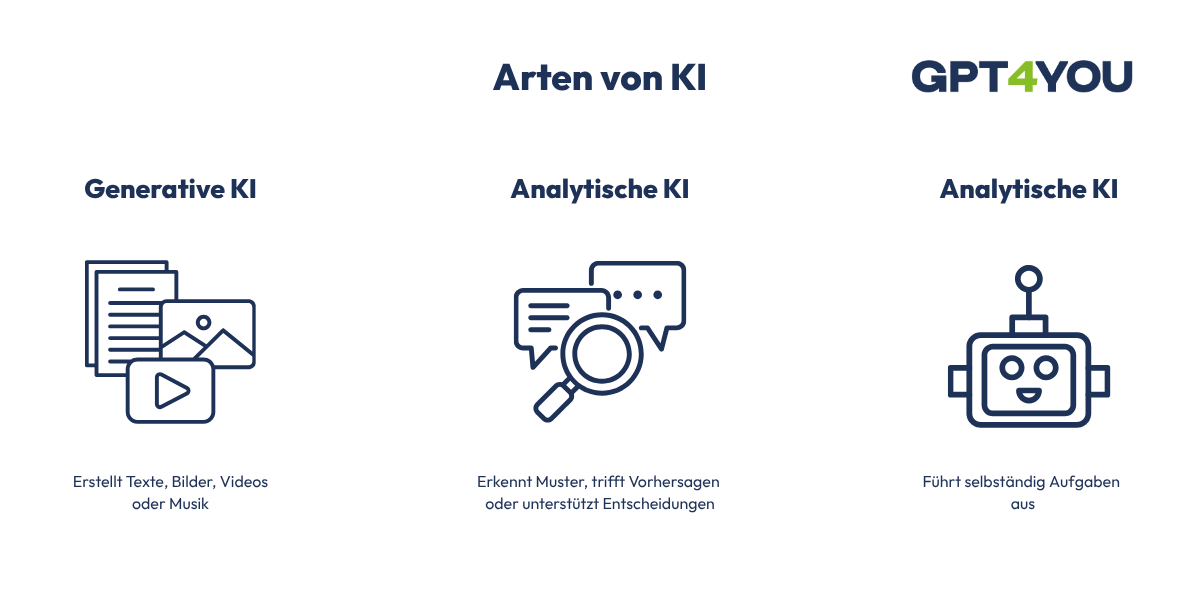
What is Generative, Analytical and Agentic AI?
Generative AI (GenAI)
Generative AI is primarily used today to create texts in various formats. This includes emails, reports, summaries and presentation content in particular. More complex content can also be structured and prepared more quickly with the help of AI.
Analytical AI
Analytical AI focuses on evaluating and understanding data. It recognizes patterns, makes predictions or supports decisions. Examples: Fraud detection, demand forecasting, medical diagnoses.
AI agents
AI agents are systems that can perform tasks independently. They plan steps, use tools (e.g. web search, programs) and pursue a goal across several actions. Example: an assistant that plans trips and prepares bookings directly.
What can AI do in the office?
Artificial intelligence can support and speed up many tasks in everyday office life. It offers great potential, especially for recurring tasks, processing large amounts of information or creating content. Nevertheless, AI is no substitute for human expertise, experience or judgment.
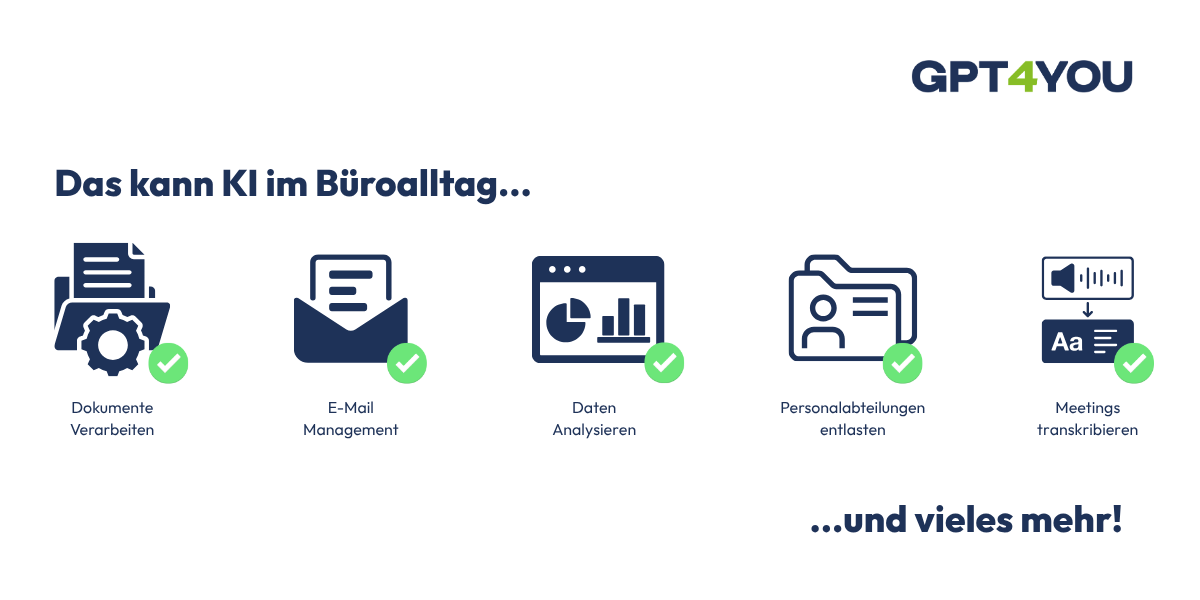
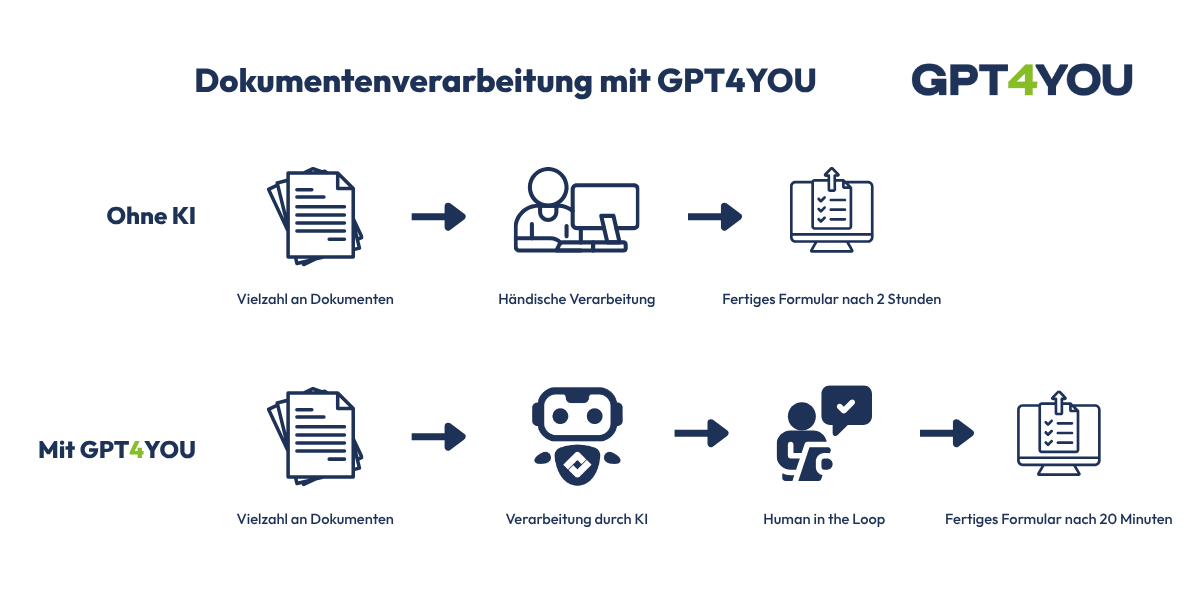
Modern AI systems can support employees in numerous tasks and thus ensure greater efficiency in their day-to-day work. Generative AI applications and integrated AI assistants currently dominate the office sector. They support employees in their daily work by creating content, structuring information and simplifying processes. AI-supported systems can increasingly automate administrative tasks. This includes, for example, the automatic recognition, allocation and posting of receipts and invoices. AI is also used in document processing to analyze content and efficiently process relevant information.
Document processing and content creation
AI can extract the most important core information from extensive documents and generate new content from it. AI-supported tools can transform even complex information into easy-to-understand reports, which is also helpful in meetings and for presentations. This allows large amounts of information to be processed and made usable more quickly.
Email and communication management
Modern AI systems support the processing of emails by categorizing messages according to priority or generating automatic reply suggestions. Chatbots are also increasingly being used, in particular to efficiently support standardized communication in everyday office life.
Data analysis and decision support
AI-supported data analysis and data processing provide companies with decision-making aids for strategic decisions. At the same time, AI accelerates processes in market research by allowing large amounts of data to be evaluated and interpreted more quickly and can also support the creation of graphics for data visualization.
Intelligent appointment and calendar management
AI also plays an important role in the area of organization. Intelligent calendar and planning systems recognize free time slots, prioritize tasks and increasingly take over autonomous scheduling.
AI in the HR and personnel sector
AI is increasingly being used in HR to support processes such as recruiting. Applications can be filtered automatically and applicant data can be managed more efficiently.
AI can help to simplify workflows and save valuable time, especially when it comes to time-consuming routine tasks.
AI in the meeting and documentation process
AI tools can automatically transcribe meetings, summarize content and create minutes. Applications such as GPT4YOU enable real-time transcription and thus significantly improve the follow-up of meetings.
In addition, AI systems support the creation of agendas and the structuring of meetings, saving valuable time.
Artificial intelligence supports day-to-day work in many areas by saving time, automating routine tasks and making processes more efficient. This creates more freedom for creative and strategic activities.
What are the limits of AI?
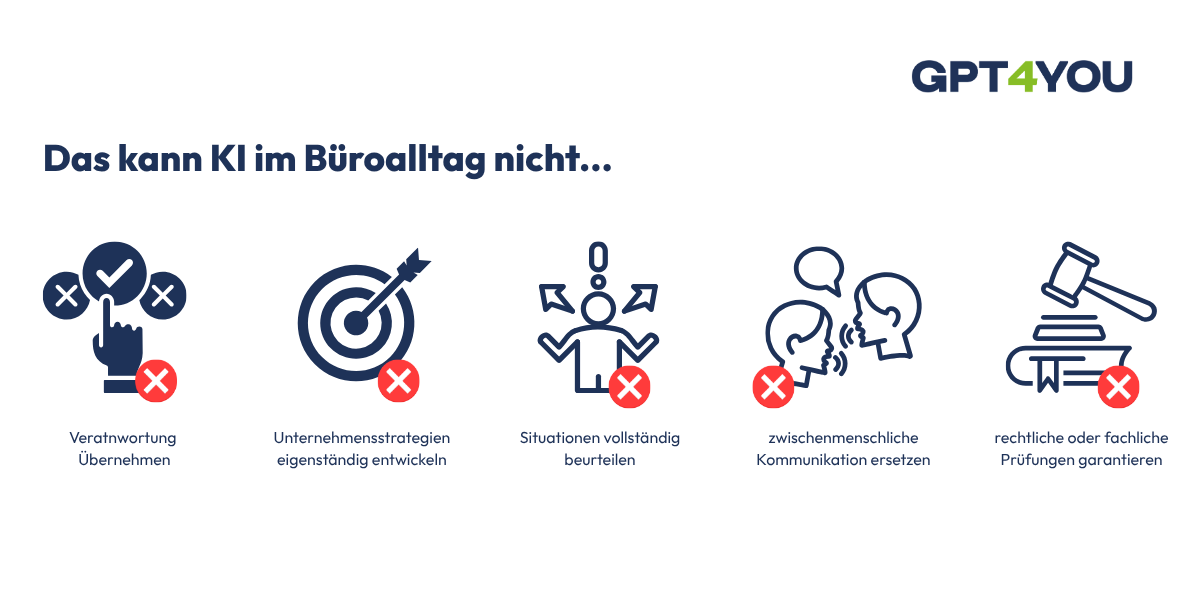
Despite its many possibilities, AI also has its limits. The systems work on the basis of data and probabilities. They have neither human experience nor a real understanding of interrelationships, corporate goals or interpersonal aspects.
AI cannot, for example:
Take responsibility for decisions
develop corporate strategies independently
fully assess complex situations
replace interpersonal communication
guarantee legal or technical audits
Ensure accuracy
process confidential information without risk
The results generated by an AI may be incomplete, outdated or incorrect. This is why important content and decisions should always be checked by humans.
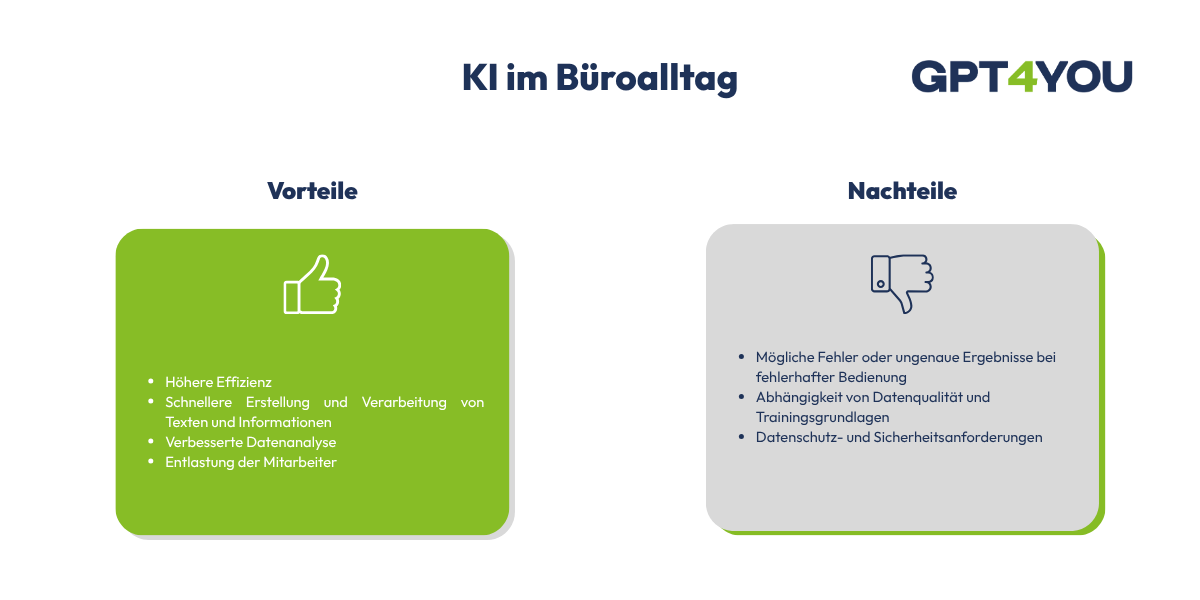
What are the advantages and disadvantages of AI in everyday office life?
The use of artificial intelligence in the office brings both clear advantages and some challenges. The key is to integrate AI into existing work processes in a targeted and meaningful way in order to achieve the greatest possible benefit.
Advantages of AI in the office
AI can make many tasks in day-to-day work more efficient and noticeably reduce the workload for employees. Its potential is particularly evident in recurring or data-intensive activities.
The most important benefits include
Time savings for routine tasks and administrative activities
Faster creation and processing of texts and information
Support for data analysis and decision-making
Relieving employees of monotonous tasks
Improved structuring and organization of work processes
Greater efficiency in communication and documentation
These effects allow employees to gain more time for complex, creative and strategic tasks.
Disadvantages and challenges of AI in the office
Despite the many advantages, there are also aspects that need to be considered when using AI. These mainly concern quality, responsibility and the handling of data.
Possible disadvantages are:
Possible errors or inaccurate results
Dependence on data quality and training bases
Necessary control and post-processing by humans
Data protection and security requirements
Investment and implementation costs
Necessary training of employees
AI is therefore not a fully autonomous system, but a tool that needs to be consciously controlled and monitored.
What should be considered when using AI for office work?
Artificial intelligence can simplify and speed up many work processes in the office. However, a number of important aspects should be taken into account to ensure its long-term success. In addition to the technical possibilities, data protection, quality assurance and employee acceptance play a decisive role.
Data protection and data security
Not every AI solution is suitable for handling sensitive company data. Before confidential information is processed, you should check how the data is stored, processed and protected.
Important questions include
Does the solution comply with the applicable data protection requirements?
Where is the data stored?
Who has access to the information entered?
Can sensitive data be processed securely?
Responsible handling is essential, especially for personal or business-critical information.
Check results critically
Even modern AI systems are not error-free. Content can be incomplete, misleading or even incorrect in individual cases. This is why AI-generated results should always be checked by a human.
This is particularly important for
Technical content
Legal issues
Business decisions
Customer communication
Financial and business data
AI can support work, but the responsibility for the results remains with humans.
Involve employees at an early stage
The successful introduction of AI does not depend on the technology alone. It is equally important to involve employees at an early stage and to communicate the benefits of the new solutions in an understandable way.
This can be helpful:
Training and further education
Clear guidelines for use
Practical application examples
Open communication about opportunities and limitations
This can reduce uncertainties and increase acceptance within the company.
Start with small projects
Not every process needs to be supported by AI immediately. It often makes sense to test individual use cases first and gather experience.
Suitable areas to start with are, for example
Text creation
Meeting summaries
Research tasks
knowledge management
Automation of simple routine tasks
In this way, you can gradually find out where AI offers the greatest added value for your company.
Understanding AI as support
The greatest benefits arise when AI is used as a tool to support employees. It can take over routine tasks, provide information more quickly and make processes more efficient. However, creativity, specialist knowledge, responsibility and interpersonal communication remain key human tasks.
Those who are aware of the possibilities and limitations of AI and use the technology in a targeted manner create the basis for successful and sustainable use in everyday office life.
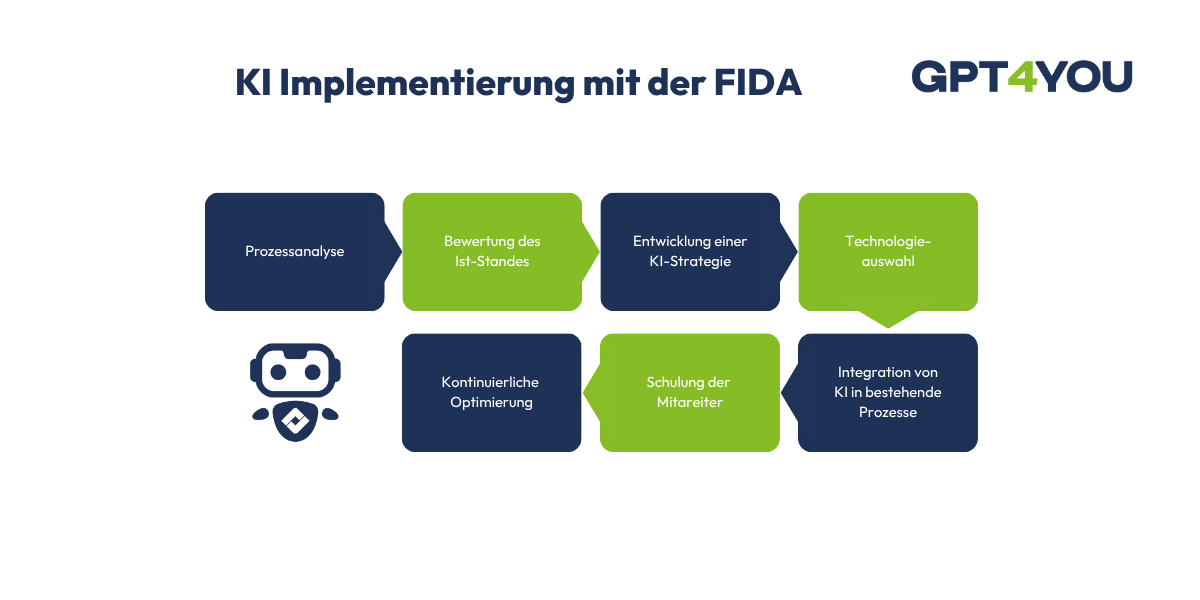
How can FIDA support you with the introduction of AI in the office?
The introduction of artificial intelligence does not begin with the selection of a tool, but with the question of which processes in your company can be usefully supported or automated. In order to realize the full benefits of AI in everyday office life, it is crucial to define clear guidelines for the deployment and use of AI in the company. This is the only way to ensure safety, efficiency and responsible use of the technology. This is exactly where FIDA comes in.
Together with you, we analyze existing workflows and identify areas in which AI can create real added value. We look at both organizational processes and administrative tasks and develop solutions that integrate seamlessly into your company's day-to-day work and requirements.
Our support can cover the following areas, among others
Analysis of processes and identification of AI potentials
Advice on the selection of suitable AI solutions and AI tools
Support with the introduction of AI applications
Automation of recurring office tasks
Integration of AI into existing systems and workflows
Training and empowering employees
Support with data protection and compliance requirements
A particular focus is on the secure and practical use of AI agents in day-to-day business. With GPT4YOU, FIDA has developed its own AI platform that supports companies in integrating artificial intelligence into their work processes in a controlled and data protection-compliant manner.
With GPT4YOU, employees can use modern AI functions for tasks such as research, text creation, knowledge management and process automation. At the same time, companies retain control over sensitive data and can adapt AI applications specifically to their individual requirements. In addition, specialized AI agents can be developed to take over recurring tasks and automate workflows.
This means that you not only receive support with the introduction of AI, but also a solution that allows you to use the potential of AI agents safely and efficiently in everyday office life.
FAQ - Frequently asked questions about artificial intelligence in the office
AI in the office refers to the use of artificial intelligence to support work processes. This includes the creation of texts, the analysis of data, the automation of processes and the organization of tasks and deadlines. The aim is to reduce the workload of employees and make processes more efficient.
AI can support or partially automate many recurring and data-based office tasks. These include, for example, writing emails, summarizing documents, creating reports, analyzing data and supporting research and scheduling.
No. AI does not replace employees, but supports them in their work. It mainly takes on repetitive tasks and provides information more quickly. Decisions, responsibility and complex assessments remain with humans.
The use of AI can be safe if suitable systems are used and data protection guidelines are adhered to. It is particularly important that sensitive company data is only processed in tested and data protection-compliant solutions.
Frequently used AI tools include applications for text generation, data analysis and automation, such as ChatGPT or Microsoft Copilot. Examples include AI-supported assistants for word processing, tools for meeting transcription or platforms for process automation, which are often used on PCs for texts, research, presentations or meeting support.
The best way to get started is step by step. First, suitable use cases should be identified, for example recurring routine tasks. Pilot projects can then be launched and the results tested. This is followed by gradual integration into existing processes.
The most important benefits are time savings, greater efficiency and reduced workload for employees. AI helps to process information faster, create content and structure workflows better.
Yes, the risks include possible errors in the results or non-compliance with data protection requirements. AI results should therefore always be checked and critically evaluated.
FIDA supports companies in analyzing processes, selecting suitable AI solutions and introducing and integrating them into existing systems. It also trains employees and assists companies with data protection and compliance requirements.
GPT4YOU is an AI platform developed by FIDA for the secure use of AI agents in day-to-day business. It enables AI functions such as text creation, research and process automation to be integrated into existing workflows and customized in compliance with data protection regulations.
It is best to start with small, clearly defined use cases, for example support with texts or summarizing information. You can then gradually expand its use and integrate additional processes.
Data protection plays a central role. Companies should ensure that the AI solutions used are GDPR-compliant and that sensitive data is processed securely. Careful examination is particularly important for cloud-based solutions.


