
How to use AI correctly in HR - our tips for more efficiency in HR
Artificial intelligence (AI) is revolutionizing HR and opening up new opportunities for HR teams. The topic of "AI in HR" is more topical than ever and offers companies numerous opportunities to optimize processes and develop them strategically.
In this article, you will find out in which areas AI is already being used in HR today, what advantages it offers and what challenges you should consider when introducing it. We also use specific examples to show how companies are successfully using AI in HR. The guide is aimed at HR managers, personnel managers and decision-makers who want to find out about the practical use of AI in HR.
Why is AI becoming increasingly important in HR?
Artificial intelligence is changing HR sustainably. Whether recruiting, personnel development or administrative tasks - AI helps companies to make processes more efficient, make better use of data and significantly reduce the workload of HR teams. At the same time, many companies are faced with the challenge of identifying the right use cases and integrating AI responsibly into existing processes.
What are the areas of application for AI in human resources?
Practical example: AI in recruitment
One of our projects shows just how great the potential of AI can be in recruiting and applicant management. A previously manual process for creating candidate profiles was automated for a recruitment agency that specializes in leadership and management positions. With the help of an AI solution, information from CVs, interviews and questionnaires is processed in a structured manner and transferred into a standardized profile.
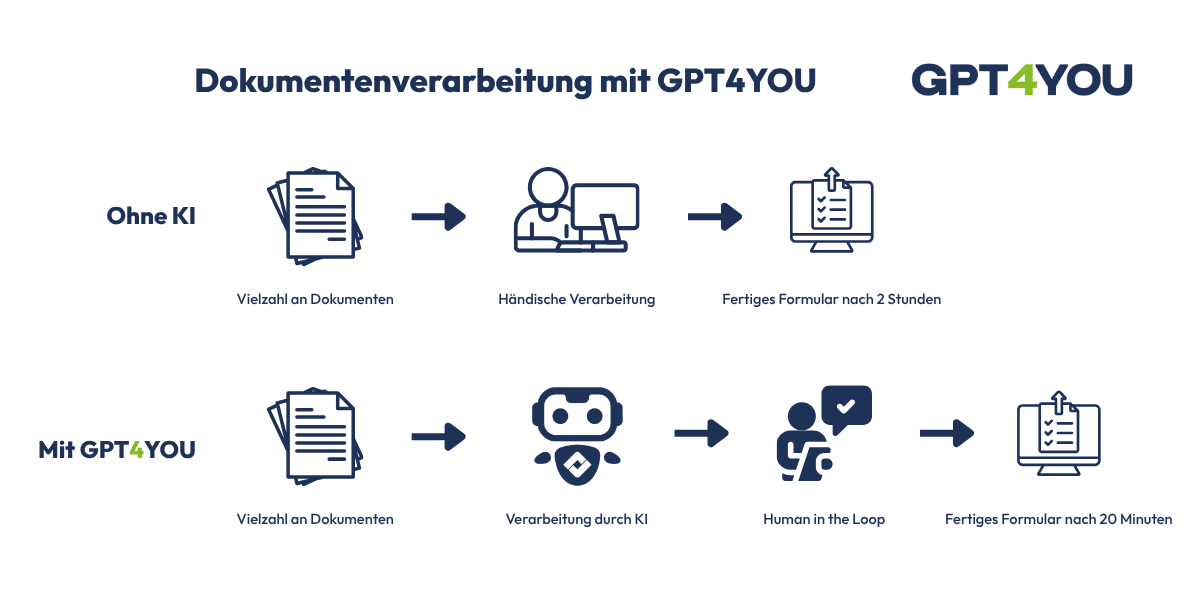
This significantly reduced the time required, standardized the quality of the results and made the entire process more scalable. This example shows how AI not only speeds up administrative tasks, but can also sustainably improve efficiency and consistency in recruiting.

How can AI be used in recruiting and applicant management?
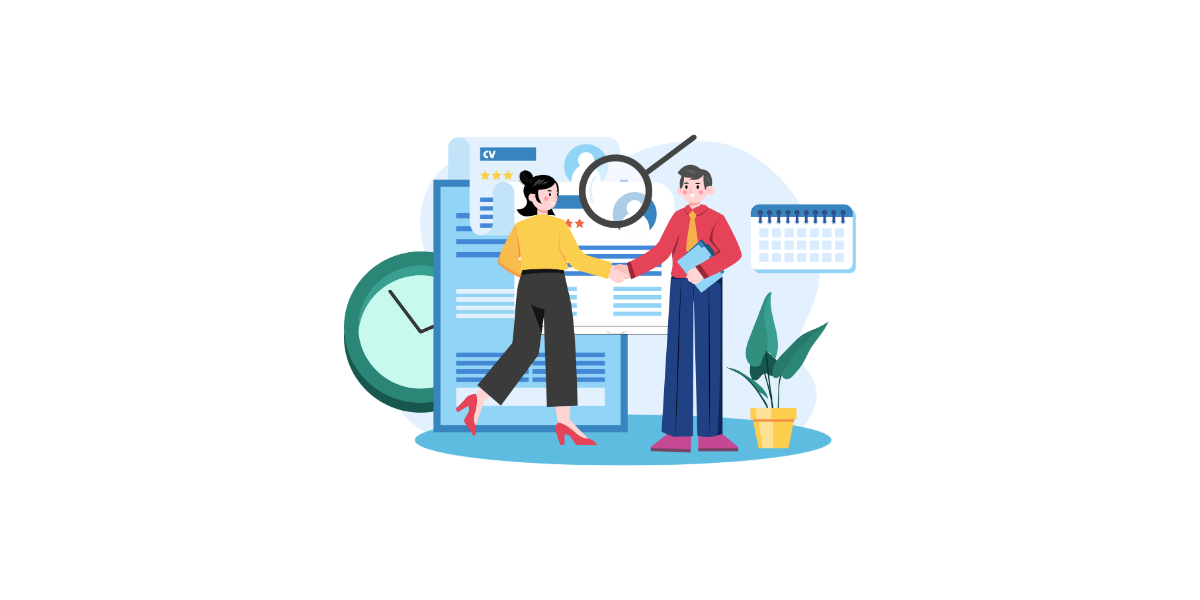
One of the best-known areas of application for AI in HR is recruiting. HR departments quickly reach their capacity limits, especially when there are a large number of incoming applications. AI-supported solutions can help to analyze application documents, identify qualifications and pre-sort candidates based on defined criteria.
Modern systems can analyze candidate profiles and provide information on which applicants are particularly well suited to the requirements of a position or the corporate culture. However, the final assessment should always be carried out by HR managers
As a recruiter, this gives you a quicker overview of suitable applicants and allows you to make the selection process more efficient.
At the same time, AI systems can optimize job advertisements by analysing formulations and making suggestions for a target group-specific approach. AI-supported chatbots are also increasingly being used in recruiting. They answer applicant questions, provide information about vacancies or guide candidates through individual steps of the application process. This improves accessibility and can significantly enhance the candidate experience.
As we can see: The importance of AI in recruiting is continuously increasing. Studies show that 70 percent of companies that use AI in recruiting already use the technology to create and place job advertisements. In addition, AI can help to identify suitable talent more quickly and shorten the entire recruitment process by several weeks in some cases.
Examples of AI tools in recruiting:
GPT4YOU - support with job advertisements, interview questions and communication
GPT4YOU - creation of texts, evaluations and recruiting documents
Personio Recruiting - applicant management with AI-supported functions
Workday Recruiting - talent acquisition and applicant management
SAP SuccessFactors Recruiting - Recruiting and talent management solution
How can AI be used to onboard new employees?
After successful recruitment, the next important phase begins: onboarding. Especially in larger companies, new employees have to receive a lot of information, process documents and go through various processes.
AI can help to make this process more structured and personalized. Digital assistants answer questions, provide important information and support new employees during their induction.
Examples of AI tools in onboarding:
GPT4YOU - support with the creation of onboarding documents
GPT4YOU - AI assistant for employee inquiries and onboarding processes
Personio Onboarding - digital onboarding processes
Workday Assistant - AI-based support for new employees
How do I use AI for employee development and training?
AI enables significantly more individualized personnel development. By analyzing existing skills, career goals and learning activities, suitable further training measures can be suggested automatically. Modern learning platforms recommend training and courses based on individual development goals and help to identify training needs at an early stage.
At the same time, the development of AI skills itself is becoming increasingly important. Studies show that so far only around 30 percent of companies offer targeted AI training for their employees. The AI skills of employees have a significant influence on how the technology is perceived and successfully used in the company.
Examples of AI tools in Learning & Development:
FIDAcademy - individual learning paths and skill development
LinkedIn Learning - AI-supported course and learning recommendations
Cornerstone Learning - talent and learning management
However, the AI Act obliges companies to ensure that their employees have sufficient AI literacy. In practice, this means carrying out training and further education. Legally, this is based on Article 4 of the EU AI Act ("AI Literacy"). It states that providers and users of AI systems must take measures to ensure a sufficient level of AI literacy. This obligation applies in principle to all AI systems.
How does AI help make data-based decisions in HR analytics?
AI offers great potential, particularly in the area of people analytics. For example, employee surveys can be evaluated automatically. AI systems can thus analyze moods almost in real time and make changes in satisfaction, motivation or stress levels visible at an early stage.
In companies with shift operations, intelligent systems can also automatically optimize duty and shift schedules, taking into account legal requirements and operational requirements.
Examples of AI tools in the field of HR analytics:
GPT4YOU - Analysis of surveys and AI-supported evaluation
Visier - people analytics and workforce analyses
Workday People Analytics - AI-supported HR evaluations
SAP SuccessFactors People Analytics - analysis of personnel data
Microsoft Power BI - visualization and evaluation of HR key figures
What advantages does AI offer in HR?
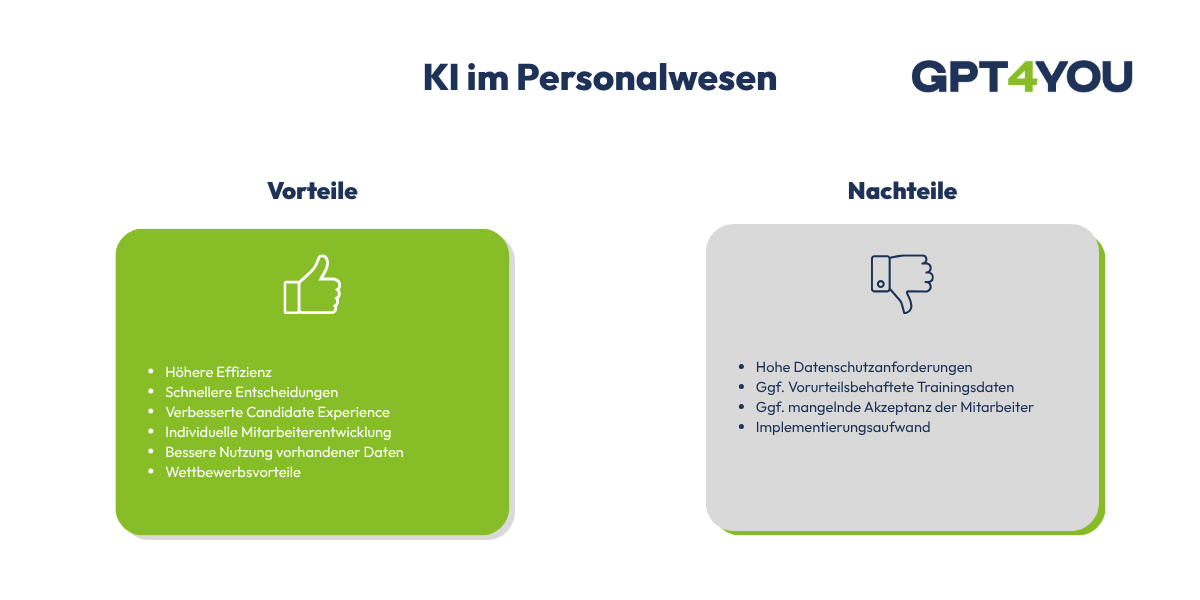
The use of artificial intelligence in HR offers far more than the mere automation of processes. Used correctly, AI can help to reduce the workload of HR departments, improve the quality of decisions and optimize the employee and applicant experience at the same time. This benefits both HR managers and the company as a whole.
The most important advantages of AI in HR at a glance:
Greater efficiency through automated processes:
Many HR tasks are recurring and involve a lot of administrative work. AI shows its potential particularly in standardized administrative tasks. AI-supported software can, for example, process vacation requests and sick notes, automatically assign documents or answer frequent employee queries. AI can speed up and partially automate such processes. This reduces administrative work and creates more space for value-adding tasks. As a result, HR teams are relieved and can focus more on strategic tasks, such as appreciative employee communication.
Companies that already use AI in HR currently see the greatest benefit in the automation of administrative processes (44%). Recruiting and employee communication follow with 25% each.Faster and more informed decisions:
HR departments today work with a large amount of data. However, without suitable tools, it is often difficult to identify relevant information and derive specific measures from it.
AI systems can analyze large amounts of data within a very short time and make patterns visible that would possibly remain undetected in a manual evaluation. This gives you a more sound basis for decisions in recruiting, talent management or personnel development.
It is important to remember that AI supports decision-making, but does not replace it. The final assessment should still be carried out by experienced HR managers.Improved candidate experience:
The application process has a major impact on how candidates perceive a company. Long response times or a lack of information can lead to applicants dropping out or choosing another employer.
AI can help to improve communication and speed up processes. Automated responses, digital assistants or faster processing of applications ensure that candidates receive prompt feedback and feel better looked after.
Especially in times of skills shortages, a positive candidate experience can be an important competitive advantage.Individual employee development:
Not every employee has the same strengths, goals or development needs. AI makes it possible to personalize further training offers to a greater extent and support individual career paths.
By analyzing existing skills and learning progress, suitable training or development measures can be suggested. This increases the relevance of training opportunities and helps employees and managers to develop their skills in a targeted manner.
At the same time, companies have the opportunity to systematically build up important skills and identify gaps in qualifications at an early stage.Better use of existing data:
Large amounts of HR data are already available in many companies. However, this information is often only used to a limited extent.
AI helps to meaningfully evaluate existing data and gain insights from it. For example, developments in employee satisfaction, possible fluctuation risks or trends in recruiting can be identified at an early stage.
This makes HR more data-driven and enables it to make strategic decisions based on better information.Competitive advantages through modern HR processes:
Companies that make targeted use of AI can make their HR processes faster, more efficient and more scalable. This is a particularly important factor in dynamic markets.
Short response times in recruiting, better employee development and data-based decisions help to increase the company's attractiveness as an employer and position it better in the competition for qualified specialists.
What are the risks and challenges of using AI in HR?
Despite the numerous benefits, the use of AI in HR should be carefully planned. As HR data is particularly sensitive and decisions often have a direct impact on people, companies need to consider various challenges.
The most important risks and challenges include
Data protection and GDPR compliance: HR data is highly sensitive and subject to strict GDPR guidelines. Handling sensitive employee data requires strict GDPR compliance. Personal data of applicants and employees must be processed and protected in accordance with the law at all times.
Data security: Companies must ensure that sensitive information is protected against unauthorized access.
Distorted results due to incorrect training data: AI can adopt existing prejudices and thereby reinforce unwanted discrimination.
Lack of transparency: One of the biggest challenges is to ensure the traceability of AI decisions. Employees want to understand how a system works, what data is processed and how recommendations or assessments are made. Companies should therefore give preference to solutions that guarantee transparency, explainability and fairness.
Quality of the data: The results of an AI are only as good as the data it works with. Incomplete or incorrect data can lead to false conclusions.
Biases in training data: AI systems can unconsciously adopt and reinforce historical biases from existing data. For this reason, results should be reviewed regularly and important personnel decisions should never be made solely by algorithms.
Acceptance by employees: New technologies can trigger reservations and increase fears of automation or job loss. Acceptance of AI is not a given. Many employees fear that AI could replace some or even all of their tasks in the future.
Implementation effort: The introduction of new AI solutions requires time, resources and often training for employees. The introduction of modern AI systems incurs costs for software, integration, training and ongoing support. A clear strategy and the selection of specific use cases help to make the benefits of the investment measurable.
AI ethics: AI-supported systems require clear ethical and legal guidelines.
To successfully overcome these challenges, companies should define clear guidelines for the use of AI, involve employees at an early stage and regularly review the results of AI systems. This will ensure that the technology is used responsibly and creates sustainable added value for HR.
How to implement AI in HR correctly - with the experts from FIDA
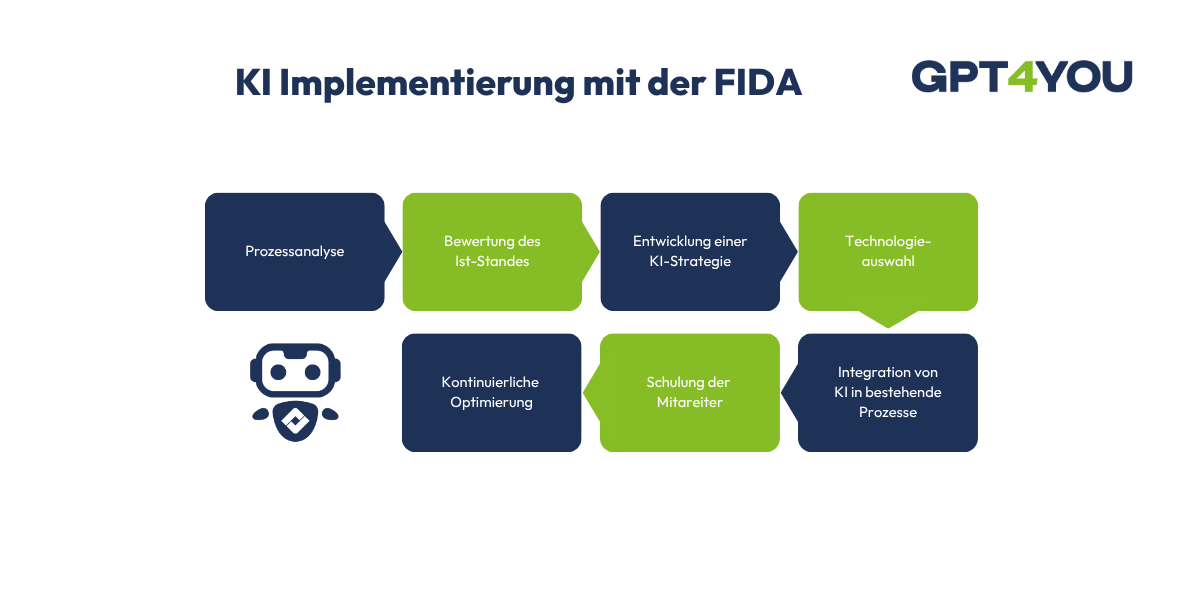
The introduction of artificial intelligence in HR should not be viewed as a pure technology project. Instead, identifying the right use cases, designing processes sensibly and involving employees at an early stage are crucial for success. This is precisely where many companies fail: They invest in new tools without having previously defined clear goals or concrete deployment scenarios.
Our proven implementation process comprises several steps:
Analysis of existing HR processes and identification of suitable AI use cases
Evaluation of technical and organizational requirements
Development of an individual AI strategy for HR
Selection of suitable technologies and systems
Integration of the solution into existing HR processes and software landscapes
Training and support for employees
Continuous optimization based on feedback and usage results
In addition to the technical introduction, employee training plays a decisive role. Even the best AI solution will only develop its potential if users understand how to use the technology sensibly and safely. This is why companies should invest in building AI skills at an early stage. For example, HR teams need to learn how to formulate suitable prompts, critically evaluate results and work with AI applications in compliance with data protection regulations.
At the FIDAcademy, we offer practice-oriented AI training courses for companies and employees. The training courses not only impart theoretical knowledge, but also use specific use cases to show how AI can be used profitably in everyday working life. This enables employees to use new technologies safely and actively exploit the potential of AI in HR.
FAQ: Frequently asked questions about AI in human resources
AI in HR refers to the use of artificial intelligence to support HR processes. This includes, for example, recruiting, applicant management, personnel development, HR analytics and the automation of administrative tasks. The aim is to make processes more efficient and support HR managers in making data-based decisions.
Artificial intelligence (AI) is transforming HR from administrative management to strategic value creation.
The use of AI can relieve HR teams in many areas. The most important benefits include
Faster processing of applications
Automation of recurring tasks
Improved data analysis and basis for decision-making
Personalized further training measures
Greater efficiency in administrative processes
More time for strategic and interpersonal tasks
No. AI can support HR managers, but not replace them. Many HR tasks require human skills such as empathy, communication and the individual assessment of situations. AI primarily serves as a tool to optimize processes and create a better basis for decision-making.
The most common areas of application include
Recruiting and applicant management
Creation of job advertisements
Applicant communication via chatbots
Onboarding new employees
Employee development and training
HR analytics and personnel planning
Automation of administrative tasks
Different solutions are used depending on the application. Frequently used tools are, for example
GPT4YOU
Microsoft Copilot
Personio
SAP SuccessFactors
Workday
LinkedIn Learning
Which solution is best suited depends on the respective requirements and processes in the company.
In principle, yes. Companies should check exactly what data is processed, where it is stored and what security measures the provider has implemented.
The most important challenges include
Data protection
Data security
Possible biases in the training data
Lack of transparency in AI decisions
Compliance with legal requirements
AI should therefore always be used responsibly and reviewed regularly.
A successful introduction begins with the analysis of existing processes and the identification of suitable use cases. Suitable technologies should then be selected, employees trained and clear guidelines for the use of AI defined. It is particularly important to consider technology, processes and people together.
Basic AI skills are becoming increasingly important. Employees should understand how AI systems work, how results can be evaluated and which data protection requirements apply. Training courses help with this and are prescribed by the EU AI Act.
Yes, many AI solutions such as GPT4YOU are now also available for small and medium-sized companies. Particularly in recruiting, administrative tasks or content creation, significant efficiency gains can be achieved with manageable effort.


