
What problem does RAG (Retrieval Augmented Generation) solve for businesses?
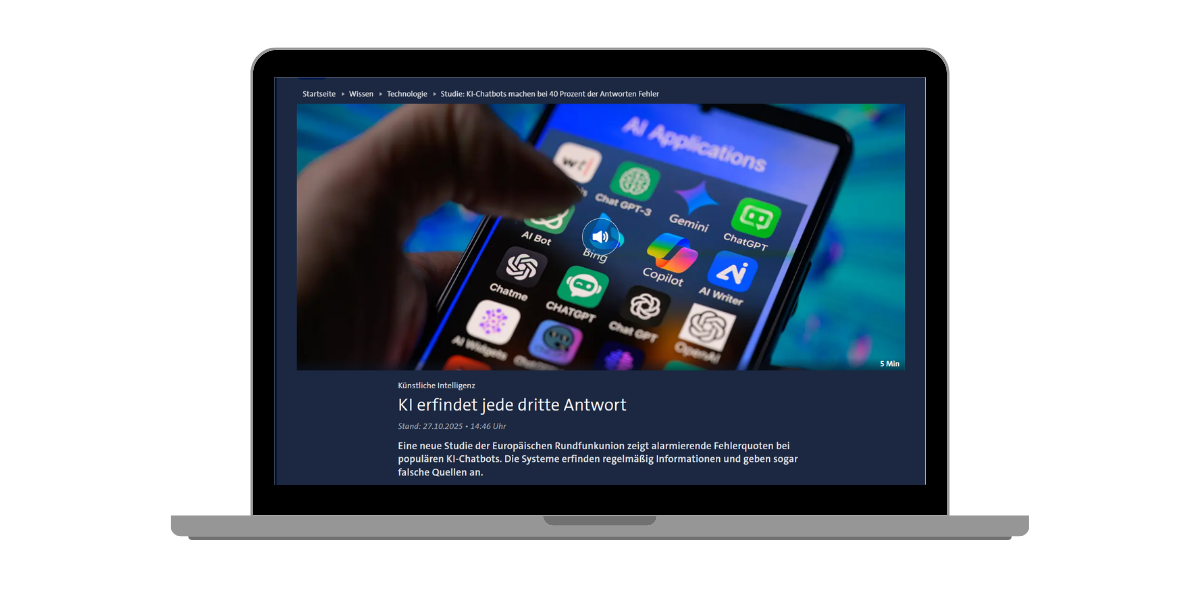
An employee asks the internal AI assistant about the current vacation policy. The answer sounds convincing—but it’s still wrong. The language model isn’t familiar with the actual company policy; instead, it generates a plausible-sounding answer based on its training data. You may recognize this exact problem from your own experience: Large Language Models (LLMs) impress with their language capabilities, but often struggle with current or company-specific questions.
The reason lies in how these models work. An LLM is trained once on massive amounts of text and stores knowledge in its parameters. After training, this knowledge remains static. The model is unaware of new products, current guidelines, or internal documents—unless someone specifically provides it with the relevant information. This is exactly where Retrieval Augmented Generation comes in.
For companies, this is more than just a technical detail. Anyone who deploys an AI application in a production environment—whether in customer service, an internal knowledge base, or administrative processing—must be able to rely on the accuracy of the responses. A convincing-sounding but incorrect answer can, in the worst case, lead to wrong decisions. RAG closes this very gap by connecting AI systems to verified, up-to-date data sources.
RAG: The Solution to a Key AI Problem
In this article, you’ll learn how RAG works, where the technology is effectively used in businesses, and what you should keep in mind when implementing it. This topic is no longer limited to AI developers. Marketing teams, IT departments, and business units are increasingly relying on RAG systems to provide AI applications with reliable, up-to-date data.
The relevance is also reflected in the numbers: According to a recent industry survey (K2view: State of Enterprise Data Readiness for GenAI), 45 percent of the companies surveyed plan to expand or introduce new GenAI applications in 2026. RAG plays a central role here because the technology specifically addresses one of the biggest weaknesses of LLMs: so-called “hallucination,” or the generation of false but convincing-sounding information.
This is a problem we encounter time and again in our AI consulting work, regardless of a company’s size! We provide a solution with our expertise in AI, data science, and data engineering!
What does Retrieval Augmented Generation (RAG) mean?
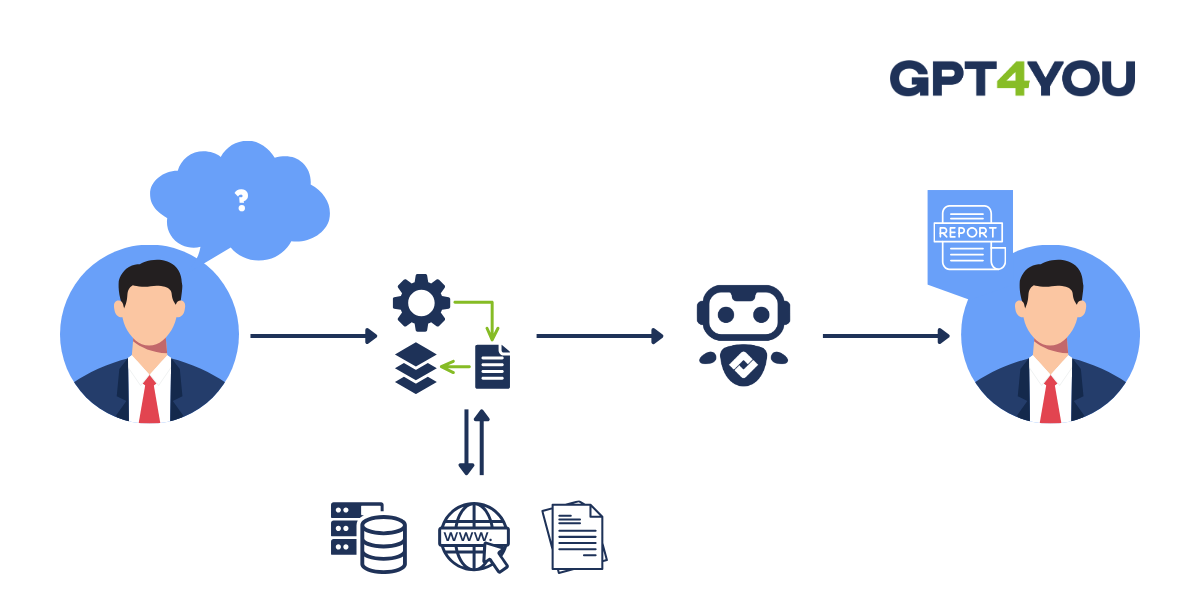
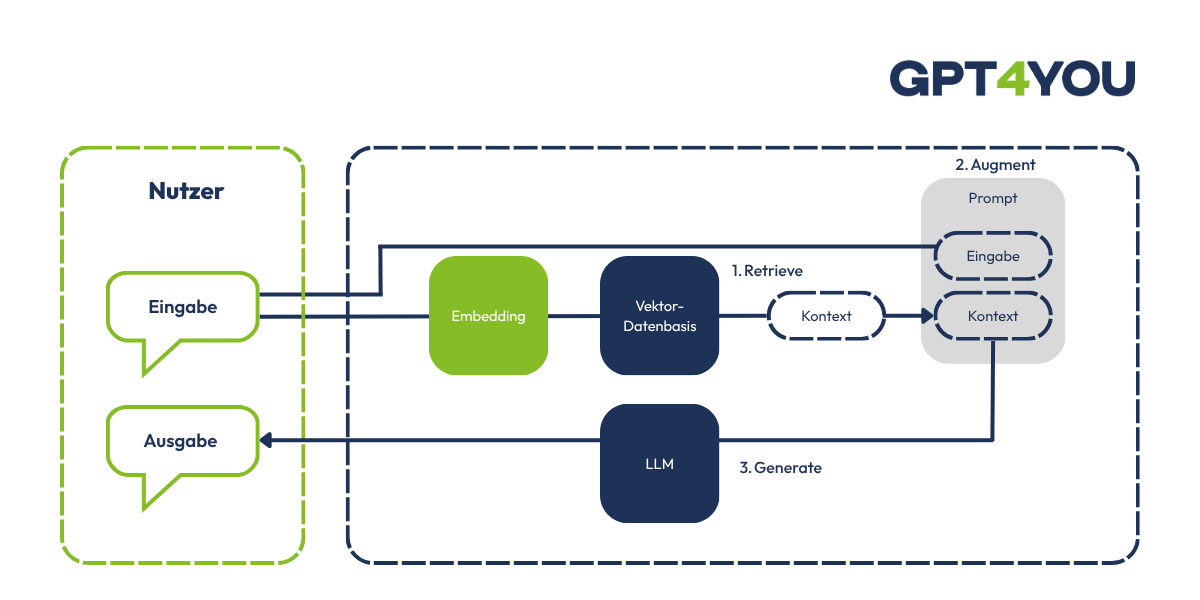
Retrieval Augmented Generation refers to a method that connects a language model to an external knowledge base. Instead of relying solely on trained parameters, the system retrieves relevant information from a data source before generating a response and uses it to enrich the prompt.
The term was coined in 2020 by a research team led by Patrick Lewis, who introduced RAG in a widely cited study as a general method for combining parametric and non-parametric knowledge (Lewis et al., 2020, arXiv:2005.11401). Since then, RAG has evolved from an academic concept into an integral part of productive AI systems.
It is important to distinguish between two types of knowledge: Parametric knowledge is embedded within the trained model and can only be changed through retraining. Non-parametric knowledge, on the other hand, resides outside the model—for example, in a database or document archive—and can be updated at any time. RAG combines both types of knowledge at the time a query is processed—the model “thinks,” while the external source provides the facts.
What is the difference between RAG AI and traditional LLMs?
A traditional LLM answers questions solely based on what it learned during training. A RAG system, on the other hand, combines two components:
Retrieval component: It searches a database or collection of documents for relevant information.
Generation component: The LLM uses this information to formulate a natural-language response.
The difference can be illustrated with an analogy from everyday work: An LLM without RAG is like a coworker who answers from memory. A RAG system is like that same coworker who first quickly looks up the information in the current manual—and can therefore back up the answer with evidence.
A concrete example from everyday IT life illustrates this: If you ask a traditional LLM for the current version number of an internal software program, at best it will make an educated guess based on patterns from its training data. A RAG system, on the other hand, first checks the current release document and provides the actual valid version—including a reference to the source.
What benefits does RAG offer businesses?
RAG systems offer companies several concrete benefits:
Up-to-date: New documents can be imported without having to retrain the model.
Traceability: Answers can be traced back to specific sources, which builds trust.
Cost-effectiveness: Eliminating the need for regular fine-tuning saves computing costs and time.
Data security: Sensitive company data remains within the company’s own infrastructure rather than being “fed into” a model.
Flexibility: RAG works with a wide variety of data sources—from databases and document repositories to APIs.
A real-world example: An IT service provider connects its technical documentation to an internal chatbot via RAG. If a process changes, only the corresponding document needs to be updated—the AI automatically accesses the new version. There’s no need for time-consuming retraining of the model, which saves time and IT resources.
Would you also like to benefit from the advantages of RAG technology? Then contact us—with our AI consulting and our AI platform GPT4YOU, we’ll find the right setup for your business!
What technologies are behind RAG?
A productive RAG system relies on the interaction of several technologies. In addition to the LLM itself, embedding models are used to convert text into vectors. Vector databases such as Milvus or Weaviate handle storage and enable fast searches within these vector spaces.
Cloud providers are increasingly integrating RAG directly into their platforms, for example through Azure AI Search or comparable services from other providers. This lowers the barrier to entry because companies do not have to build and operate every component themselves. However, for specific requirements, a custom architecture tailored to a company’s own data landscape often remains the best approach.
The combination of LLM, embedding model, and vector database that works best depends heavily on the specific use case. A consulting firm with high security requirements will have different priorities than a marketing team that needs quick answers from publicly available content.
How a RAG System Works, Step by Step
For RAG to work in practice, every request goes through several technical steps. Let’s take a closer look.
Step 1: Prepare the data and divide it into chunks
Before a system can search through documents, the data must be prepared. This includes internal documents, database entries, PDFs, or content from APIs. Since LLMs can only process a limited amount of context, long texts are divided into smaller sections—a process known as chunking.
The chunk size directly affects the quality of the subsequent search: Sections that are too small lose context, while those that are too large dilute relevance. Current recommendations range from about 256 to 512 tokens per chunk for fact-based use cases. In practice, this usually translates to sections of around 200 to 500 words.
In addition to size, structure also plays a role. A chunk should end at natural breaks whenever possible—such as at the end of a paragraph or chapter—rather than cutting off in the middle of a sentence. Many teams also use a small overlap between consecutive chunks to ensure that important context isn’t lost at the boundary.
Step 2: Embeddings and Vector Database
Each chunk is then converted into a vector—a numerical representation that captures the semantic meaning of the text. These so-called embeddings are stored in a vector database. Well-known solutions for this include Milvus, Weaviate, or managed services such as Azure AI Search.
The advantage: Similar content is close together in the vector space, even if it uses different phrasing. This enables a search based on content rather than a purely literal search.
The choice of embedding model influences how well the system recognizes semantic similarity. For multilingual companies that maintain content in both German and English, an embedding model that reliably represents both languages is recommended—otherwise, the hit rate for cross-language queries drops noticeably.
Step 3: Semantic Search (Retrieval)
When a user asks a question, that question is also converted into a vector. The system compares this query vector with the stored chunk vectors and identifies the most relevant results based on content. This semantic search works independently of exact search terms—a decisive advantage over traditional full-text search.
For example: If an employee searches for “notice period for small businesses,” a RAG system will also find documents that mention “contractual term for small businesses”—even though not a single word matches exactly. A traditional keyword search would miss this result.
Step 4: Generation—the answer is generated
The found text segments are passed to the LLM along with the original question as context. The model uses this to formulate an answer based on the provided information rather than purely on training data. But what does this mean specifically for the quality of the answers?
A study comparing the accuracy of a baseline LLM with a RAG system on benchmark datasets such as HaluEval, SQuAD-V2, and TriviaQA clearly demonstrates the effect: While the language model alone achieved accuracy scores ranging from about 5 to 13 percent, accuracy rose to 19 to 45 percent with a simple RAG approach. RAG thus demonstrably reduces the likelihood of hallucinations.
RAG or Fine-Tuning: Which Is Right for Your Use Case?
In addition to RAG, fine-tuning is a second widely used approach for adapting LLMs to specific requirements. Fine-tuning retrains a model using additional, company-specific data, thereby modifying the model parameters themselves.
The approaches differ fundamentally:
RAG is suitable when data changes frequently, sources need to remain traceable, and costly retraining is not desired.
Fine-tuning is suitable when a model needs to permanently “learn” a specific format, tone, or specialized technical vocabulary.
In practice, the two approaches are not mutually exclusive. Many companies combine a slightly fine-tuned model with a RAG system for up-to-date facts. RAG significantly reduces the cost of training LLMs because it eliminates the need for time-consuming retraining with every data update.
For most cases, RAG is recommended as a starting point because it can be implemented more quickly and the effect on response quality can be verified immediately. Fine-tuning is more worthwhile as a second step once a specific need—such as a consistent tone across all responses—has clearly emerged.
What are the challenges and limitations of using RAG systems?
As useful as RAG is, the technology also has limitations that you should consider when implementing it. The quality of the answers depends directly on the quality of the underlying data. Outdated, contradictory, or poorly structured documents can lead to inaccurate results even in a RAG system. In addition, there remains a residual risk of hallucinations: if the retrieval component provides incomplete or ambiguous context, the model may still draw incorrect conclusions.
Added to this is the technical complexity. A RAG system consists of several components—data preparation, an embedding model, a vector database, retrieval logic, and the actual LLM. Each component must be maintained, monitored, and adjusted as needed. Data protection and access rights also require special attention, especially when different user groups are permitted to access different documents.
Last but not least, a RAG project requires realistic expectations. RAG is not a tool that functions without further maintenance once it has been implemented. Data sources change, new documents are added, and old ones become obsolete. Without a clear process for continuously updating the knowledge base, the quality of responses declines noticeably over time.
To ensure your systems deliver reliable answers over the long term, we make sure your knowledge base is always up to date!
What role do data protection and security play in RAG systems?
As soon as a RAG system begins processing corporate data, data protection becomes a key concern. Unlike in fine-tuning, raw data in RAG does not flow directly into the model but remains stored in the external knowledge base. While this reduces certain risks, it also creates new requirements for access controls.
Above all, it is important that the access rights management of the source documents is also reflected in the RAG system. If an employee is not authorized to view a personnel file in the original system, a RAG-powered assistant must not provide them with any information from that file either. In addition, it is important to verify where the vector database and the LLM are hosted—especially when dealing with sensitive data from areas such as human resources, legal affairs, or insurance, the server location plays a crucial role in ensuring compliance with data protection regulations.
Best Practices for Successful RAG Implementation
In our AI consulting practice, we encounter the same challenges time and again. To ensure that a RAG system functions reliably in day-to-day business operations, we’ve summarized the most important lessons learned for you here.
Tip #1: Ensure the Quality of Your Data Sources
Before you set up a RAG system, you should review your data. Outdated or duplicate documents need to be removed. A clear structure with metadata—such as date, department, or document type—significantly improves search results later on. It also pays to have a clearly defined person responsible for data maintenance: Without clear accountability, knowledge bases gradually become outdated, and the quality of answers declines without anyone noticing at first.
Tip #2: Choose a chunking strategy
The correct chunk size depends on the use case. Smaller sections are suitable for precise factual questions, while slightly larger ones are better for topics that require explanation. Chunking based on content boundaries—such as paragraphs or chapters—typically yields better results than rigid character limits.
Tip #3: Choose the Right Vector Database
Depending on the volume of data, budget, and existing infrastructure, different vector databases may be suitable. Open-source solutions like Milvus or Weaviate are suitable for teams with their own infrastructure, while managed cloud services reduce operational overhead.
Tip #4: Regular Evaluation and Monitoring
RAG systems should be evaluated regularly to ensure answer quality. This includes random checks of answers, feedback loops with real users, and monitoring which queries frequently lead to inaccurate results.
What Are Typical Use Cases for RAG?
RAG can be used in any field where AI is employed. A look at typical AI use cases illustrates the technology’s potential.
Customer Service and Support Chatbots
Support teams use RAG to connect chatbots to up-to-date product information, FAQs, and manuals. Unlike a traditional rule-based chatbot, an RAG-powered system can also answer more complex, open-ended questions—based on actual company documents rather than generic training data.
Knowledge Management in the Workplace
Large companies often have thousands of internal documents spread across various systems. RAG makes this knowledge searchable and accessible without employees having to know which folder or system a piece of information is located in. This is particularly beneficial in situations with high employee turnover or complex onboarding processes: New employees can find answers on their own instead of interrupting colleagues with questions.
Public Administration and Compliance
RAG is also gaining importance in the public sector. Government agencies work with extensive legal texts, regulations, and internal guidelines. A RAG system can answer inquiries regarding responsibilities or procedural steps while always referencing the currently valid legal basis—an important factor for transparent, legally sound responses.
Insurance and Claims Processing
In the insurance industry, RAG supports claims processing, for example. Claims adjusters can quickly access relevant policy provisions, previous case rulings, or internal guidelines without having to manually search through extensive documents. This speeds up decision-making while ensuring more consistent assessments.
In which area would you most like to automate tedious routine tasks? Our GPT4YOU platform can be flexibly adapted to your processes!
RAG Makes Large Language Models More Reliable in the Enterprise
Retrieval Augmented Generation combines the language capabilities of LLMs with up-to-date, verifiable knowledge from a company’s own data sources. For businesses, this means more precise answers, fewer hallucinations, and an AI that adapts to new information without requiring time-consuming retraining.
At the same time, RAG is not a surefire success. Data quality, chunking strategy, and ongoing monitoring determine whether a system functions reliably. Those who pay attention to these fundamentals will find that RAG is a tool that makes AI applications noticeably more practical for everyday business use.
Whether in customer service, internal knowledge management, public administration, or the insurance industry: concrete use cases show that RAG is no longer merely an academic concept. For companies that want to use AI reliably and transparently, a well-designed RAG architecture is virtually indispensable.
Want to implement AI safely and securely in your company? Our experts will guide you every step of the way—from requirements analysis to performance evaluation!
Frequently Asked Questions About RAG (FAQ)
No. Fine-tuning modifies a model's parameters through additional training. RAG supplements an existing model with external knowledge at runtime without modifying the model itself.
In general, both structured and unstructured data are equally suitable: documents, database entries, wikis, PDFs, or API responses. The key is that the sources are properly formatted and up to date.
No. RAG significantly reduces the likelihood of hallucinations, but cannot completely rule them out. Incorrect or incomplete source information can still lead to inaccurate answers.
Some of the most widely used options include Milvus, Weaviate, and Azure AI Search. The choice depends on the volume of data, budget, and existing infrastructure.
Yes, RAG generally scales with the volume of data. Even smaller companies can benefit from more precise, source-based AI responses, even with manageable document collections.


