
Requirements Engineering: How Requirements Turn into Successful IT Projects
An insurance company is planning a new customer portal. The project team’s assignment can be summed up in one sentence: “Customers should be able to file claims online.” After three months, the team presents the first version. The business unit is disappointed: photos can’t be uploaded, the claim doesn’t get entered into the core system, and brokers don’t have access. No one did a poor job. The requirements had simply never been properly clarified.
Scenes like this are not isolated incidents. In a 2014 study by the Project Management Institute (PMI), inadequate requirements management was the primary cause in 47 percent of failed projects. This is exactly where requirements engineering comes in.
In this article, you’ll learn what requirements engineering is and how it differs from requirements management. You’ll discover the four core activities, best practices, and common mistakes. This article is aimed at project managers, business units, and IT teams who want to clarify requirements more effectively.
Key Points at a Glance
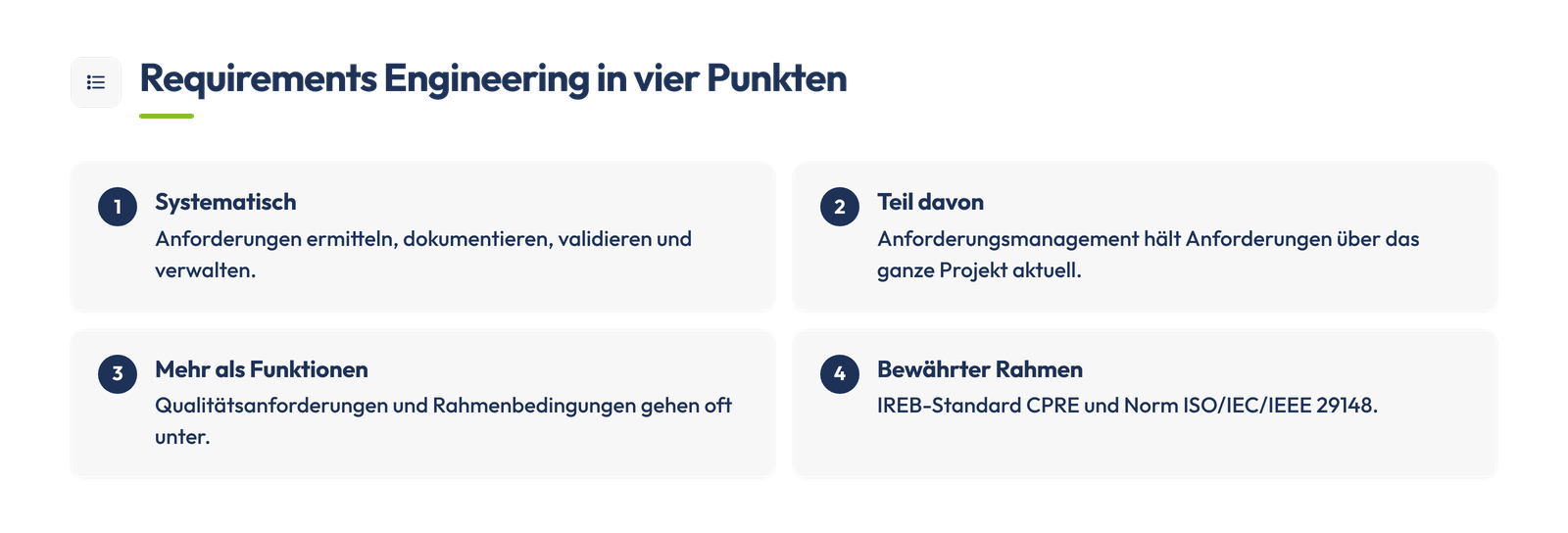
Requirements engineering is the systematic handling of requirements: identifying, documenting, validating, and managing them.
Requirements management is a part of this and keeps requirements up to date throughout the entire project.
In addition to functional requirements, quality requirements and framework conditions are important—yet these are often overlooked.
The IREB CPRE standard and the ISO/IEC/IEEE 29148 standard provide you with a proven framework.
What is Requirements Engineering?
According to the International Requirements Engineering Board (IREB), requirements engineering (RE) is the systematic and disciplined approach to specifying and managing requirements. The goal is to understand the wishes and needs of stakeholders and reduce the risk of delivering a system that does not meet them.
Stakeholders are all individuals or organizations that influence requirements or are affected by the system. These include users, clients, IT operations, data protection agencies, or regulatory authorities. A requirement describes a need, capability, or characteristic that a system, software, or product should have.
Requirements engineering is not an end in itself. The IREB puts it this way in its first principle: Requirements are a means to an end. Clear requirements create a shared understanding among all parties involved and establish a binding foundation between the client and the development team.
Requirements Engineering and Requirements Management: The Difference
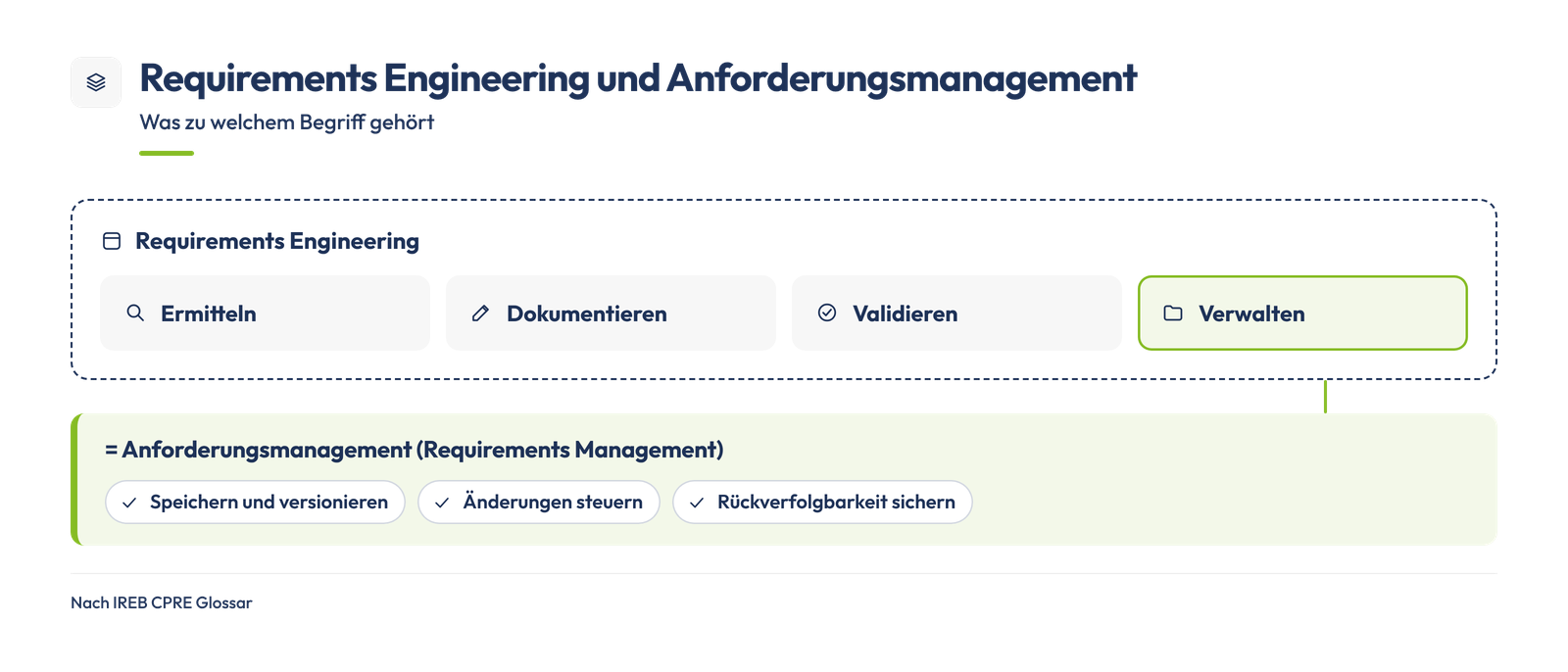
In everyday practice, many teams use both terms interchangeably. Technically speaking, requirements management is a part of requirements engineering. The IREB defines it as the management of existing requirements: storing, modifying, and tracking them. This includes change management and version control.
Requirements engineering begins earlier. It first clarifies which requirements actually exist and then documents them in a comprehensible manner. Our article on requirements management shows you how to capture, prioritize, and maintain requirements in day-to-day project work.
Why Requirements Engineering Ensures Project Success
The later in the project a requirements error is detected, the more work it creates. If a missing requirement is not discovered until the testing phase, teams must adapt the design, code, and tests. According to PMI, 5.1 percent of every dollar invested in projects was lost due to poor requirements management. Good requirements engineering makes expectations clear before they turn into conflicts, thereby reducing risk in the development process.
Requirements Engineering Process: What Are the Four Core Activities?
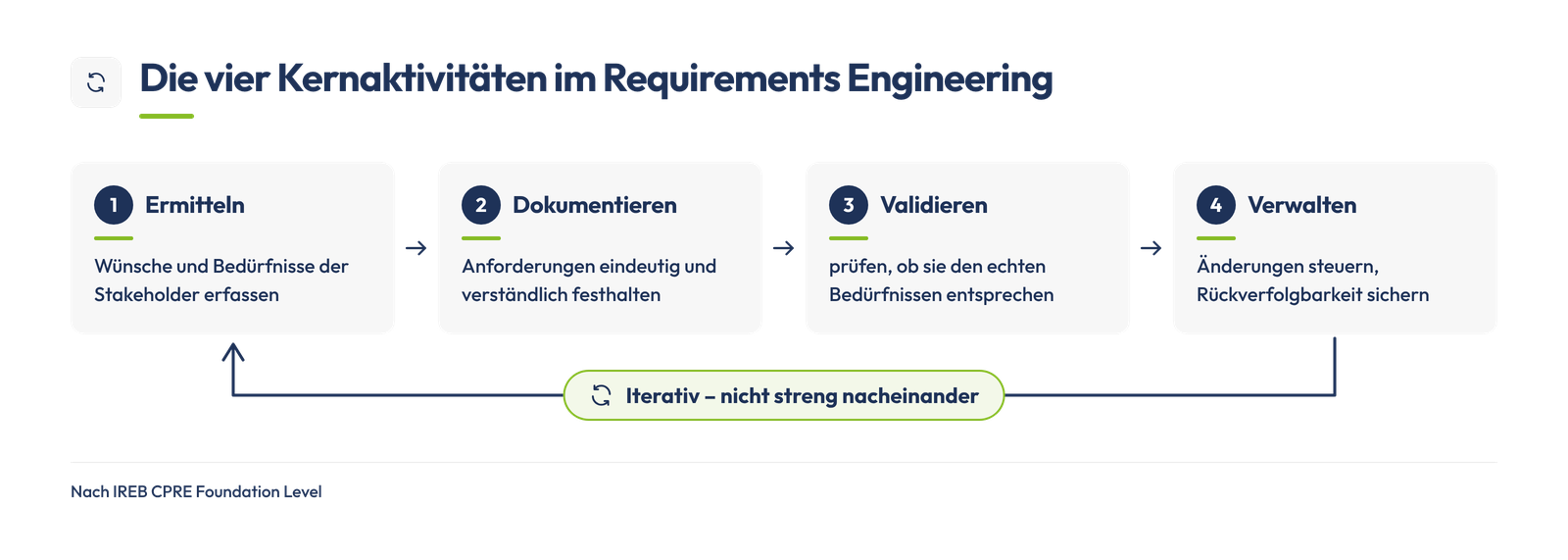
The IREB identifies four core activities for requirements engineering: identifying, documenting, validating, and managing requirements. These activities do not occur strictly one after another but rather overlap and repeat.
1. Eliciting Requirements
During requirements elicitation, you gather the wishes and needs of the stakeholders. Sources include people, documents such as laws and guidelines, and existing systems. If you overlook a group here, you’ll end up having to make up for their requirements later at great expense. In requirements analysis, you review and structure the results and resolve conflicts, such as those between sales and compliance.
2. Documenting Requirements
The requirements specification clearly and unambiguously defines the requirements. For documentation, the IREB distinguishes between natural language, templates such as user stories, and models in UML or BPMN. These are standardized graphical notations for systems and business processes. A glossary defines what terms such as “insurance claim” mean in the project.
3. Validate requirements
Validation checks whether the documented requirements correspond to actual needs. According to IREB, unvalidated requirements are useless. Reviews, prototypes, and alpha and beta tests have proven effective. Validation accompanies the entire process, not just a single phase. Whether a requirement is testable also determines the quality of your software tests.
4. Manage Requirements
Requirements change. According to IREB, this is not an accident but the norm. In requirements management—the actual process—you assign priorities, statuses, and sources to requirements and manage changes through a clear process. Traceability shows whether all requirements have been implemented and tested.
Which requirements engineering methods have proven effective?
Which requirements engineering methods you use depends on the project, the stakeholders, and the approach. In requirements engineering, you usually combine several techniques.
Stakeholder interviews, workshops, and observation
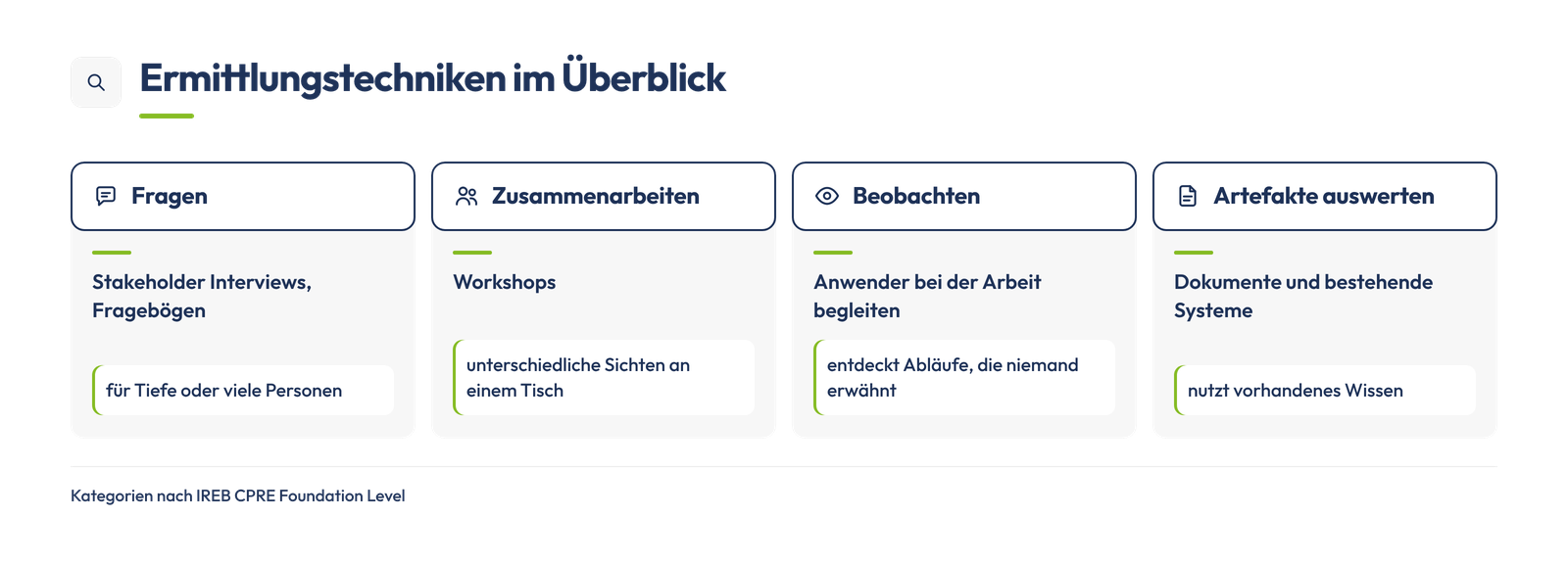
The IREB divides elicitation techniques into four groups:
Questioning techniques: stakeholder interviews for depth, questionnaires for large groups.
Collaboration techniques: Workshops bring different perspectives to the table.
Observation techniques: You observe users at work and discover processes that no one mentions.
Artifact-based techniques: You analyze existing documents and systems.
User Stories, Use Cases, and Prototypes
User stories describe a requirement from the user’s perspective: “As a policyholder, I want to upload photos of my claim so that the claims adjuster can make a decision faster.” Acceptance criteria make the story verifiable. Use cases describe, step by step, how a user achieves a goal using the system, including error scenarios.
Prototypes make requirements tangible. Stakeholders click through a design and immediately point out what’s missing. For user interfaces, this combines requirements engineering with UX/UI design.
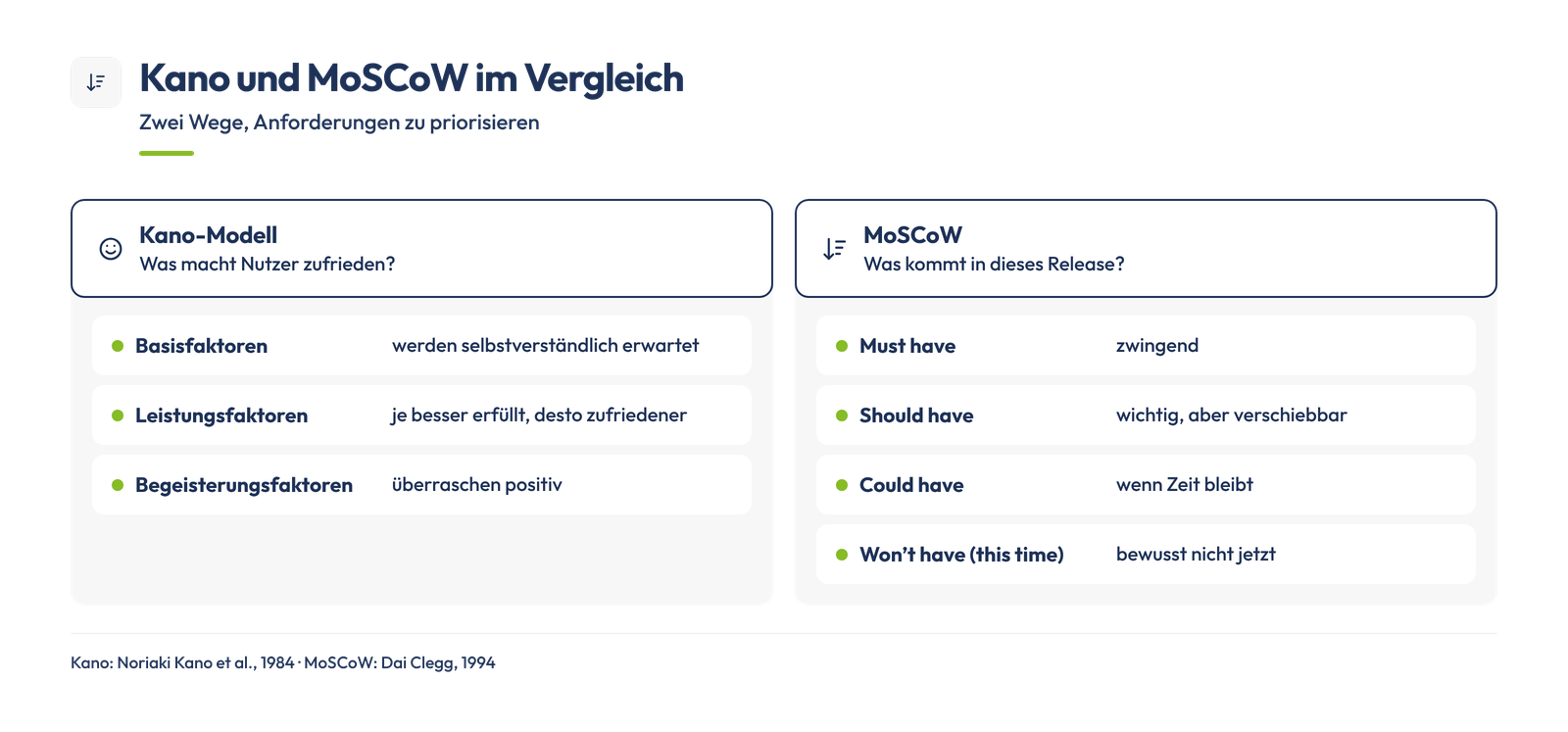

Prioritizing Requirements with Kano and MoSCoW
Noriaki Kano’s Kano model distinguishes between basic factors—which users take for granted—performance factors—which increase satisfaction when met—and excitement factors—which provide a positive surprise. Dai Clegg’s MoSCoW method categorizes items for a fixed period into “Must have,” “Should have,” “Could have,” and “Won’t have.” This allows you to manage your budget and sprints more effectively.
Standards: IREB CPRE and ISO/IEC/IEEE 29148
The IREB defines the Certified Professional for Requirements Engineering (CPRE) as an internationally recognized knowledge standard. The ISO/IEC/IEEE 29148:2018 standard lists nine characteristics of good requirements: necessary, appropriate, unambiguous, complete, unique, implementable, verifiable, correct, and conforming.
Functional and Non-Functional Requirements: What Are the Differences?
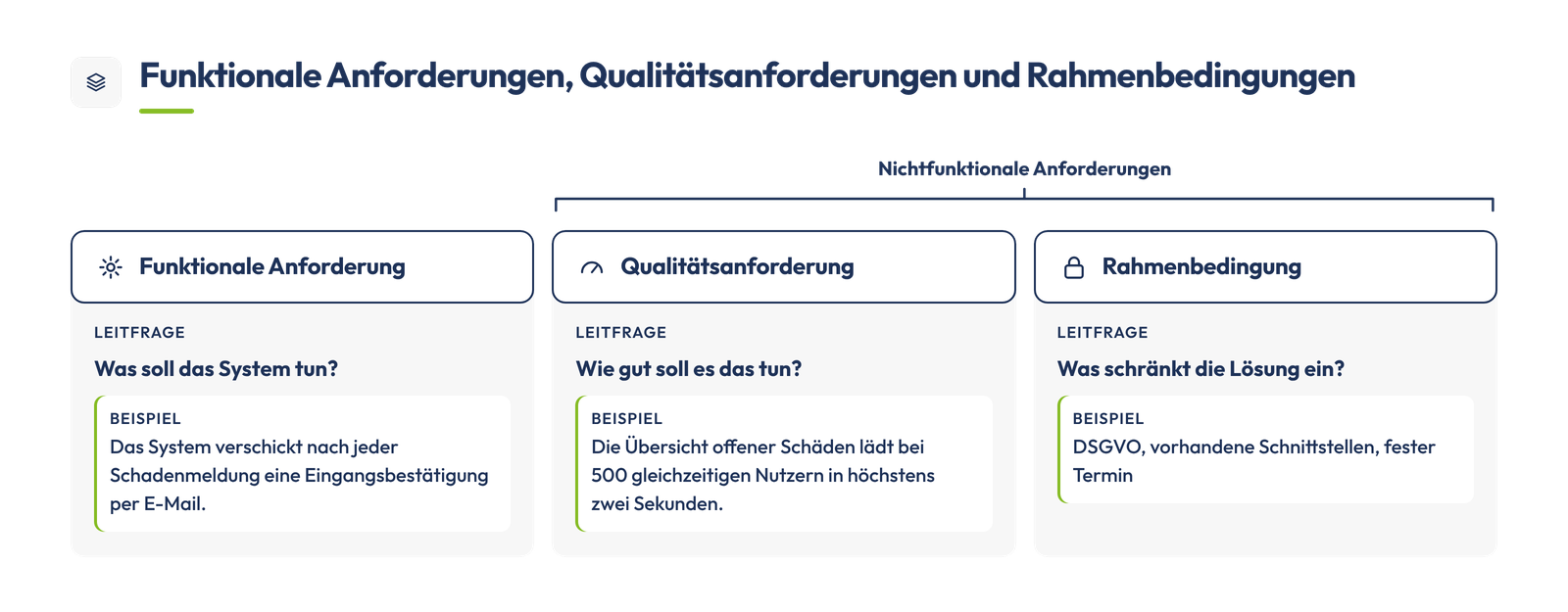
Functional requirements describe what a system is supposed to do. Example: “After each damage report is submitted, the system sends a confirmation of receipt via email.”
Non-functional requirements specify how well the system should perform and what framework conditions apply. In addition to functional requirements, the IREB distinguishes two other types:
Quality requirements relate to aspects such as performance, security, or usability. The quality model defined in the ISO/IEC 25010:2023 standard, with its nine quality characteristics, serves as a checklist.
C onstraints limit the solution, such as the GDPR, existing interfaces, or a fixed deadline.
Formulate quality requirements in measurable terms. “The portal should be fast” doesn’t help anyone. Better: “The overview of open claims loads in no more than two seconds with 500 concurrent users.”
A Comparison of Agile and Traditional Requirements Engineering
In the traditional approach, teams define the requirements as completely as possible at the outset, for example in a requirements specification. The phases are clearly delineated and proceed sequentially.
Agile requirements engineering operates iteratively throughout the entire development process. The Product Owner maintains the backlog, the teams collaboratively refine user stories, and each sprint provides feedback. The IREB makes it clear: Agility is no excuse for unsystematic requirements engineering. Our article on Scrum project management explains how Scrum works in this context.
What common mistakes in requirements engineering should you avoid?
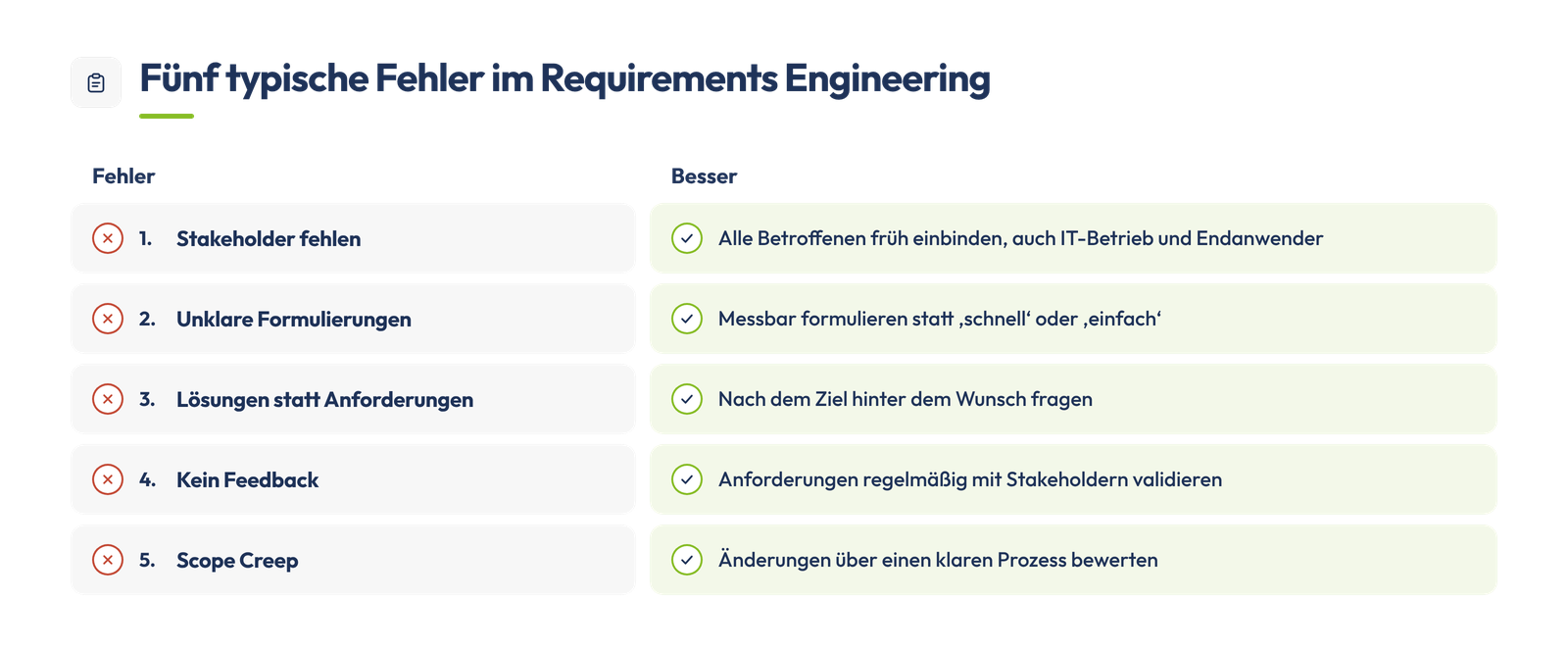
You’ll encounter these patterns time and again in projects:
Missing stakeholders: IT operations or end users are consulted too late.
Unclear wording: Words like “fast” or “simple” leave a lot of room for interpretation.
Solutions instead of requirements: “We need a drop-down menu” leaves the actual goal undefined.
No feedback: Requirements are written down but never validated.
Scope creep: New requests are thrown into the project on the fly. The scope creeps up gradually, and time and costs rise.
What Do Requirements Engineers Do?
Requirements engineers identify, document, validate, and manage requirements. They work at the intersection of business units, management, and software development teams. Their responsibilities include facilitating stakeholder interviews and workshops, describing requirements, helping to resolve conflicts, and evaluating changes.
To do this, they need knowledge of the subject matter, analytical thinking, and facilitation skills. The role isn’t called the same thing everywhere. Often, business analysts, product owners, or project managers take on these tasks. What’s crucial is that someone clearly takes responsibility.
Conclusion: Good requirements are the foundation of every IT project
Structured requirements engineering takes time at the beginning. You’ll usually recoup this investment because fewer revisions will be needed later on. To get started, three questions are enough: Who is affected by the system? How do we know when a requirement has been met? And how do we handle changes?
Want to define requirements clearly for your next project? At FIDA Business Consulting, requirements engineering is a core competency of business analysis. Our business analysts translate business objectives into user stories, use cases, and process models—even in complex environments such as insurance, banking, and public administration. Reach out to us—we look forward to discussing this with you.
Frequently Asked Questions About Requirements Engineering
Business analysis has a broader scope. It examines an organization's business processes and objectives and uses them to identify areas for change. Requirements engineering focuses on the requirements for a specific system. In practice, the two overlap significantly.
According to DIN 69901-5, the client specifies its requirements for goods and services in the requirements specification. In the functional specification, the contractor describes how it intends to meet these requirements.
Backlog tools such as Jira, wikis such as Confluence, modeling tools such as Enterprise Architect, and digital whiteboards for workshops are frequently used.
The IREB's CPRE framework is widely used. The entry point is the CPRE Foundation Level, which involves a multiple-choice exam with no prerequisites. The CPRE Practitioner builds on this, offering specializations such as Requirements Elicitation, Requirements Management, Requirements Modeling, and RE@Agile.


