
How does SCRUM project management work?
Do you know this? Projects drag on like chewing gum, the requirements are constantly changing and in the end the result is completely different than expected? Welcome to the often stressful everyday life of many companies! But there is a way to break out of this vicious circle: SCRUM. SCRUM is a form of agile project management that promotes flexibility and iterative development as a central method. Agile project management enables teams and projects to continuously improve and react quickly to changing requirements. Iterative working methods, clear roles and continuous improvement significantly increase efficiency in companies.
SCRUM is far more than just a buzzword. It is an agile framework that helps teams get to grips with complex projects, deliver faster and react flexibly to changes. In short, it makes work more effective and more enjoyable!
At FIDA, we have been successfully using the SCRUM method for years to turn our customers' visions into reality. In this article, we will not only show you exactly what SCRUM is, but also how we use it on a daily basis to optimize workflows and not only complete projects, but make them a real success.

What is the SCRUM framework?
Before we go into detail, let's clear up the biggest misunderstanding: SCRUM is not a method in the traditional sense, but a framework. It provides you with a clear structure, but gives you the freedom to implement it.
SCRUM is a process model for project and product management that is used in particular for agile software development. However, SCRUM is not just limited to software development, but is also used successfully in other areas such as marketing, research and product design.
Think of SCRUM as a well-organized sprint relay race where your team doesn't know how long the total distance is. Instead of planning the entire project at once, you break it down into small, manageable stages, known as sprints. The SCRUM process is based on an iterative approach in which clear SCRUM rules, defined artifacts and regular SCRUM events such as Sprint Planning, Daily SCRUM, Sprint Review and Retrospective structure the process and promote continuous improvement. In these time-limited sprints, a self-organized development team develops potentially deliverable products that can be reviewed at the end of each sprint.
The aim of SCRUM is to deliver a functioning product increment quickly and continuously. The SCRUM artifacts - product backlog, sprint backlog and product increment - serve as central tools to ensure transparency, planning reliability and traceability in the project. In each SCRUM sprint, sub-products are created that are gradually improved and reflect different content such as software functionalities or other results. The complexity of the tasks is assessed in sprint planning using techniques such as story points to estimate the relative difficulty.
Instead of waiting a long time and realizing at the end that you have missed the target, you and your customer check after each short sprint whether you are still on the right track. This transparency, review and adaptation are the three pillars on which SCRUM is based. The clear allocation of roles in the team - consisting of the SCRUM roles of Product Owner, SCRUM Master and Development Team - ensures clear responsibilities and efficient collaboration. The responsibilities are clearly defined and support a flexible response to changes in the project team. Compared to the traditional project manager, the tasks in SCRUM are distributed across several roles.
Techniques and steps in the SCRUM process help to implement the principles and values of agile working methods. Suggestions for changes or improvements are discussed in meetings such as the backlog refinement and transferred into the form of artifacts. A guide supports teams in the introduction and application of SCRUM by presenting the most important principles, roles, events and best practices in a structured manner.

The most important things at a glance:
Agile: Flexible reaction to changes instead of a rigid plan.
Iterative: Working in short, fixed cycles (sprints). A sprint is a work period of one to four weeks in which an increment of a product functionality is implemented.
Incremental: After each sprint, a functioning, finished sub-product is created, the so-called product increment, which includes the new or improved functionalities and can be reviewed by the stakeholders.
Sprint backlog: The sprint backlog is the to-do list for the sprint, which is created during sprint planning and contains all the tasks that are to be implemented in the current sprint.
Definition of Done: The Definition of Done defines the quality criteria and requirements that must be met for a product increment to be considered completed and ready for acceptance.
It is precisely this simplicity and simultaneous focus that makes SCRUM so powerful, especially for complex projects whose exact outcome is still unclear at the start.

What makes SCRUM so special?
You have now learned about the roles and processes, but what is the basic agile feeling that makes SCRUM so effective? The use of SCRUM in project management increases efficiency and productivity, as resources and processes are optimally utilized and continuously improved. There are three core aspects in particular that fundamentally change the way we work:
Personal responsibility: in the SCRUM process, team members assume a high level of personal responsibility and organize themselves in order to achieve the sprint goals together. Close collaboration and the different skills of the team members are crucial for the success and continuous development of the product. Well-composed project teams play a central role in this: they can react flexibly to changes and ensure project success in agile project management through continuous communication with stakeholders.
Collaboration: Collaboration is particularly important in software development teams. By using agile methods such as SCRUM, software development teams can drive innovation faster, solve problems in the development process efficiently and strengthen team dynamics.
The vision stands above the rigid plan
When starting a FIDA project, we do not begin with a detailed plan that is fixed down to the last screw. Instead, we work with you to define a clear vision - the idea of what added value the final product should create in the end.
The goal is deliberately formulated independently of overly rigid initial requirements. We know that the way there will change. SCRUM allows us to constantly readjust the route without losing sight of the actual vision.
The customer is our constant companion
In traditional project management, you often only see the result at the very end. With SCRUM, things are different: to ensure that we are always focused on your needs, regular consultations take place (in the sprint review).
Your role: You and the other stakeholders see the partial results after each sprint. This involves various content such as software functionalities, creative content or marketing campaigns, which are delivered flexibly and transparently in the SCRUM process.
The added value: your direct feedback is immediately incorporated into the next plan. This continuous feedback ensures that we don't just deliver anything, but exactly what you really need.
Personal responsibility is the driving force
A key feature that we value at FIDA is the self-organization of the development team.
No distribution of tasks: There is no classic "boss" who assigns tasks from above. The team itself decides who takes on which task and how best to achieve the sprint goal.
Your opportunity: This gives the team members the opportunity to take on personal responsibility, develop their professional skills and work on the solution with maximum motivation. The team members contribute different skills and experience, work closely together and jointly contribute to the achievement of the sprint goals and the incremental development of the product. The result is usually a much higher quality of work.
A short journey into history: Where does SCRUM come from?
You may be wondering how this clever framework actually came about. The history of SCRUM is exciting because it shows that the idea of working differently has been in the air for a long time.
The foundations were laid back in 1986: Hirotaka Takeuchi and Ikujiro Nonaka published a groundbreaking article in the Harvard Business Review. This was the first time the Scrum method was presented by Hirotaka Takeuchi and Ikujiro Nonaka in the Harvard Business Review in 1986. They compared ideal product development to the scrum in rugby: the team passes the ball to each other and works together to move forward. A perfect metaphor for teamwork and working towards a common goal, right?
The actual codification and the big breakthrough for software development came in 1995 with Ken Schwaber and Jeff Sutherland. They developed the ideas further and created the SCRUM development process as we know it today. The introduction of SCRUM in companies requires careful planning and preparation, as integration into existing structures is often associated with challenges. A structured introduction guide can help to implement Scrum successfully.
At the time, their work was a direct reaction to rigid methods such as the classic waterfall model. This involved working through one step after the other in a fixed order - first plan, then build, then test. Schwaber and Sutherland knew that this was too inflexible for complex projects. You need a more flexible, iterative process that allows you to constantly gather feedback and adapt.
This way of thinking - reviewing and adapting - is precisely why SCRUM is still relevant today. Schwaber and Sutherland continue to cultivate this approach and regularly update their Scrum Guide. Because the way we work also needs to constantly evolve! It's about you and your team always questioning how you can work even more effectively.
The three SCRUM roles in the team
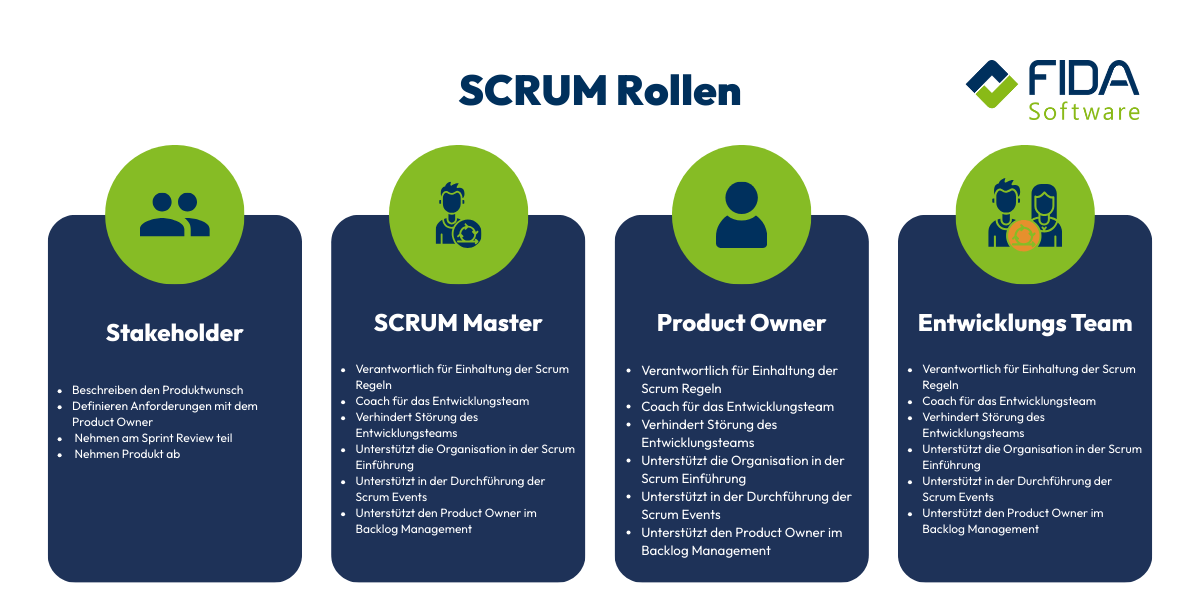
In a SCRUM project, there are no classic project managers or departmental thinking, but three clearly defined Scrum roles: Product Owner, Scrum Master and Development Team. The clear allocation of roles ensures that responsibilities are clearly defined and that everyone knows which tasks and duties they are responsible for in Scrum project management. Each role has specific tasks and is essential for success:
The Product Owner (PO) - the "what" specialist in the SCRUM team
The product owner is responsible for the characteristics and commercial success of the product. He creates, prioritizes and explains the product features to be developed and ensures that the team always works on the most important and valuable tasks. Important: The Product Owner is always a single person and not a committee.
Your responsibility: He manages the product backlog (the prioritized wish list of all features) and ensures that the tasks deliver maximum business value. He decides which function is most important and in which sprint it should be implemented together with the team.
Important to know: He must always be available to answer questions from the team and make decisions. He maximizes the value of the work that the team does.
The Scrum Master (SM) - the "how" enabler
The Scrum Master is responsible for ensuring that Scrum succeeds as a framework. He helps the team to understand and implement the principles and practices of Scrum. He also moderates the sprint retrospective and often the sprint planning and backlog refinement.
Your responsibility: He is not a boss, but a problem solver and protector. He removes impediments (obstacles) that stop the team from working and coaches the team, the product owner and the organization in agile principles. They ensure that all SCRUM events are carried out correctly.
The development team - the implementers
The development team consists of a cross-functional team of professionals, e.g. developers or business analysts, who carry out the work together. It is responsible for delivering the product functionalities in the order requested by the product owner. The Scrum team organizes itself and does not allow anyone to tell it how to implement backlog entries.
Your responsibility: The team is responsible for the "how" - how the requirements are best implemented. They estimate the work, plan the sprint and deliver a finished product increment at the end of the sprint.
Important to know: With SCRUM, there are no internal hierarchies in the team. Everyone is an equal developer, regardless of whether they are a designer, programmer or tester.
In short: the PO says what needs to be done, the Scrum Master helps the team to do it optimally and the development team implements it independently.

The SCRUM events: how to get the rhythm into the project
The magic of SCRUM lies in the so-called time boxes. This means that each event has a fixed, non-negotiable maximum duration. This forces focus and prevents endless meetings.
SCRUM events such as Sprint Planning, Daily Scrum, Sprint Review and Sprint Retrospective structure the entire process and ensure a clear project management process. At the end of a sprint, important Scrum events such as the Sprint Review and the Sprint Retrospective take place, during which the results are evaluated and improvement measures are planned for future sprints.
The Scrum sprint - the centerpiece
The sprint is the central time frame in SCRUM. It is a fixed cycle that usually lasts two to four weeks and in which all the work takes place.
Goal: At the end of each sprint, a finished, functional product increment must be created that fulfills the requirements planned in the sprint and can be presented to the stakeholder.
During the sprint, sub-products are developed - these are incrementally improved and expanded product sections that gradually lead to the complete end product.
Acceptance of the increment is based on the Definition of Done, which describes the jointly defined quality criteria and requirements under which work is considered complete.
Important to know: The goal must not be changed during a sprint. This protects the team from constant interruptions and enables concentrated work.
Sprint planning - what do we do next?
At the start of each sprint, the entire SCRUM team meets to plan.
Your responsibility: You select the tasks from the product backlog (the wish list) that are to be implemented in the upcoming sprint. In sprint planning, these selected tasks are transferred to the so-called sprint backlog, which serves as a to-do list for the sprint. During this meeting, suggestions for prioritizing and adapting the requirements are discussed to ensure the optimal sequence and implementation. The product owner explains the "what" and the team decides the "how" and commits to a sprint goal.
Daily SCRUM (or daily stand-up) - short daily check
The Daily SCRUM is the most important tool for daily synchronization. It lasts a maximum of 15 minutes and takes place every day at the same time and in the same place. Various techniques, such as the stand-up format, the use of task boards or timeboxing, support the team in carrying out the Daily SCRUM effectively.
Goal: The team coordinates and identifies obstacles (impediments). It is not about a status report to the boss, but about planning for the next 24 hours so that the team achieves the sprint goal.
Sprint review - show what you've got!
At the end of the sprint, the team presents the finished increment to the stakeholders (customers, users, management).
The content developed during the sprint is presented, such as new software functionalities, creative content or marketing campaigns that were developed flexibly and transparently using Scrum.
Your goal: You gather feedback. The stakeholders see the product, test it and give feedback to the product owner. This feedback is essential and flows directly into the product backlog for the next planning stage.
Sprint retrospective - We are getting better!
This meeting is only for the SCRUM team and takes place directly after the review. It is not about the product, but about the process.
Goal: You ask yourself and your team: What went well? What went badly? What can we do better in the next sprint? The sprint retrospective is a central element in Scrum project management that is used for reflection and continuous improvement. It enables the team to regularly review its working methods and processes. Regular retrospectives offer the opportunity to learn from past experiences and to continuously optimize the work process. The retrospective is the engine for continuous improvement in your team.

The SCRUM artifacts: Tools for transparency
In the agile world, we need to ensure that we are all talking about the same thing. This is why we have the so-called artifacts. These are the central documents and lists that give your team and you transparency about the product and progress at all times.
There are three main artifacts that you should know:
Product backlog (the product wish list)
You already know the product backlog: it is the central, prioritized list of all functions, requirements, bugs or ideas that you want for your product.
Goal: It is the master plan for your product. The product owner maintains it and ensures that the most important things are at the top, measured by the value they have for you as a customer. The backlog is dynamic and is constantly adapted as the project progresses.
Sprint backlog (the planning commitment)
The sprint backlog is a section of the product backlog. It contains the exact tasks that your development team wants to implement in the current sprint.
Your benefit: It serves as a planning commitment for the team. It is created during sprint planning. Here you can see which part of the overall project the team will realistically complete in the sprints.
Product Increment (the finished piece of product)
The product increment (or simply the increment) is the finished result of a sprint. It is the sum of all product backlog items completed in the sprint - plus the increments of all previous sprints.
Your benefit: It is not an unfinished concept or document, but a functional version of your product. The increment must fulfill the so-called Definition of Done (DoD) in order to be considered finished. It is the concrete, tangible delivery that you look at in the sprint review.
These three artifacts are closely interlinked and ensure that everyone involved is working on the same information basis.

The three agile pillars: Transparency, review, adaptation
SCRUM is not just a collection of meetings and roles. It is based on three profound principles that ensure that you and your team not only work quickly, but also correctly. They are the foundation of our success:
1. transparency (seeing what's going on)
Transparency is the key. It means that all relevant aspects of the project must be fully visible and comprehensible to everyone involved - from you as the customer to the development team.
Advantages: You can see the progress of the work at any time, recognize obstacles immediately and know which tasks have priority at any given time.
Effect: This openness creates trust and allows informed decisions to be made instead of groping in the dark.
2. review (look regularly)
If everything is transparent, you also need to review (inspect) it regularly. SCRUM is full of planned review points:
In the Daily Scrum we review the day's progress.
In the Sprint Review, we check the completed product increment with you.
The point: these fixed checkpoints ensure that you notice at an early stage if the project veers off course. This prevents months of work from ending up at the wrong destination.
3. adaptation (continuous improvement)
The knowledge gained from the inspection leads directly to the third principle: adaptation. If the inspection shows that something is not running optimally or the requirements have changed, you must react.
Your consequence: Based on the feedback, the team adjusts the work process (in the retrospective) or the product owner sets new priorities (in the product backlog).
Effect: The ability to continuously adapt makes the team incredibly flexible and enables us to react to changes faster than any other project method.
Remember: Without transparency, there is no meaningful review. Without review, there is no necessary adaptation. These principles are inextricably linked.
Advantages and disadvantages of SCRUM at a glance
SCRUM is incredibly effective, but it is not a miracle cure. Like any method, it has clear strengths and also places certain demands on the team and the organization.
The advantages of SCRUM
Why do we and many other successful companies rely on SCRUM? The advantages are obvious, especially when you have to manage complex, rapidly changing projects:
Greater flexibility and adaptability: you don't have to set the entire plan in stone at once. If requirements change - and they almost always do - you can simply take them into account in the next sprint. You react flexibly and deliver what the customer really needs.
Faster results (time-to-market): Because you work in short sprints, you deliver a working product increment after just a few weeks. Your customer can work with it early on, you receive feedback and see the progress immediately.
Reduced project risk: Thanks to the constant review (sprint review) and early feedback, errors or undesirable developments are quickly identified. You minimize the risk of working on the wrong product for months.
High transparency: The events (especially the daily scrum and the review) ensure that everyone - in the team and among the stakeholders - knows what is currently happening, what is planned and where there are problems.
More motivated teams: The development team works in a self-organized and autonomous manner. This creates trust, boosts motivation and often leads to more creative and better solutions.
The potential disadvantages and challenges
Where there is light, there is also shadow. You should keep these points in mind if you want to introduce SCRUM:
High demands on the team: self-organization and a sense of responsibility are the be-all and end-all. If your team does not have this maturity or does not adapt to the new roles, SCRUM can quickly fail.
Intensive communication and availability: The product owner must be available to the team at all times in order to make decisions and clarify questions. Daily meetings (Daily Scrum) also require discipline and constant attendance.
Focus on the what, less on the when: SCRUM emphasizes delivering the greatest possible added value, not meeting a fixed, inflexible end date. The method is only suitable to a limited extent for projects in which a very fixed delivery date (scope) must be adhered to.
"Scrum-But" risk: Many companies try to apply SCRUM only partially, bend rules or integrate old, rigid management structures. This often leads to a "Scrum-But" (We do Scrum, but...) and takes away the effectiveness of the framework.

Successfully implementing agile project management with FIDA's expertise
We don't just talk about SCRUM, we live it - and that's crucial for you. At FIDA, we use this framework not just to manage IT project management, but to actively shape it.
The key: we bring our agile experts directly into your organization. Whether you're looking for an experienced scrum master to manage the process or a developer to deliver with the highest quality, we integrate our expertise directly into your existing teams. Our experts are not just executors, but active problem solvers, constantly working to find the best technical solution for your vision while empowering your internal teams in the agile way of working. We make sure that agile theory becomes a measurable reality in your project.
FAQ - Frequently asked questions about SCRUM
No, not at all! Even though SCRUM has its origins in software development, it is an agile framework that can, in principle, be used for any complex project. At fida, we also use the principles successfully in areas such as product development, marketing campaigns and organizational development. SCRUM shows its strengths wherever there is uncertainty and flexibility is required.
Both are agile methods, but they have different focuses:
SCRUM is a framework that sets a clear rhythm through fixed cycles (sprints) and fixed roles. It focuses on delivering continuously functioning increments.
KANBAN is more of a visualization method. There are no fixed cycles. The focus is on optimizing the flow of work andlimiting the number of tasks started at the same time(Limit Work In Progress).
Teams often use a mixture of both approaches(Scrumban) to combine the structure of SCRUM with the focus on the continuous flow of KANBAN.
The product backlog is the prioritized wish list of the product. It contains all functions, requirements, bug fixes and improvements that could ever be implemented.
Responsibility: Responsibility for the backlog lies solely with the product owner (PO). They decide what is important, when and in what order in order to create maximum added value for you as a customer and for the company.
The ideal duration of a sprint is usually between one and four weeks.
In practice, most teams opt for two weeks. This is short enough to receive feedback quickly and remain flexible, but long enough to actually complete a meaningful amount of work. It is important that the duration remains constant.
This can happen, but it is not a failure, it is a learning opportunity! If the team was unable to complete the promised increment, the sprint review makes it transparent which parts are finished and which are not.
The reaction: The reasons for this are analyzed in the sprint retrospective. The aim is to find out whether the estimate was too optimistic, whether obstacles have arisen or whether the planning was not precise enough. The aim is to make the planning for the next sprint more realistic.


