
Which ChatGPT alternative is right for your business? A comparison of AI assistants that comply with data protection regulations
It’s Monday morning at a medium-sized insurance company where AI-powered software has long been part of everyday life: A claims adjuster copies a claim report into her personal ChatGPT account. In the chat, she drafts a response to the customer. But no one in the company knows where the information is now, whether it’s being used for training, or who can access it.
Scenes like this are prompting many IT departments to look for a ChatGPT alternative. Rarely is the goal simply to find a better AI chatbot. What they’re looking for is an AI assistant that best fits the company’s data protection policies, infrastructure, and workflows.
This article gives you an overview of the AI landscape surrounding generative AI: what operating models are available and how they differ in terms of data protection, model selection, integration, and operation. By the end, you’ll have eight questions to help you find the AI tools that best suit your needs. We’ll also show you how to use GPT4YOU, Claude, DeepSeek, Mistral, and other AI models in parallel. You’ll notice we’ve deliberately omitted rankings and pricing here.
Key Points at a Glance
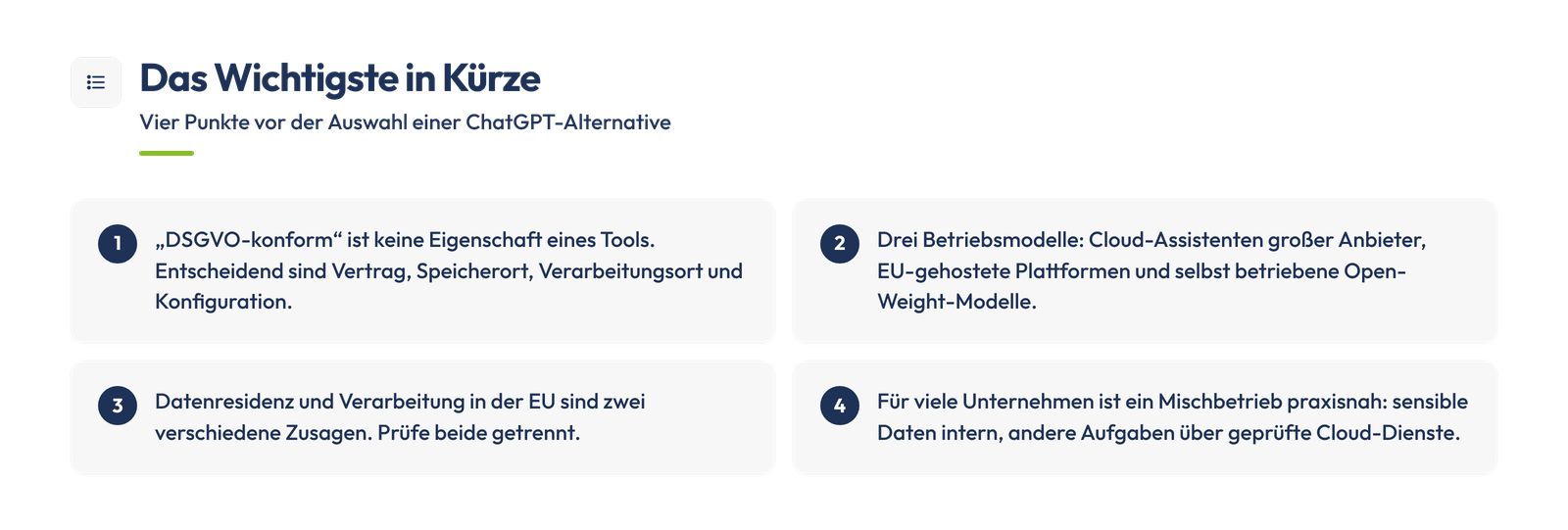
“GDPR-compliant” is not a feature of a tool. What matters are the contract, storage location, processing location, and configuration.
There are three operating models: cloud-based assistants from major U.S. providers, EU-hosted services, and self-operated open-source models.
Data residency and processing within the EU are two distinct commitments. Review both separately.
For many companies, a hybrid approach makes practical sense: sensitive data stored internally, while other tasks are handled via vetted cloud services.
Why Are Companies Looking for a ChatGPT Alternative?
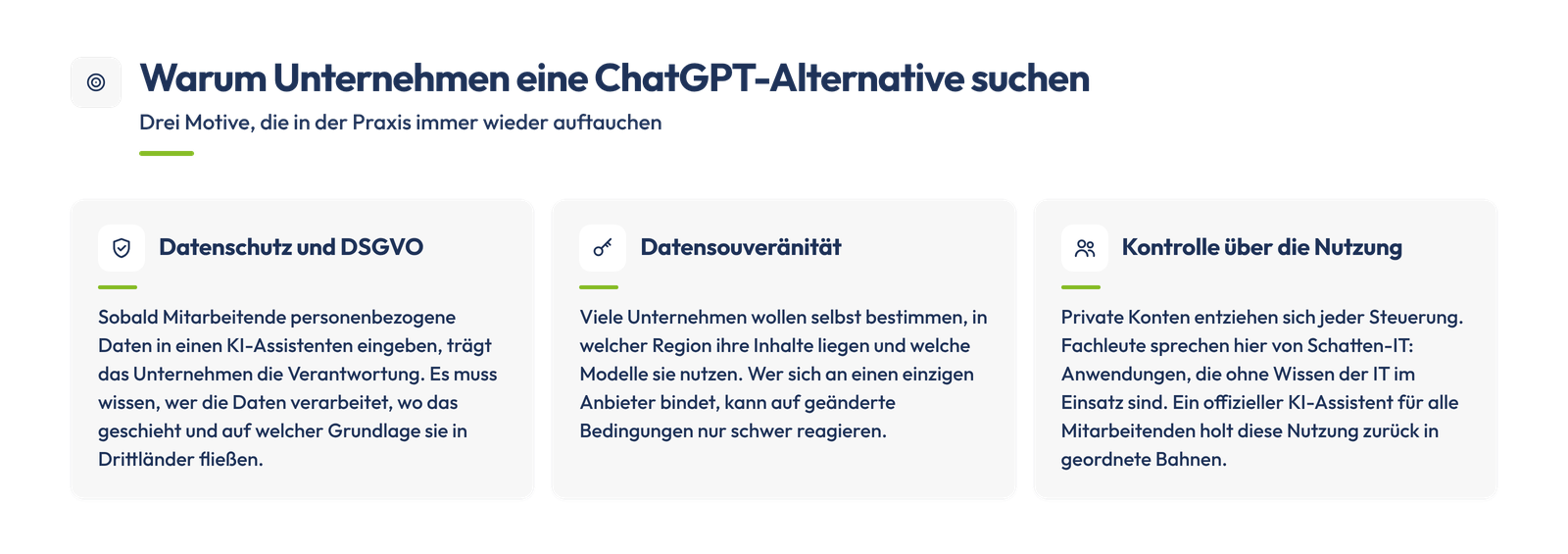
Companies usually look for a ChatGPT alternative not because of poor answers, but because they need control over data, contracts, and dependencies.
Data Protection and the GDPR
As soon as employees enter personal data into AI chatbots, the company is responsible for data processing under the GDPR.
Data Sovereignty
Many companies want to decide for themselves in which region their files and documents are stored and which AI models best suit their work.
Control Over Usage
Private accounts, freely used AI tools, and chatbots in personal apps are beyond any control. Experts refer to this as “shadow IT”—that is, applications used without the IT department’s knowledge. An official AI assistant with regulated access for all users on the team brings them back under control.
Our LLM Guide to AI chatbots, tools, and models explains which LLMs are best suited for tasks such as research, writing emails, or analyzing images and files.
Can ChatGPT be used by businesses in compliance with the GDPR?
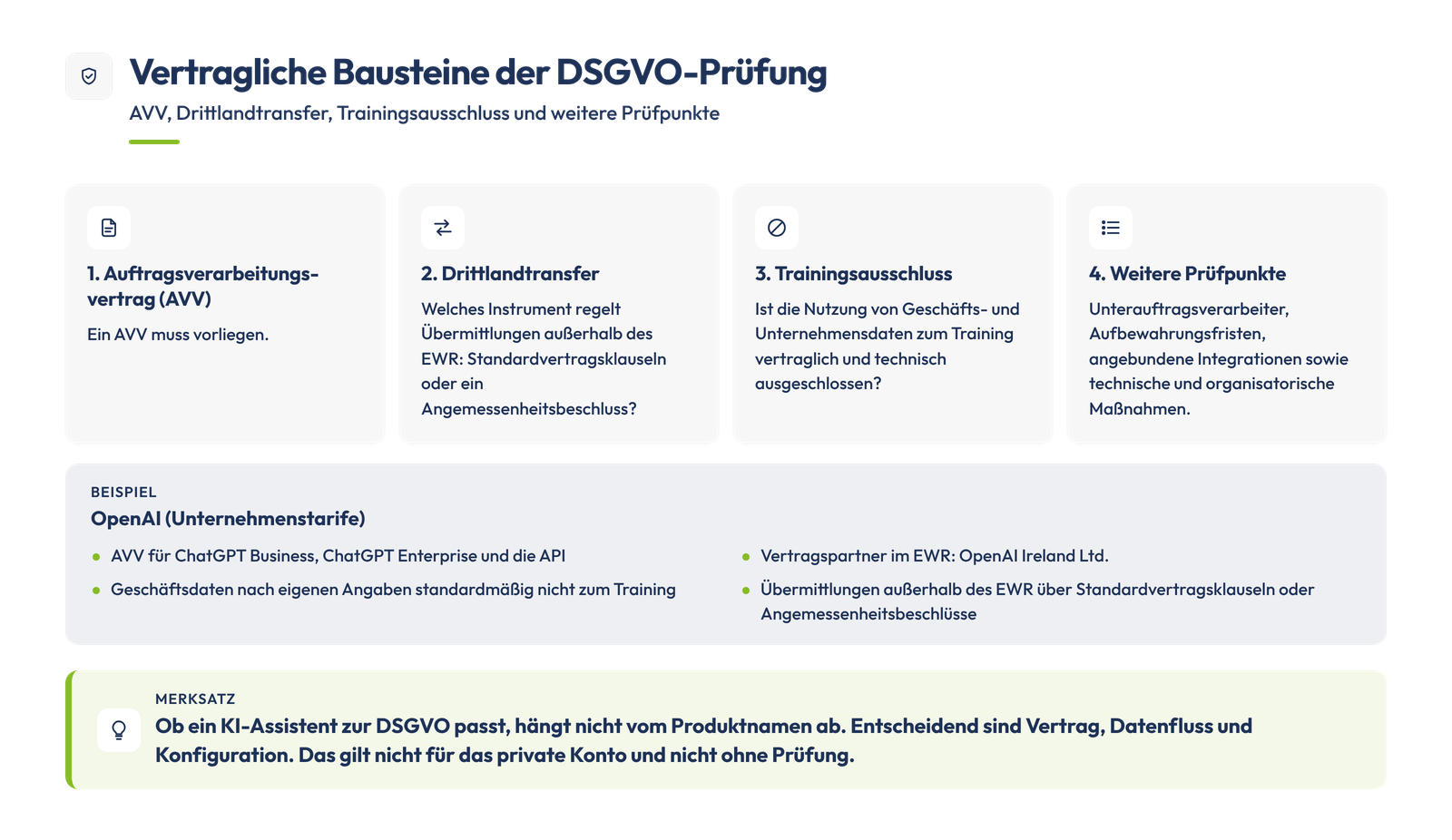
In principle, yes, but not with a personal account and not without an assessment. The key factors are the use case, the contract, the data flow, and the configuration—for ChatGPT as with any other AI chatbot.
OpenAI offers a Data Processing Agreement (DPA) for ChatGPT Business, ChatGPT Enterprise, and the API. The contracting party for customers in the European Economic Area (EEA) is OpenAI Ireland Ltd. According to the provider, business data is not used for training by default.
Storage Region Is Not the Processing Location
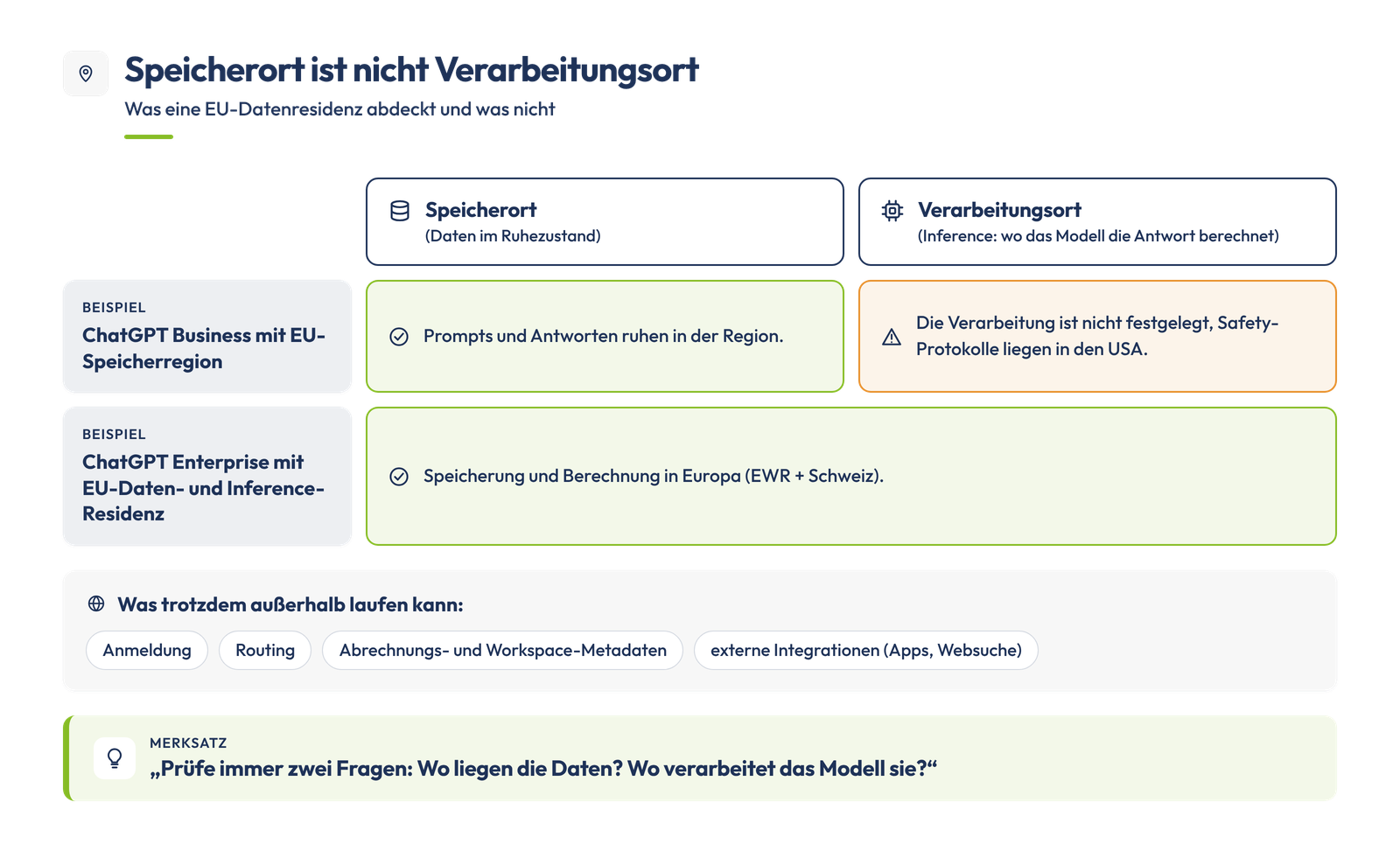
With ChatGPT Business (formerly ChatGPT Team), the selected storage region only determines where the chat history—including prompts and responses—is stored. It does not determine where the model processes it.
Inference Residency for ChatGPT Enterprise
For ChatGPT Enterprise, there is also inference residency in Europe: servers in the selected region process the requests.
It’s best to always ask two questions: Where is the data stored? And where does the AI process it? Other factors to consider include subcontractors, retention periods, connected tools and apps, as well as your technical and organizational measures.
What kinds of ChatGPT alternatives are there?
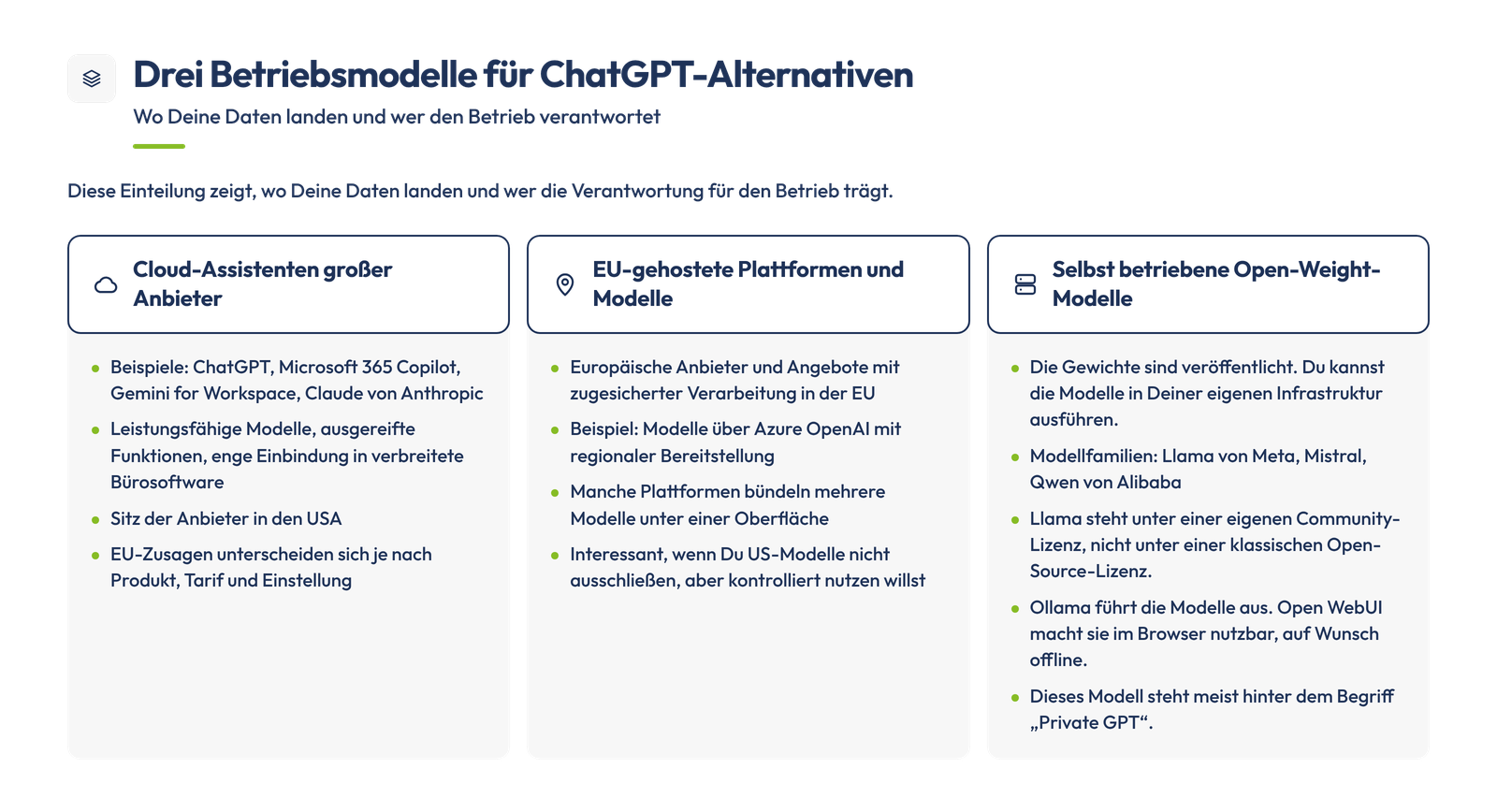
ChatGPT alternatives and other AI assistants can be categorized into three operating models.
Cloud-based assistants such as Microsoft 365 Copilot, Gemini, and Claude
These AI assistants include ChatGPT itself, Microsoft 365 Copilot, Google’s Gemini for Workspace, Anthropic’s Claude, and Perplexity AI for research. They offer many AI features and tight integration with Office tools and apps, as well as—increasingly—AI agents for multi-step tasks.
EU-hosted AI tools and services
These include offerings with guaranteed processing within the EU, such as GPT via Azure OpenAI with regional deployment.
Self-hosted open-weight and open-source models
Open-weight models are language models for which the provider publishes the weights. You can download them and run them on your own infrastructure. Well-known model families include Llama from Meta, Mistral, Qwen from Alibaba, and DeepSeek. It’s best to check the license, as not all of them are true open-source models: Llama, for example, is licensed under its own community license.
AI tools like Ollama run open-weight and open-source models. Interfaces like Open WebUI make them usable for team collaboration as a browser-based chat. Our article on how to run AI locally provides more details on this approach.
GPT4YOU: The ChatGPT Alternative for Businesses That Offers Full Control
GPT4YOU is FIDA’s multi-LLM platform for generative AI with a ChatGPT-like interface; the technology behind it is Open WebUI. According to FIDA, you can “integrate OpenAI, Claude, Deepseek, Mistral, and other models in parallel—and centrally control which model is assigned to which team, agent, or use case.” This allows you to use all AI models in one place and select the LLM that best fits each task.

Cloud, hybrid, or on-premises deployment
GPT4YOU runs in the cloud, in a hybrid environment, or entirely on-premises on your own hardware—whichever you prefer. It can be connected to, for example, Microsoft Azure, AWS Bedrock, OpenAI-compatible interfaces, or local open-source language models. The use of your content to train the language models is contractually excluded from the agreed scope of services.
AI models you can use in GPT4YOU: Claude, DeepSeek, Mistral, and more
GPT via Microsoft Azure: available in the EU upon request.
Claude by Anthropic: Anthropic cites writing and text analysis as its strengths. Current versions of Claude can process up to one million tokens of context, meaning very long documents.
DeepSeek-R1: According to DeepSeek, it is designed for logical thinking and programming and is released under the MIT license.
Mistral: The French provider hosts customer data in the EU by default and releases several models under the Apache 2.0 license, which you can customize. Its AI assistant, Mistral Vibe, uses the “Knowledge” memory feature to remember preferences and context from your chat history upon request.
Qwen from Alibaba and other open-source LLMs for on-premises deployment.
AI Features for Documents, Research, and Workflows
GPT4YOU is also a multi-agent solution with more than ten pre-built AI agents and RAG: The AI assistant answers questions using your internal documents and files as sources. You can create documents and images, transcribe audio, translate text, and use OCR as well as a prompt library. For research, there’s a web search similar to what you’d find in Perplexity AI. Perplexity AI combines language models with real-time web search and cites sources. Through integrations, the chatbot gains access to tools and apps such as CRM systems (e.g., HubSpot), ERP, project management, email, and accounting.
An Official AI Chatbot Instead of Shadow IT
Users can log in via LDAP or SSO. Using user and group permissions, you can centrally control which users have access to which language models, knowledge bases, and features—such as AI tools—and replace private accounts with an official AI chatbot. The multilingual interface can be adapted to accessibility requirements, such as the BITV for government agencies. In practice, TÜV Thüringen, for example, uses GPT4YOU for local transcription.
What GPT4YOU Is Not
GPT4YOU is not a standalone language model. The quality of the responses depends on the LLM used and the use case; in critical processes, your team reviews the results. Local language models require sufficient hardware.
How do the operating models compare in terms of data protection, model selection, integration, and operation?
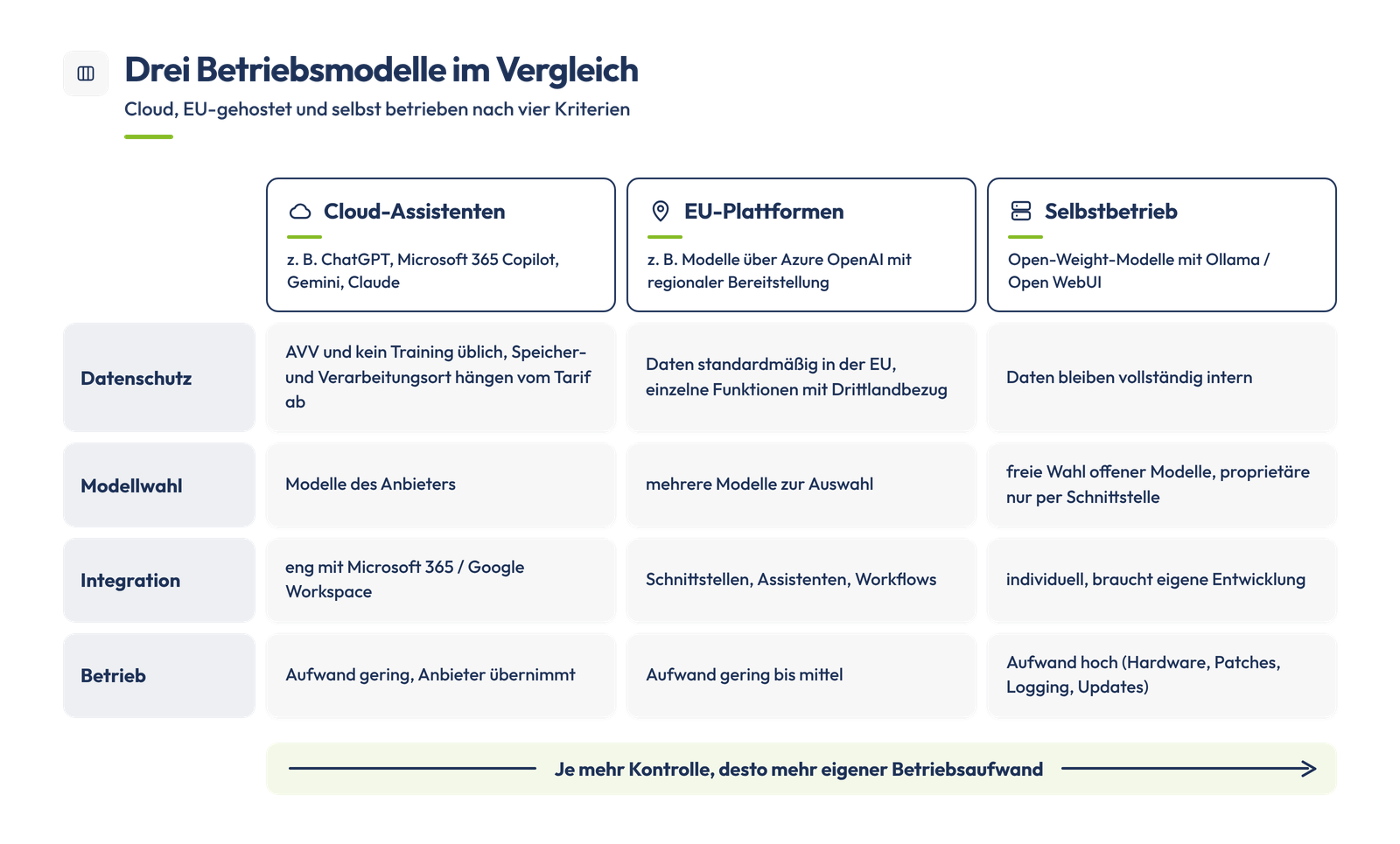
Cloud assistants score well in terms of features and integration; EU-based offerings excel in data protection and model selection; and self-hosting offers greater control.
Data Protection and Data Processing
Cloud assistants: Data processing agreements (DPAs) in accordance with the GDPR and the exclusion of training are standard in enterprise plans; storage and processing locations depend on the plan and configuration.
EU platforms such as Mistral Vibe: By default, data is stored in the EU, though individual functions can still be transferred to service providers outside the EU.
On-premises deployment: Data remains entirely internal; access and logging are entirely up to you.
Model Selection and AI Providers
Cloud assistants: You typically use the provider’s models—for example, Gemini from Google or Claude from Anthropic.
EU platforms: Multi-LLM solutions offer several LLMs to choose from, including some U.S. models hosted in the EU.
Self-hosting: You’re free to choose from open-source models. You integrate proprietary LLMs like GPT or Claude only via APIs.
Integration and AI Features in Workflows
Cloud assistants: Copilot and Gemini are tightly integrated with Microsoft 365 or Google Workspace and, within the scope of permissions, have access to emails, chats, documents, and apps.
EU platforms: You connect systems via APIs, assistants, and workflows.
Self-hosted: You integrate AI tools, documents, and workflows individually, but this requires developers on your own team.
Operation, Security, and Support
Cloud assistants: The provider handles updates, scaling, availability, and support.
EU platforms: The effort required is low to moderate.
In-house operation: Hardware, patches, logging, updates, and quality assurance are your team’s responsibility.
What You Should Check With Major Cloud Providers
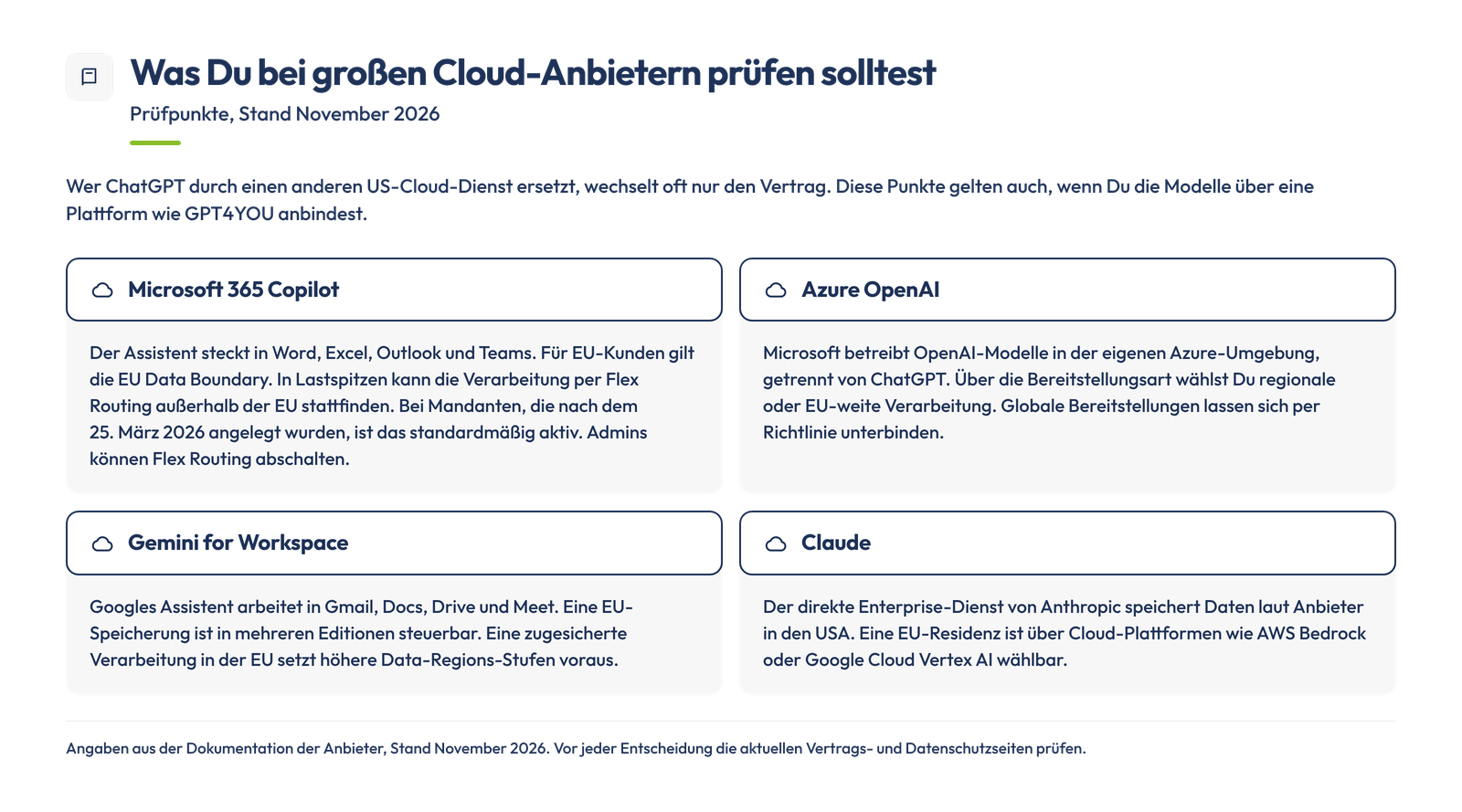
If you replace ChatGPT with another U.S. AI provider, you’re often just switching contracts. These points also apply if you integrate models from these providers via GPT4YOU:
Microsoft 365 Copilot: The EU Data Boundary applies to EU customers. However, during peak loads, Copilot may process requests outside the EU via Flex Routing. For tenants created after March 25, 2026, this is enabled by default. Admins can disable Flex Routing.
Azure OpenAI: Microsoft runs the GPT models in its own Azure environment, separate from ChatGPT. You can choose between regional or EU-wide processing via the deployment type.
Gemini for Workspace: Google’s assistant works in Gmail, Docs, Drive, and Meet. EU storage can be configured in several Google editions. Guaranteed processing within the EU requires higher Data Regions tiers.
Claude: According to Anthropic, this direct enterprise service stores data in the U.S. EU residency can be selected via cloud services such as AWS Bedrock or Google Cloud Vertex AI.
Privacy-focused AI assistants like Lumo from Proton: According to Proton, Lumo is developed and hosted in Europe, does not log chats, stores chat histories with zero-access encryption that only users themselves can read, and uses open-source models. Verify such claims as you would with any provider. With GPT4YOU running on your own infrastructure, you have this control in your own hands.
All information is taken from the providers’ documentation, as of November 2026. Features and prices change frequently, so be sure to check the most recent sources.
Which ChatGPT alternative is right for your business?
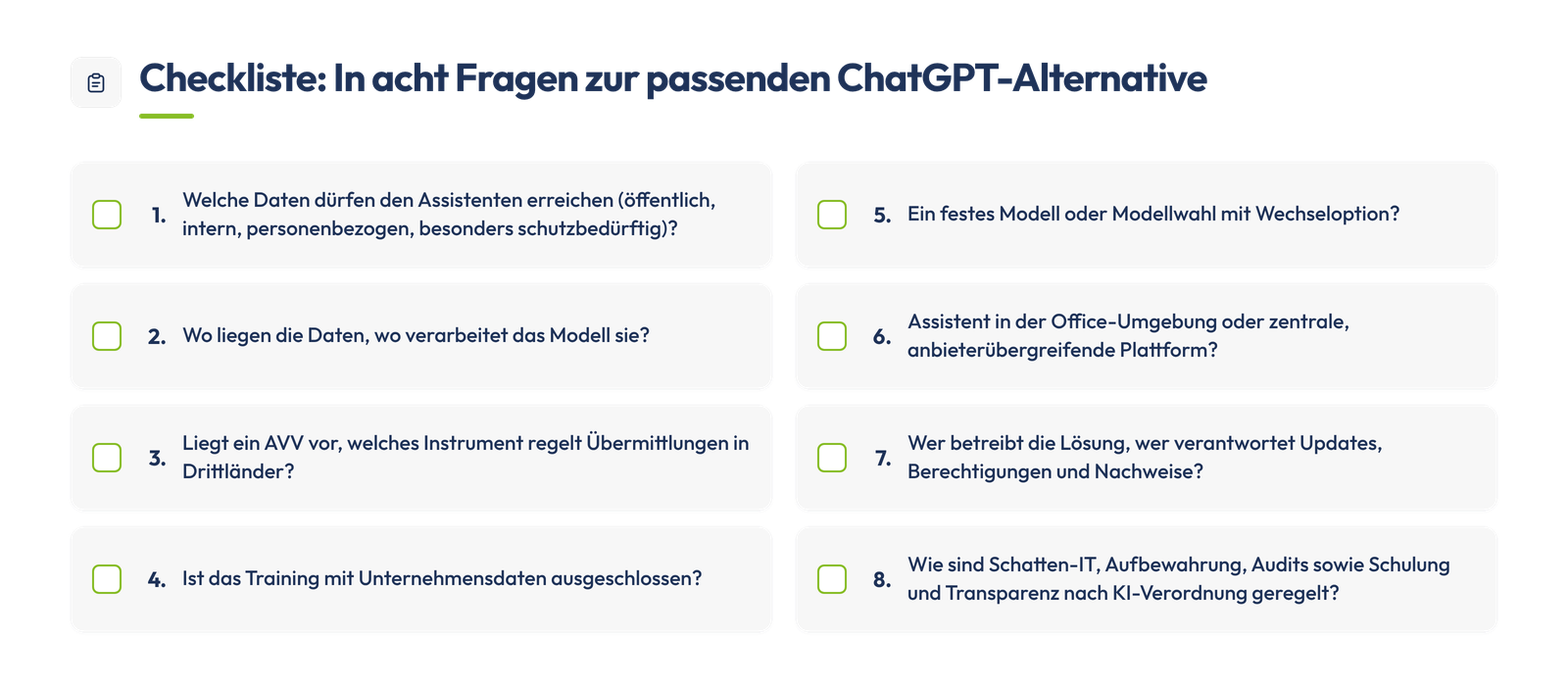
The best ChatGPT alternative depends on your data, your IT infrastructure, your resources, and your requirements—not on a ranking. Work through these eight questions step by step:
What kind of information is allowed to reach the chatbot at all: public, internal, personal, or particularly sensitive?
Where is the data located, where does the model process it, and which protocols or integrations cross this boundary?
Is there a data processing agreement in place, and what mechanism governs data transfers to third countries under the GDPR?
Is training using your company’s data contractually and technically prohibited?
Do you need a fixed model, or do you want to be able to choose models and switch later?
Should the assistant operate within your Office environment or as a centralized, cross-vendor solution?
Which team operates the solution, and who is responsible for updates, permissions, and compliance documentation?
How do you manage shadow IT, data retention, audits, as well as training and transparency in accordance with the AI Regulation?
Typical Patterns
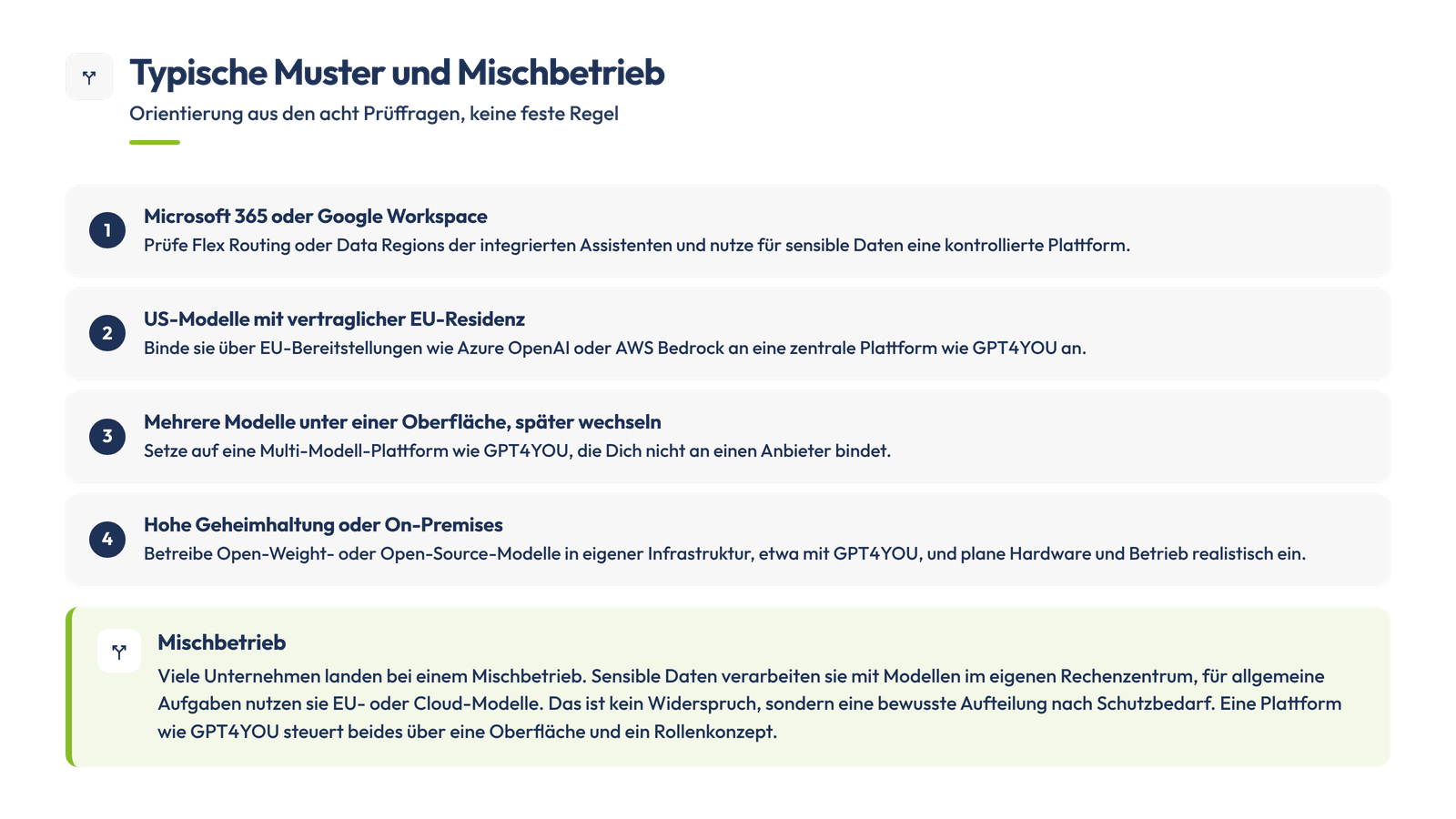
The responses reveal typical patterns, but no hard-and-fast rules:
If you work with Microsoft 365 or Google Workspace: Check out Flex Routing in Copilot or Data Regions in Gemini, and use a controlled solution for sensitive data.
If you need U.S. models with contractual EU residency: Integrate them centrally into GPT4YOU via EU deployments such as Azure OpenAI or AWS Bedrock.
You want to use multiple models under a single chat interface and be able to switch between them later: Rely on a multi-model platform like GPT4YOU that doesn’t lock you into a single provider.
You have strict confidentiality requirements or need to run the system on-premises: Run open-source models on your own infrastructure—for example, with GPT4YOU—and plan for hardware and operations realistically.
Hybrid Operation Based on Security Needs
For many companies, a hybrid approach works best. They process sensitive data using LLMs in their own data center, while using EU-based or cloud services for general tasks such as research. GPT4YOU manages both through a single interface and a role-based system.
What does the EU AI Regulation require of internal AI assistants?
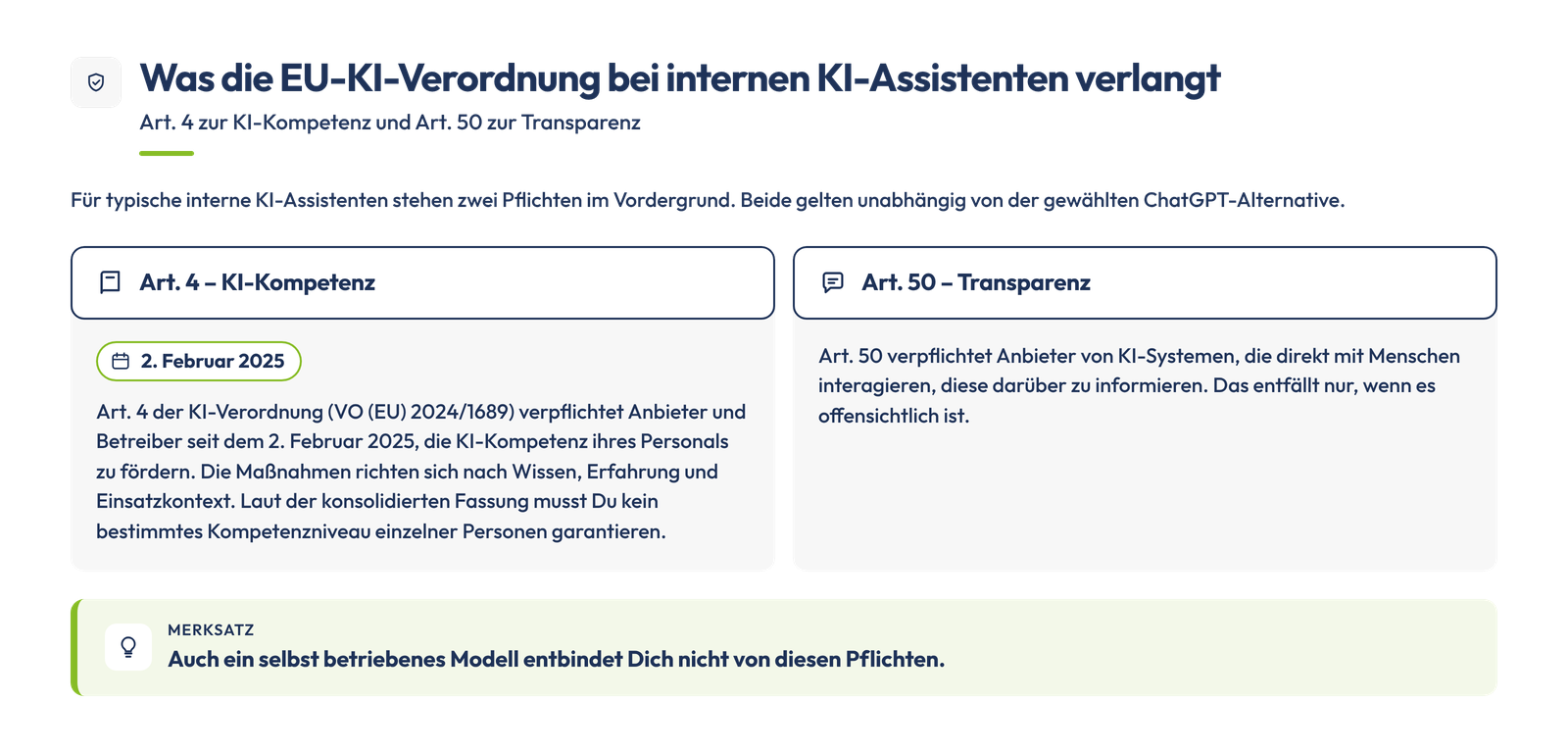
For typical internal AI assistants and chatbots, two requirements are paramount: AI expertise within the team and transparency toward users.
Art. 4: AI Competence Within the Team
Article 4 of the AI Regulation (Regulation (EU) 2024/1689) requires providers and operators, effective February 2, 2025, to promote AI competence among their staff.
Art. 50: Transparency for Users
Article 50 requires providers of AI systems that interact directly with humans—such as chatbots—to inform users of this fact. This requirement does not apply if it is already obvious.
Conclusion: Finding the Right Alternative Starts with Your Data
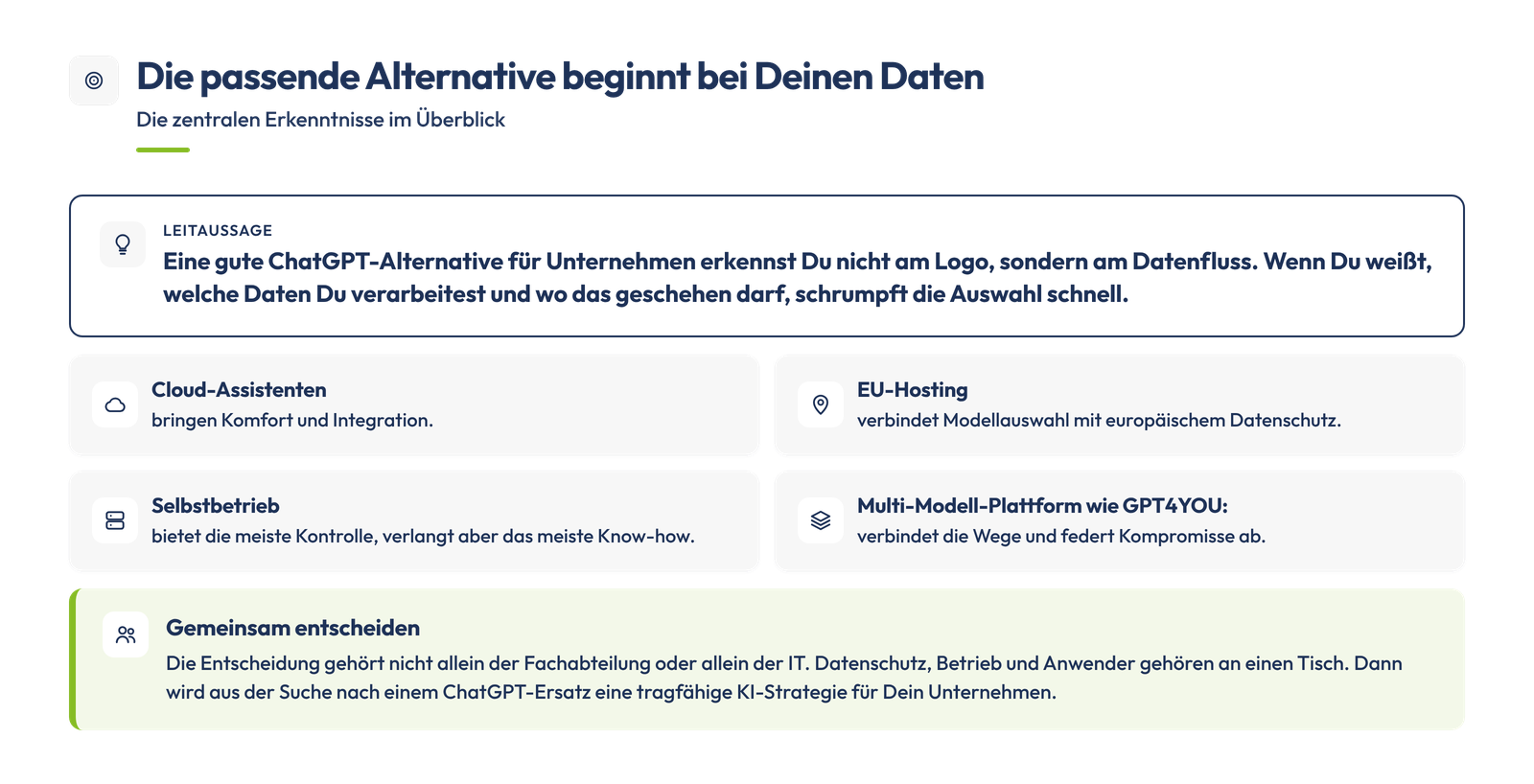
You can’t tell a good ChatGPT alternative for businesses by its logo, but rather by its data flow. Cloud assistants like Microsoft Copilot, Google Gemini, or Claude offer convenience, a wide range of features, and seamless integration. EU-based hosting combines model selection with European data protection standards. Self-hosting offers the most control but requires the most expertise. Every choice involves trade-offs, which a multi-model platform like GPT4YOU can help mitigate.
It’s best for the business unit, IT, data protection, and future users to make the decision together as a team.
If you want to replace ChatGPT with controlled AI assistants in your company, we'd be happy to show you how GPT4YOU best fits your use case.
Frequently Asked Questions About the ChatGPT Alternative for Businesses
Choose the solution that best fits your data, requirements, and IT environment. In Microsoft 365 or Google Workspace, start by checking the privacy settings for Microsoft Copilot or Google Gemini. For data sovereignty and the freedom to choose your model, GPT4YOU combines cloud-based models and local open-source language models into a single interface.
It is usually not a specific product, but rather a company-owned, GPT-like chatbot with controlled data and internal knowledge sources—often a self-hosted Open-Weight model with Open WebUI. GPT4YOU implements this approach for businesses.
AI tools such as Ollama and Open WebUI are open source and free of charge. According to its license, Open WebUI requires an additional enterprise license if you want to use your own logo or branding and have more than 50 users within a 30-day period. For enterprise use, however, there are still costs and expenses associated with infrastructure, operations, security, and maintenance. Free consumer versions of well-known chatbots, such as those from Google or Microsoft, are not suitable for confidential or GDPR-relevant information.
Traditional chatbots provide answers. AI agents are AI functions that perform multi-step tasks within workflows: they launch tools, search through documents and files, or draft emails. To get started, an AI chatbot with access to internal information is often sufficient. For agents, you need clear rules regarding functions and access.


