
AI Agents on the Team: How Humans and Agents Can Work Together Successfully in Everyday Life
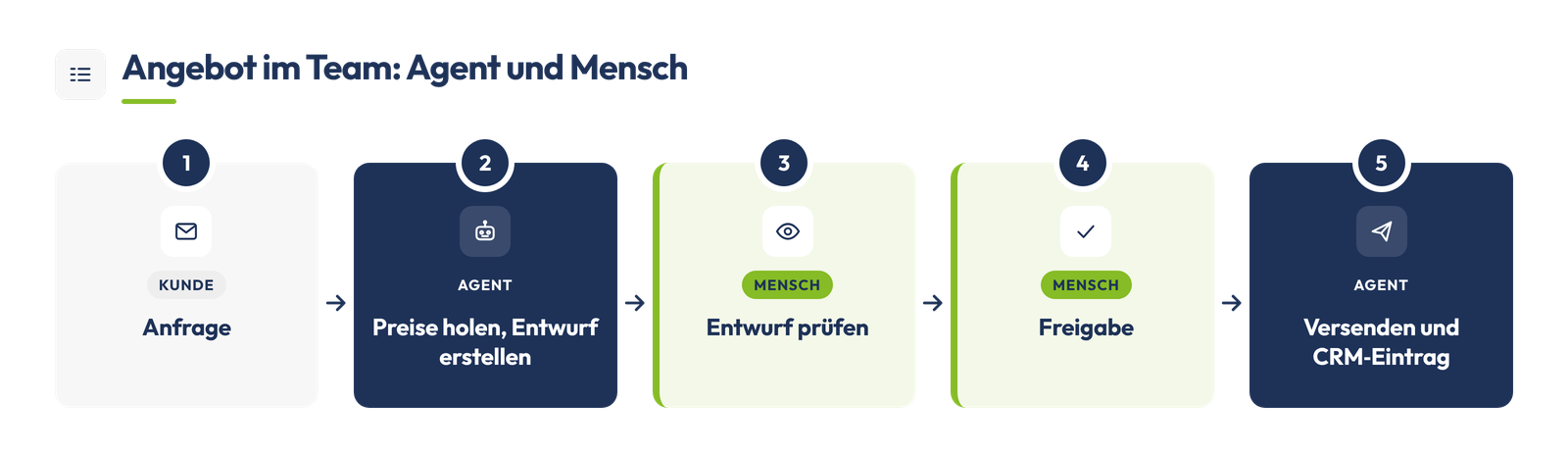
In the morning, an AI agent starts up in the sales department. It reads a customer’s email and retrieves the appropriate prices from the price list. It then drafts the quote and submits it for approval. The sales manager reviews it, tweaks a sentence, and approves it.
This article is aimed at decision-makers as well as subject matter and IT experts in companies and organizations. It explains how AI agents are changing roles and responsibilities and how you can implement them step by step. According to a 2026 Bitkom study, 57 percent of companies in Germany now use artificial intelligence. The idea behind it: Agents take over routine tasks, while you retain decision-making authority. The transition is successful when done side by side with colleagues.
Key Takeaways
An assistant delivers a result. AI agents carry out entire processes.
Responsibility remains with humans, even when the agent is working.
What is the difference between an AI agent and an assistant?
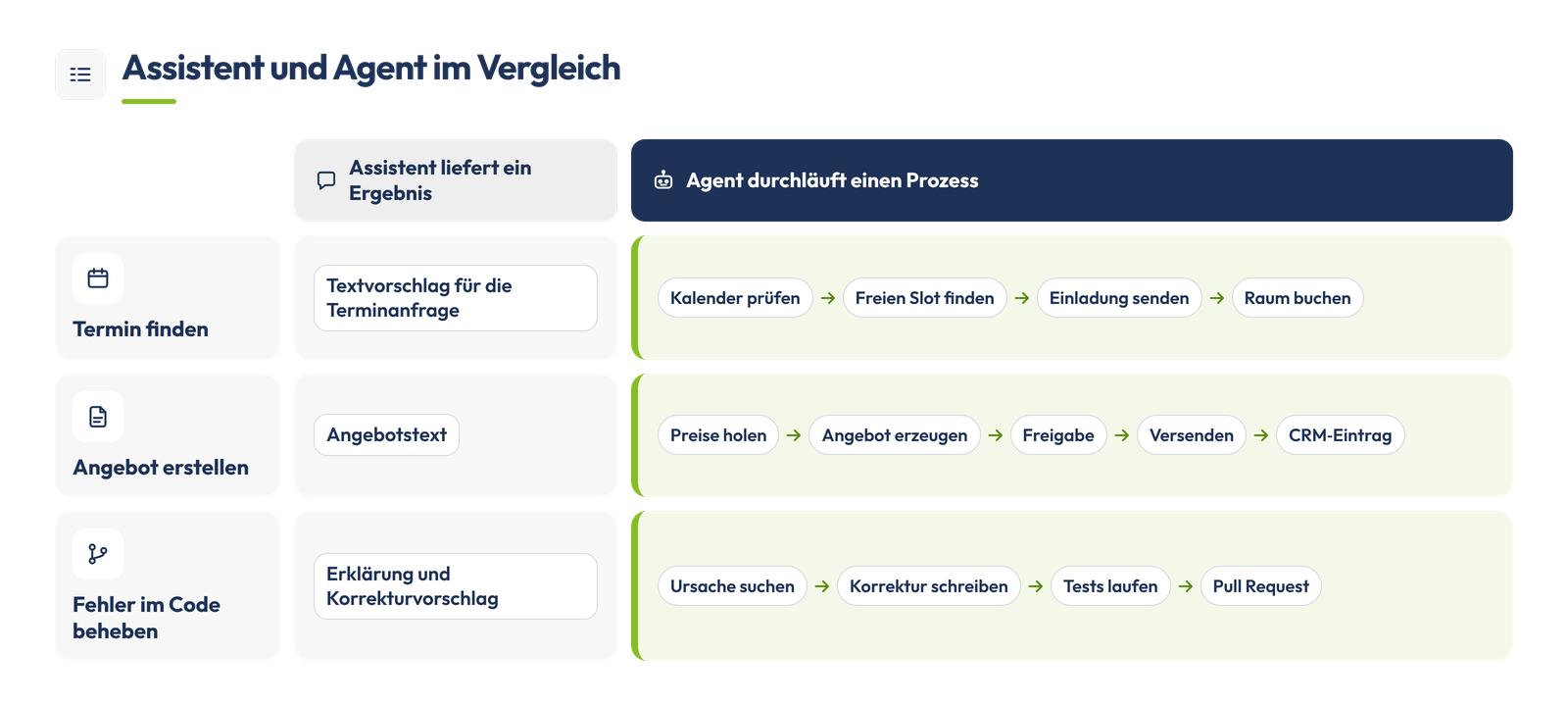
An assistant provides the result of a query; an AI agent carries out a process. The assistant responds to individual questions, and you control every step. An agent is given a goal, plans the steps, uses data and tools, and asks for clarification when needed. In English, they’re called AI agents; in German, KI agents. The vision: artificial intelligence works as part of a team. This allows AI agents to automate even complex, multi-step workflows.
This gives artificial intelligence the freedom to act. Modern agents combine language models (Large Language Models, or LLMs for short) with other system components. According to IBM, they perform tasks autonomously and learn from previous interactions. Their autonomy has limits that you set. Three examples:
Scheduling a meeting: The assistant drafts a text proposal. The agent checks all calendars, sends the invitation, and books the room.
Creating a quote: The assistant provides a draft quote. The agent compiles prices, submits the quote for approval, and enters it into the CRM after it’s sent.
Fixing errors in the code: The assistant suggests a correction. The agent searches for the cause in the repository (code storage), runs the tests, and opens a pull request—that is, a request to merge the change.
How does a team change when AI agents are part of the team?
When AI agents join the team, tasks, roles, and coordination shift. Artificial intelligence changes the way we work and requires new skills. Here are four changes you’ll notice right away:
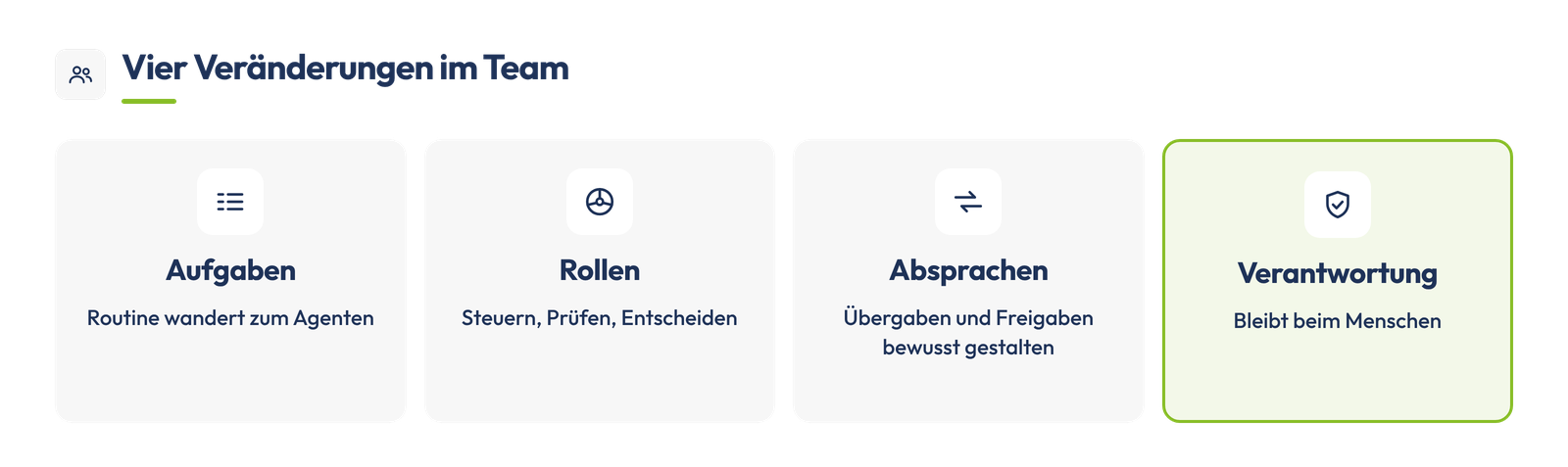
Tasks: Routine and preparatory work are handled by the agent. It gathers information and takes over data analysis and the creation of drafts. Employees gain more time to focus on complex cases.
Roles: The focus shifts from execution to oversight: Specialists review work and make decisions. This requires subject matter expertise, an understanding of the context, and new skills.
Coordination: You consciously manage handoffs and approvals. Without clear coordination, gaps will arise.
Responsibility: The agent carries out the steps. People remain accountable for the outcome.
Case Study: How Do AI Agents Support Weather Reports on the Radio?
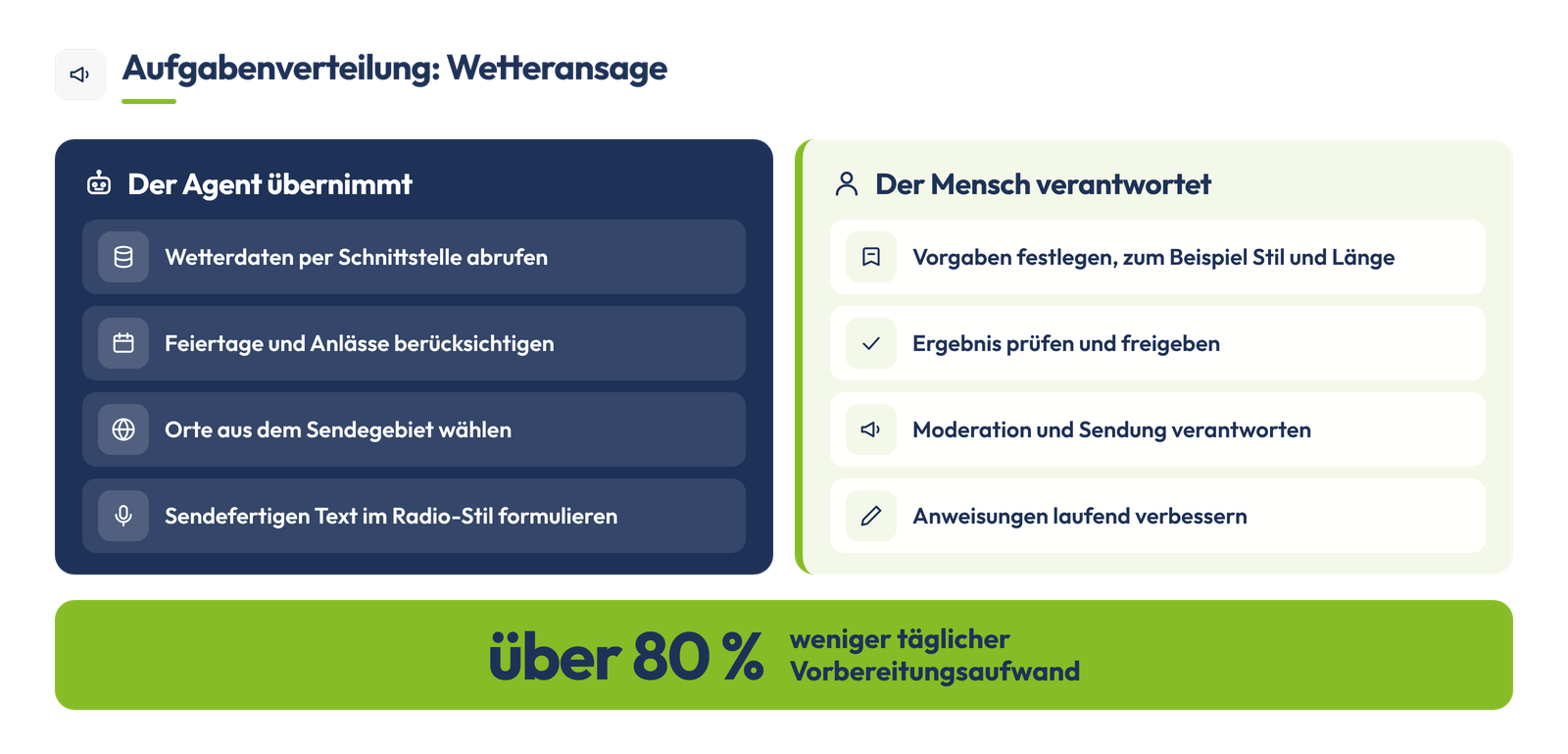
A regional leader in broadcasting has automated its weather reports using an AI agent. Previously, the editorial team would gather weather data from various sources each morning and write individual scripts in a radio-style format. This was time-consuming, and the style and quality varied. The goal: to generate the report at the push of a button.
The agent retrieves weather data via an API, takes holidays into account, selects locations within the broadcast area, and formulates the text ready for broadcast. The editorial team defines the style and length, reviews, approves, and refines the specifications.
The result: The daily preparation effort was reduced by over 80%.
How do you structure your collaboration with AI agents?
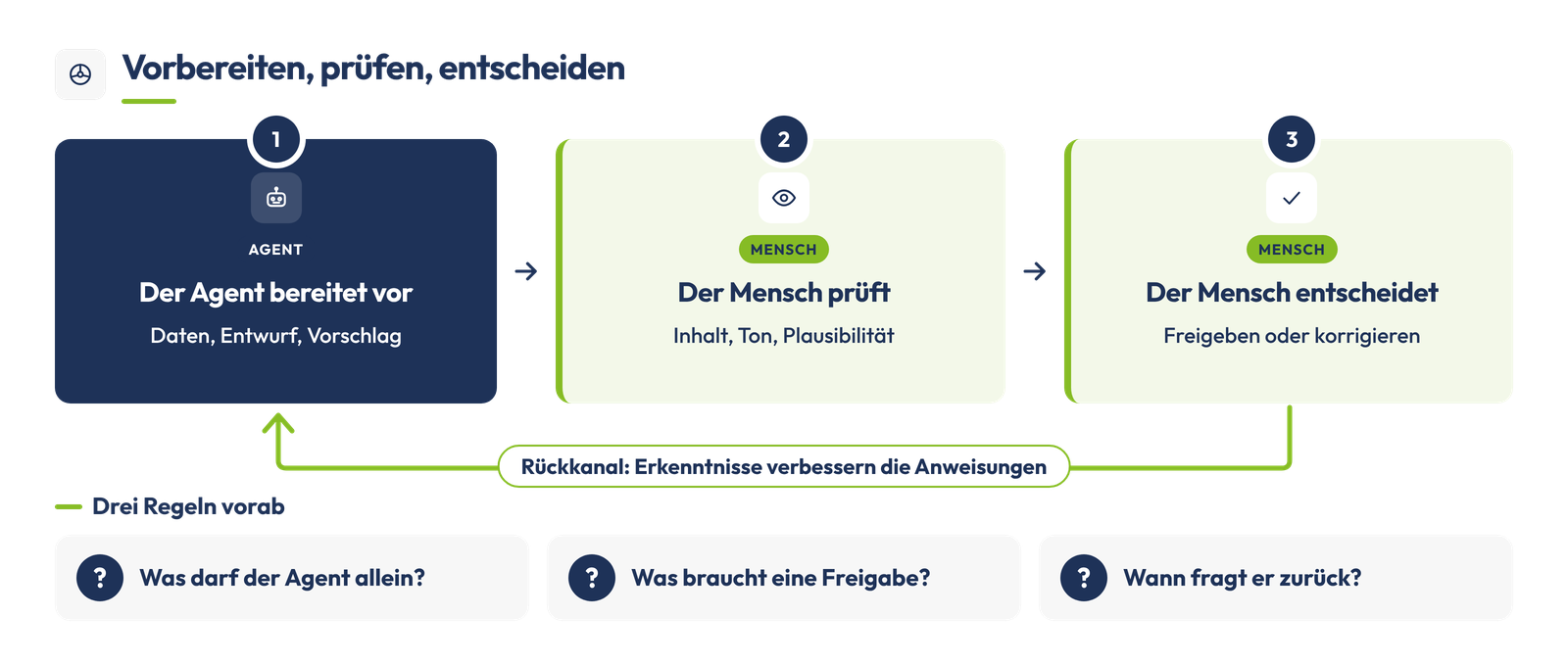
Break the work down into three steps plus a feedback loop. The goal: to lighten the load without losing control. The agent learns from the review: insights improve its instructions and optimize the workflow.
The agent prepares the work. It provides data, a draft, and a proposal.
The human reviews. They check the content, tone, and plausibility.
The human makes the decision. They approve or make corrections.
What three rules do you clarify in advance?
What is the agent allowed to do on their own?
What requires approval?
When does the agent ask for clarification?
What are some examples of AI agents in everyday life?
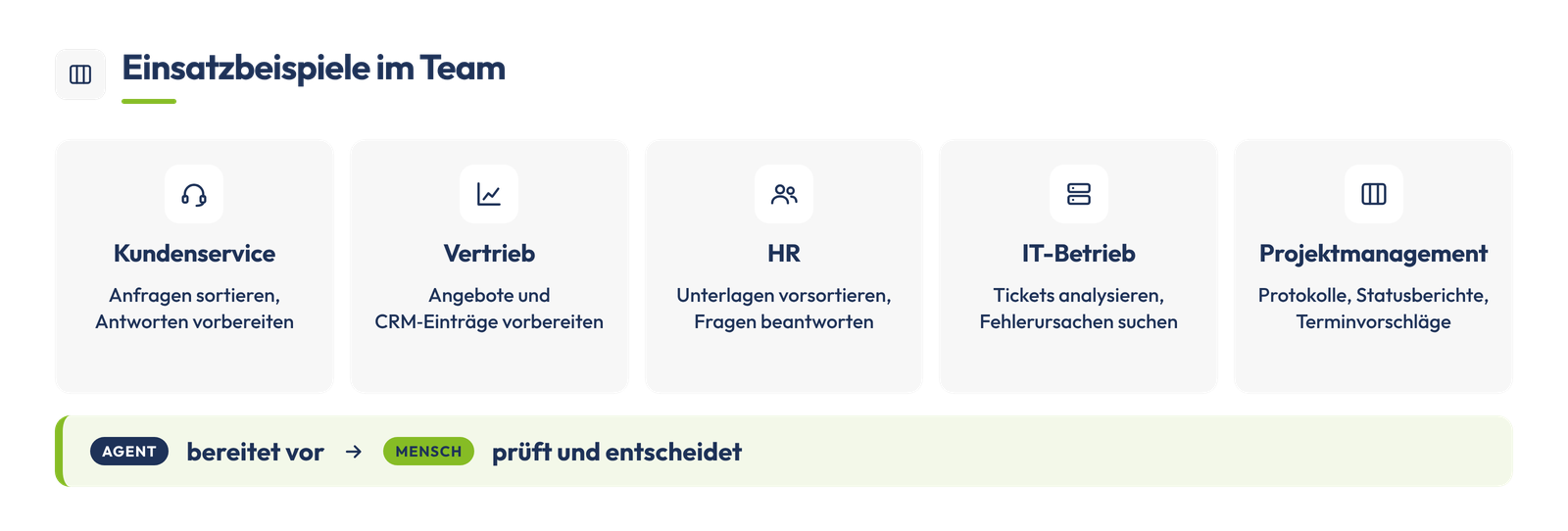
AI agents are used in many industries. Fraunhofer IESE describes pilot projects in public administration, such as ticket issuance. The GDV cites AI-supported invoice verification in the insurance industry, where humans review the results. They are most effective for recurring tasks. Business processes with clear rules are particularly well-suited. Agents work with tools such as email, calendars, and CRM systems and offer practical solutions. When used correctly, this can increase efficiency and productivity within a company.
Customer Service: The systems sort inquiries and prepare responses via email.
Sales: The systems prepare quotes and CRM entries (CRM: customer relationship management system).
HR: It pre-sorts documents; decisions remain with the relevant department, saving them time.
IT Operations: The systems analyze tickets in the system and identify root causes.
Project Management: The systems generate meeting minutes and status reports.
How do AI agents help with IT security?
A security department receives thousands of alerts every day. Agents filter out false positives, provide additional context, and prioritize alerts. Unlike humans, they don’t get tired and can work around the clock. This can reduce the workload and help combat alert fatigue. According to Bitkom, AI can help detect anomalies early on. The BSI considers the active use of AI tools in code security to be essential. Agents can thus help identify anomalies sooner and reduce the mean time to detect (MTTD).
What are multi-agent systems?
In complex processes, several specialized agents work together: one researches, one writes, and one verifies. More capabilities require more control: In a multi-agent system, each agent is assigned a clear role within the architecture.
How can you create and implement AI agents?
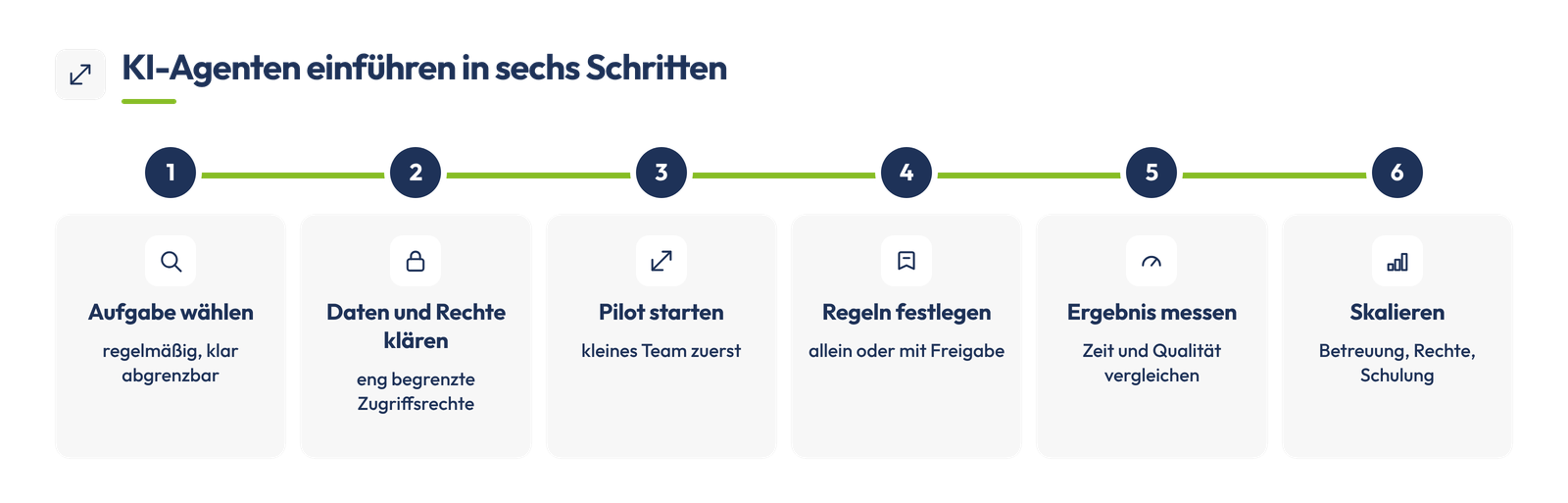
Follow these six steps. You can create them without writing any code: Using no-code tools, you can build your first workflows and processes yourself.
Choose a task: Look for a clearly defined task with a measurable goal.
Clarify data and permissions: Integrate systems only with strictly limited permissions (APIs) and a clearly defined role, even for tools like CRM.
Launch a pilot: Test the implementation in one department. The goal of the pilot: to learn and gain experience with minimal risk.
Set guidelines: Define the extent to which agents can act independently and what the AI should not do.
Measure results: Compare time spent and quality.
Scale up: Plan for growth early on, including the automation of additional workflows and training.
According to Fraunhofer IESE, technical implementation relies on large language models (LLMs) and process automation, as well as interfaces (APIs). This is complemented by integrations with your systems, the automation of workflows, and a robust architecture. If you prefer to work via a user interface, choose a platform with chat and tools. This also makes it easier to develop your own agents.
What common startup pitfalls should you avoid?
One problem is storing personal data in tools that aren’t approved for that purpose. Other issues include blind trust in results, imprecise prompts (inputs to the AI), a lack of boundaries for the AI, and planning for scaling and costs too late in the process.
How do you get employees on board?
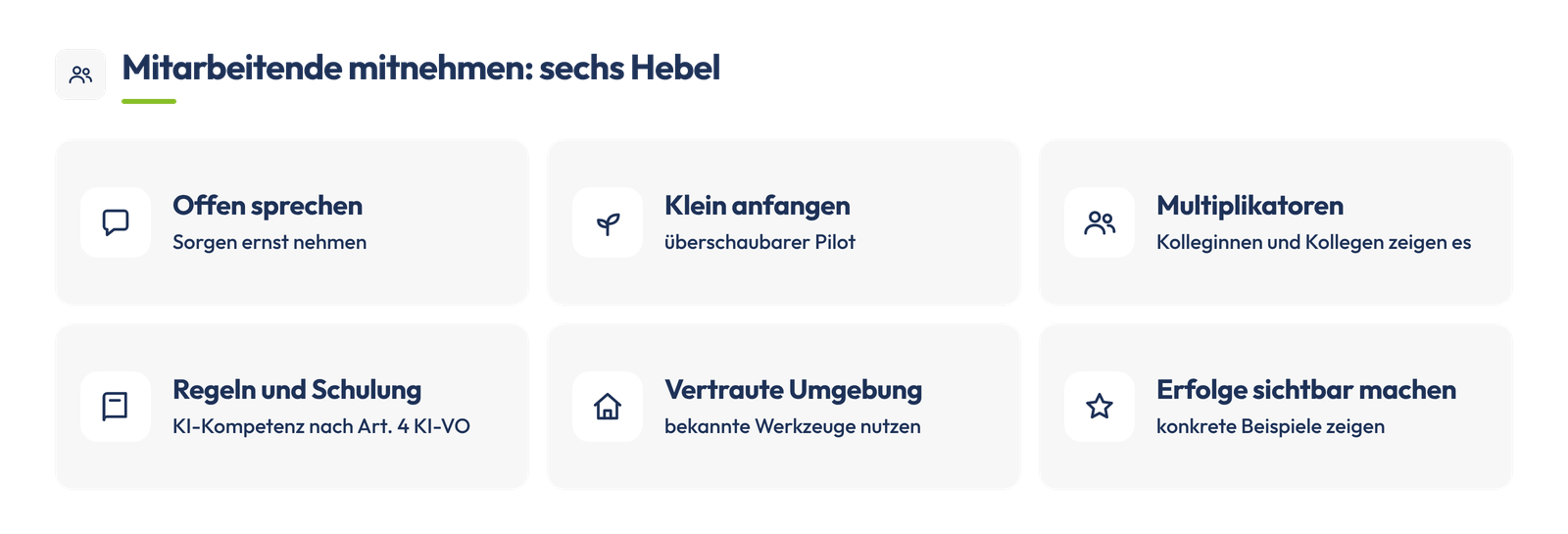
Talk openly about concerns regarding artificial intelligence, such as job security, data security, or dependence on U.S. corporations. Solutions include European AI models like Mistral and small, local models. Start small, gain experience, and let everyone learn at their own pace. Enlist key advocates who can convince other colleagues. Since February 2025 , Article 4 of the AI Regulation has required staff to have sufficient AI competence. Training builds understanding and skills. Use familiar tools and showcase successes.
What are the obstacles, and what kind of environment do you need?
AI experiments only provide support when the environment is right. Otherwise, users will go their own way, which poses a problem for data protection. A shared platform also helps with sharing results—for example, when multiple employees use the same agent.
How do you handle data protection and regulation?
AI agents are subject to the GDPR and the AI Regulation, i.e., Regulation (EU) 2024/1689. Article 14 requires human oversight for high-risk systems. Also, clarify where your data is processed and review each system.
Which platforms are suitable for AI agents in a business setting?
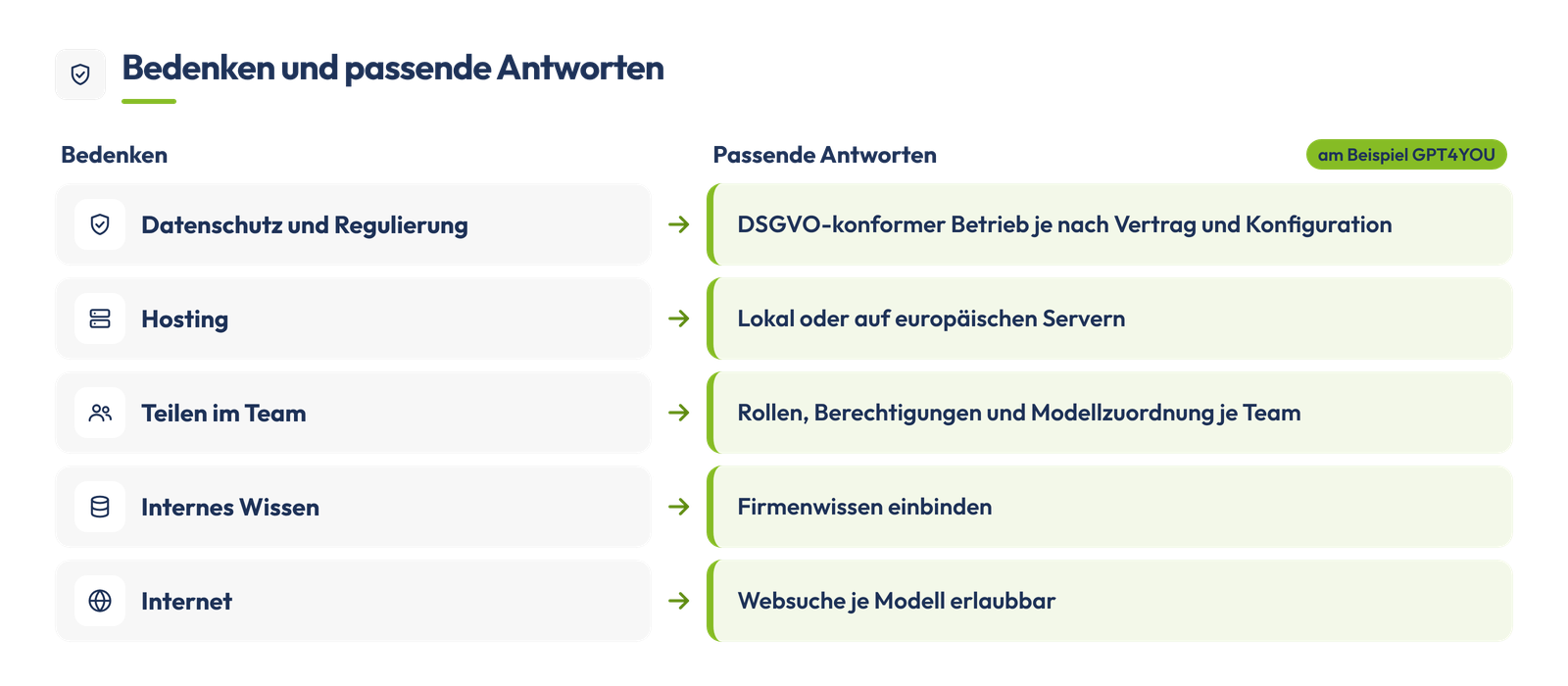
Platforms bundle models, agents, integrations, and solutions. GPT4YOU from FIDA is one option among several. These include:
Operate locally on your own hardware or on European servers
Groups, roles, and permissions, as well as model assignment per team
Integration of company knowledge
10+ pre-built agents
Integration with existing business applications
Web search for research; internet access can be configured as desired
Work with AI models from OpenAI (via Microsoft Azure), Claude, and Deepseek all in one place
The use of your content to train language models is contractually excluded from the agreed scope of services.
Whether you comply with the GDPR depends on the contract, storage location, and configuration.
Conclusion: What You’ll Take Away from This Article
Artificial intelligence in everyday life is changing roles and agreements.
Responsibility remains with humans.
Clear guidelines, a small pilot project, and the right environment turn experiments into real support.
Want to try out AI agents in your company? A free initial consultation can help you identify a suitable first use case.
FAQ: Frequently Asked Questions About AI Agents
A chatbot answers questions. An AI agent also performs several tasks independently, such as retrieving data or using tools. The responsibility remains with the human.
That depends on the effort required for integration and operation. A small pilot project makes it easier to get started and keeps costs manageable.
For simple agents, you usually don't need any programming skills. Clear tasks and good instructions are more important.


