
Photo Documentation on the Construction Site: How Can fraudify Help Document Construction Progress?
Numerous photos are taken every day on a construction site. They show work that has been completed, document defects, or capture building components that will no longer be visible later on. But as the number of photos grows, so does the effort required: Where was a photo taken? Which project does it belong to? Is the image already in the system? Was the file edited afterward? And will it still be possible later to determine what the image was intended to document?
A simple photo storage system is therefore often insufficient for large-scale construction projects. Reliable photo documentation on a construction site requires clear rules, unambiguous information, and a structured review process. Apps and centralized software solutions simplify data capture and management.
Image verification is particularly important for large construction and infrastructure projects involving multiple service providers. For example, in government-funded construction projects, submitting duplicate images or discovering manipulations can result in the loss of funding.
This is exactly where fraudify comes in. The AI-powered image forensics can examine construction site images for duplicates, similar subjects, digital alterations, and conflicting metadata, among other things. In this way, the software helps departments investigate anomalies more effectively and reduce manual effort.
What is photographic documentation on a construction site?
Photographic documentation is the systematic visual recording of conditions, work steps, and events. In the construction industry, it tracks a project from its initial stage through to completion.
Typical content includes:
the condition before work begins,
individual construction phases,
work performed,
concealed pipes and components,
defects identified,
damage and pre-existing damage,
deviations from the plans,
Repairs,
acceptances,
special events on the construction site.
A systematic approach is crucial. Individual construction site photos taken on various smartphones do not constitute reliable documentation. Only the combination of images, project information, and clear lines of responsibility ensures traceability.
Photographic documentation becomes particularly relevant when grants are involved, as the disbursement of these funds is sometimes tied to construction progress. That is precisely why it is crucial that the images accurately depict what they are intended to show—and that the funding does as well.
Why is photographic documentation important in construction?
On construction sites, multiple companies often work simultaneously or one after another. Site managers, project managers, planners, subcontractors, and clients need to be on the same page.
Furthermore, many work steps cannot be easily verified later on. Once pipes are backfilled, waterproofing is covered, or rebar is encased in concrete, the only record left is often the photographic documentation created beforehand.
Structured photographic documentation is particularly helpful for:
quality control,
monitoring construction progress,
defect management,
the construction log,
communication among project participants,
the preparation of reports,
documentation of concealed work,
providing evidence to clients,
and the resolution of subsequent inquiries.
What role does photographic documentation play in preserving evidence?
Photos can serve as evidence in disputes. For example, they can show that pre-existing damage was already present before work began or that a specific service was performed at a documented time.
However, photos alone do not guarantee legally sound preservation of evidence. Their evidential value depends, among other things, on whether they have been clearly labeled, are complete, and have been stored in a traceable manner.
Important accompanying information includes:
date and time,
location where the photo was taken,
project and construction phase,
Name or role of the person taking the photo,
factual description,
GPS coordinates, if permitted and necessary,
Links to reports or logs,
Traceable processing and verification steps.
The applicable legal requirements depend on the project, the contract, and the specific intended use. Companies should therefore review guidelines regarding archiving, data protection, and access rights on a project-by-project basis.

Why are verifiable photos important in fiber-optic and broadband deployment?
Accurate and unambiguously identifiable documentation photos are crucial, especially in large-scale cable installation projects. This is particularly true today for fiber-optic and broadband deployment. The photos document the progress of the rollout at Network Level 2 (NE2), Network Level 3 (NE3), and for in-building cabling at Network Level 4 (NE4). Since large-scale expansion projects can quickly generate thousands of images from various construction phases, the images must be fully captured, clearly assigned, and efficiently reviewed. Find out how fraudify supports EWE NETZ GmbH in its fiber-optic expansion in our detailed case study!

What problems arise when dealing with large volumes of images?
Large-scale construction projects can quickly generate thousands of photos. Multiple employees and external service providers submit photos from different phases of construction.
Typical challenges include:
duplicate files,
visually similar images,
reused photos,
incomplete image series,
incorrect assignments,
inconsistent quality,
inconsistent shooting data,
unclear review status,
high manual effort.
A project already implemented as part of the fiber-optic network expansion demonstrates that AI-powered inspection using fraudify can automatically and consistently analyze large image datasets. This allows for the detection of duplicate and similar images, thereby reducing the need for traditional visual inspection.
Why is a manual visual inspection often not enough?
Folders and document management systems can store files. However, they do not automatically check what is shown in the images.
With just a few images, a manual check is feasible. As the number of images grows, however, three major drawbacks arise:
The review process takes up a lot of work time.
Similar images can easily be overlooked.
Different reviewers may evaluate images differently.
This is exactly where automated image review can complement the process.

How does fraudify support photo documentation on the construction site?
fraudify can be used as a verification step between capturing and approving construction site photos.
Here’s one possible workflow:
Employees take photos using an app, camera, or smartphone.
The photos are tagged with project information.
The files are uploaded to a central software system.
fraudify analyzes the images using defined verification procedures.
The software clearly highlights any anomalies.
Authorized employees evaluate the results.
Approved photos are archived and linked to reports.
Thus, fraudify does not primarily support image capture on the construction site; rather, the solution complements the subsequent review of the submitted image files.
How does the duplicate check work?
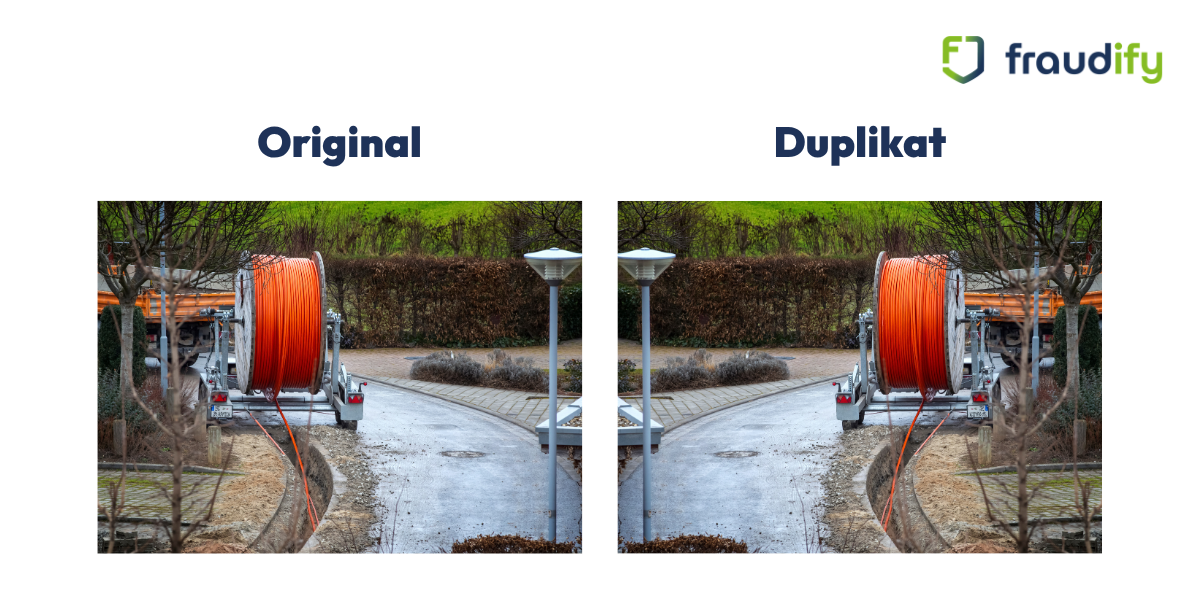
The duplicate check verifies whether an image has already been used in a previous process. For construction site photos, for example, this feature is relevant if:
the same file has been uploaded multiple times,
the same image exists under different file names,
images have been used in multiple reports,
similar photos are assigned to different construction phases,
external parties submit identical photos.
fraudify can also detect similar images, even if the photos differ in minor details. This is helpful when an image has been cropped, resaved, or slightly altered.
However, a match is not in itself proof of improper use. Two similar images may be part of an intentional photo series. A professional assessment is therefore still required.
How can tamper detection be used?
Manipulation detection examines image files for signs of digital alterations. fraudify automatically checks submitted images for such anomalies. This can be relevant for photographic documentation if there is suspicion that:
parts of the image have been removed,
elements have been added later,
relevant details have been obscured,
multiple images have been combined,
colors or contrasts distort the documented condition.
Here, too, the following applies: A technical note is no substitute for a professional examination. It indicates which file should be examined more closely.

What role does deepfake detection play?
Deepfakes are media content generated or heavily altered using artificial intelligence. fraudify includes a deepfake detection feature. In traditional construction documentation, fully synthetic images are currently less common than duplicates or simple image edits. As generative AI becomes more widely available, this issue will also gain importance.
This feature may be relevant, for example, when an image has not only been edited but the purported construction site condition has been fully or partially generated artificially.
How does the metadata check help?
The metadata check analyzes the additional information stored in an image file. fraudify can detect inconsistencies that indicate tampering or forgery. For a construction project, the following information, among others, may be relevant:
Date created,
Modification date,
device used,
file format,
editing software,
GPS information,
technical file properties.
For example: A photo is intended to document the condition of a building in May, but the available file information suggests that it was created or edited at a later date. This discrepancy should be investigated.
Metadata may be missing or have been technically altered. Therefore, it should not be considered in isolation. The analysis becomes more meaningful when considered in conjunction with project information, image content, and other audit results.
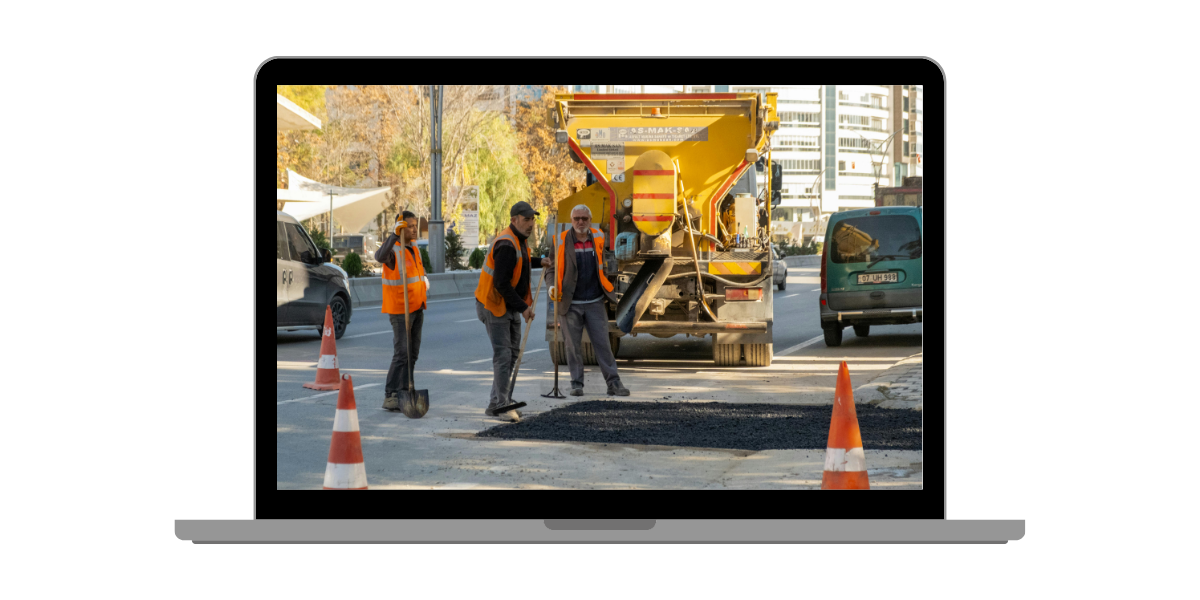
When is a reverse image search useful?
An automated reverse image search can determine whether a submitted image is already publicly available online. This can be relevant for construction documentation if:
a third-party construction site photo is used as your own evidence,
an image comes from a catalog or image database,
an older photo is presented as current construction progress,
publicly available images have been included in reports.
Even a finding on the Internet is initially only an indication for further review. Project managers must clarify whether the use is permissible and factually correct.
How can audit rules be adapted to a construction project?
Not every project requires the same controls. A subsidized infrastructure project may have different requirements than internal renovation documentation.
fraudify offers traceable and customizable rules. Companies can define individual audit parameters and transparently track how specific audits are conducted.
Possible project-specific rules include:
Always submit duplicates for manual review,
Flag metadata discrepancies after a specified time period,
Prioritize reverse-lookup hits,
Treat certain file formats separately,
use different verification profiles for construction progress and defects.
Before going live, the business unit, IT, and data protection should jointly define the rules.
How can fraudify be integrated into existing systems?
Many companies already use a photo documentation app, a project management system, or a central web app. fraudify does not necessarily have to replace these systems.
The software can be integrated into existing IT structures and, according to the provider, is available for both cloud-based and on-premises deployment. On-premises means that the application is operated within the company’s own or controlled IT infrastructure.
One possible integrated process is as follows:
Taking a photo via the app,
transfer to the project platform,
automatic transfer to fraudify,
technical image verification,
return of the verification result,
Subject-matter approval,
Archiving in the document management system.
The specific interfaces available should be technically verified prior to implementation.

Does Fraudify replace site managers or project managers?
No. AI can analyze and compare images and flag anomalies. However, it does not automatically understand all technical, contractual, and project-specific contexts.
The responsible site manager or project manager continues to decide:
whether the work has been performed properly,
whether a defect exists,
whether a photo is sufficient as evidence,
whether similar photos are technically necessary,
what corrective action is necessary,
whether a construction phase can be approved.
fraudify supports the preliminary review. Technical responsibility remains with the person conducting the review.
What are the benefits of automated image inspection?
Automated inspection can offer several advantages when dealing with large image databases:
less extensive manual review,
more consistent inspection processes,
faster identification of suspicious files,
detection of duplicate and similar images,
additional verification of technical image information,
greater traceability,
scalable processing of growing data volumes.
However, these advantages require that data capture, assignment, and technical post-processing are also clearly organized.
For which construction projects is fraudify particularly relevant?
Automated image verification is particularly useful when large volumes of images are generated on a regular basis or when traceable documentation is required.
Possible areas of application include:
Fiber-optic and broadband expansion,
energy and utility networks,
civil engineering,
road construction,
commercial building construction,
Renovation programs,
Fire safety documentation,
projects involving multiple subcontractors,
subsidized infrastructure projects,
recurring inspection and acceptance processes.
For a small number of images, a manual review may be sufficient. However, as the number of images increases, the benefits of an automated, rule-based review process become more significant.
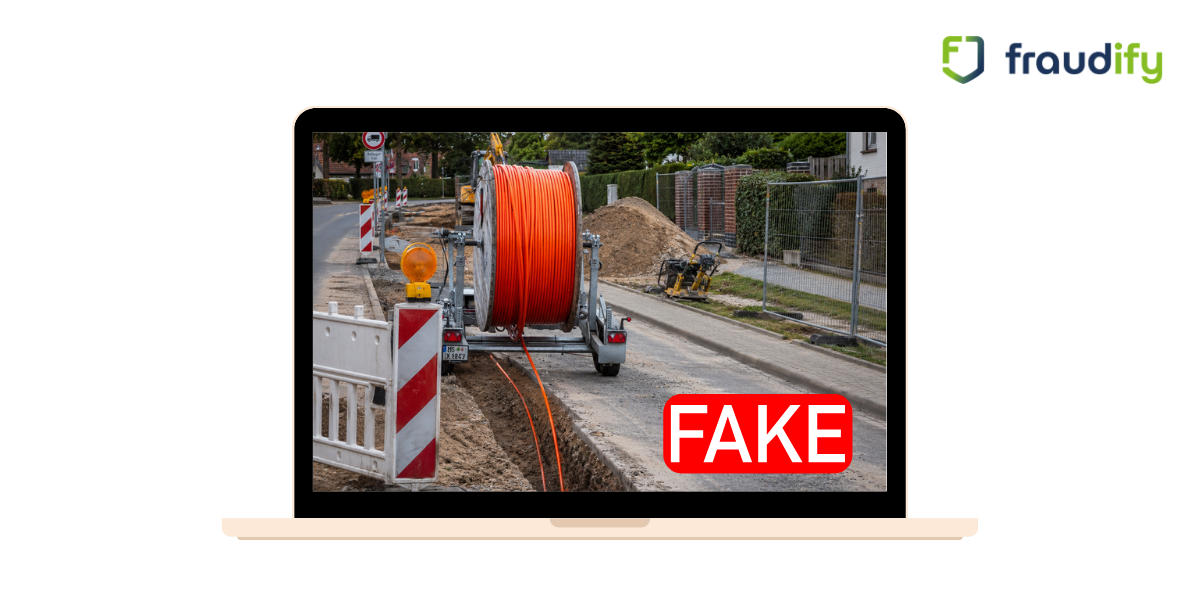
Photographic documentation requires structure and verifiable review processes
Reliable photo documentation on a construction site involves more than just a large number of photos. It combines meaningful images with project information, clear responsibilities, structured filing, and traceable review decisions.
A photo documentation app simplifies data capture directly on the construction site. It can link photos to plans, defects, construction logs, and reports. However, with large image collections, another task arises: companies must identify duplicates, similar images, technical inconsistencies, and potential changes.
This is exactly where fraudify can complement construction documentation. Its feature set includes manipulation detection, deepfake detection, metadata checks, reverse web searches, and duplicate checks. Explainable AI, combined verification methods, and configurable rules are designed to ensure the results are transparent. Flexible hosting options also allow for operation in the cloud or on-premises.
fraudify does not replace site managers or project managers. It helps them review large image collections more effectively and focus their attention on suspicious files. This transforms a growing photo collection into structured and more easily verifiable construction documentation.
FAQ: Frequently Asked Questions About Photographic Documentation on Construction Sites
A complete photo documentation includes not only photos but also the information that allows for unambiguous identification. This includes, in particular:
project and construction phase,
exact location of the photo,
date and time,
the documented work step,
a description of the subject,
Name or role of the person recording the entry,
Relation to a defect, report, or construction log entry.
Depending on the project, GPS coordinates, plans, or other technical data may be included. The key is that a third party should be able to understand the documented condition at a later date.
The required frequency depends on the project and the specific work step. Photos should be taken especially when a condition can no longer be verified later on. This applies, for example, to pipes before backfilling, reinforcing bars before concrete placement, or waterproofing before superstructure construction.
Additional photo opportunities are recommended:
before work begins,
at key milestones in construction progress,
when a defect occurs,
before and after a repair,
when there are deviations from the plan,
during inspections,
upon completion of a construction phase.
To ensure consistent monitoring of construction progress, you should define fixed locations and inspection intervals.
Construction site photos can help preserve evidence. Their evidential value increases when they are in focus, clearly labeled, and saved along with the date, time, location, and a factual description. It is also important to store the original files in a traceable manner.
However, a photo is not automatically legally admissible evidence. Whether it is accepted in a specific dispute depends, among other things, on the context, the quality of the documentation, and the legal framework. For important evidence, you should therefore have the requirements reviewed by an expert.
A photo documentation app links the photo directly to the relevant project. Employees can assign photos to a construction phase, plan, defect, or construction log entry while still on the job site.
Automatic recording of date and time,
optional storage of GPS data,
notes and markings,
offline availability,
Synchronization with a central photo repository,
Creation of reports and logs,
Role and permission management.
This reduces the effort required for sorting later in the office. However, an app is no substitute for mandatory documentation rules.
Large-scale construction projects quickly generate thousands of photos from various construction phases. A purely manual review is time-consuming and difficult to scale as the volume of images grows. In addition, reviewers may overlook similar images or evaluate them differently.
Automated inspection can analyze images consistently, identify similar or duplicate subjects, and prioritize suspicious files for technical review. A case study from a fiber-optic network expansion project shows that this approach reduces the need for traditional visual inspections and speeds up the processing of large volumes of images.
The following functions are particularly useful for reviewing construction site images:
Duplicate check: Detects whether an image has already been used in a previous process.
Manipulation detection: Scans files for signs of digital alterations.
Deepfake detection: Checks for AI-generated or synthetically altered image content.
Metadata check: Analyzes technical image information and flags potential inconsistencies.
Reverse image search: Checks whether a submitted image is already publicly available on the internet.
These features can be combined. For example, an image can be checked simultaneously for previous use, suspicious metadata, and possible digital alterations.
The duplicate check verifies whether a photo has already been included in a previous transaction. In addition, the AI-powered image verification can recognize similar subjects, even if the images differ in minor details.
This can be relevant if a photo:
has been resubmitted under a different file name,
has been cropped or slightly modified,
has been assigned to multiple construction phases,
is part of a series of nearly identical images.
However, a match does not necessarily prove unauthorized multiple use. The person in charge must verify whether it is a legitimate series of images, an accidental duplicate, or a suspicious submission.
Fraudify automatically scans image files for traces of digital alterations. In addition, the software can analyze metadata and identify inconsistencies that may indicate editing or incorrect attribution.
A suspicious analysis result does not constitute conclusive proof of manipulation. It serves as an indication that a more in-depth technical and expert review is warranted. The original file, project information, and documented construction status should always be considered together.
The reverse image search automatically checks whether a submitted image is already publicly available online. This can, for example, reveal images that belong to others, are older, or are not specific to the project.
However, a web search result does not automatically mean that the photo was used improperly. It is conceivable, for example, that a company has already published its own image related to the project. The result must therefore be evaluated in the context of the project.
"Explainable AI" refers to artificial intelligence that can be explained. Users should be able to understand how fraudify arrives at an assessment. This allows audit processes to be explained and results to be verified without having to treat the AI as an opaque black box.
This is particularly important for construction documentation: A construction manager should be able to recognize why a photo was flagged before deciding whether to request clarification, reject it, or approve it.
No. Fraudify analyzes files and provides indications of potential anomalies. The technical decision remains with the person in charge.
Site managers or project managers must still assess:
whether the photo belongs to the specified construction phase,
whether the work shown is done properly,
whether there is a defect,
whether similar photos are required,
whether the image is sufficient as evidence,
whether additional documentation needs to be requested.
The automated analysis thus supports the preliminary review but does not replace the technical project context.
Yes. fraudify offers customizable rules that allow companies to define and adjust individual verification parameters. This makes it possible, for example, to set up different verification profiles for construction progress, defect documentation, or acceptance inspections.
Possible rules include:
Always check duplicates manually,
Prioritize certain metadata discrepancies,
handle results from reverse web searches separately,
check individual file formats more thoroughly,
and perform different checks depending on the type of project.
The rules should be established jointly by the business unit, IT, and data protection before implementation.
Fraudify can be integrated into existing systems. The application can be run both in the cloud and on-premises. On-premises means that the software runs within an IT infrastructure that you control yourself.
One possible process is:
Capturing photos using a photo documentation app,
Uploading them to the central project platform,
Transferring the files to fraudify,
automated image verification,
Return of results,
Technical evaluation and approval,
Archiving in the existing storage system.
The interfaces and technical requirements applicable to the respective system must be reviewed as part of the implementation process.
fraudify is primarily designed for the forensic examination of submitted image files. Therefore, the software does not necessarily replace an app for taking photos, maintaining a construction log, managing defects, or facilitating project communication.
In an end-to-end process, both solutions complement each other: The photo documentation app handles structured data capture and assignment. fraudify then checks the images for duplicates, possible alterations, suspicious metadata, or content already available on the internet.
For notable results, there should be a mandatory review and approval process:
Review the technical notes.
Compare the original file with the project data.
Check for similar images or previous instances.
If necessary, ask the submitter for clarification.
Document the technical decision.
Approve, reject, or request the file again.
Archive the result in a traceable manner.
It is important to maintain a neutral assessment: A technical note initially means only that an image should be examined more closely. On its own, it is not proof of manipulation or deception.


