
AI in the Energy Sector: How Artificial Intelligence Is Transforming the Industry

Free Webinar: Why the Energy Transition Needs AI
In our webinar “AI: A Curse and a Blessing—Why Renewables Need AI,” Dr. Simon Kroll provides a concise and practical insight into the role of AI in the energy transition. Using key application areas as examples, he demonstrates how artificial intelligence enables more accurate forecasts, supports smart grids, makes plant operations more efficient, and optimizes the use of energy storage systems. At the same time, he highlights the limitations, risks, and challenges associated with the use of AI.
A grid operator looks at his monitoring screen one afternoon and sees a problem developing: Thousands of wallboxes are charging electric cars at the same time, while a cloud front is causing a sharp drop in power feed-in from solar panels in the region. Within minutes, the balance between generation and consumption shifts—and the power grid comes under pressure. Scenes like these have long been part of everyday life for many energy providers.
But what does this mean, specifically, for managing an increasingly complex energy system? This is exactly where artificial intelligence comes in. In this article, you’ll learn how AI is being used in the energy industry, what advantages and challenges it presents, and what companies should keep in mind when implementing it.

Why is AI gaining importance in the energy sector right now?
The energy sector is in the midst of a profound transformation. Renewable energy sources are increasingly feeding into the grid on a decentralized basis, electromobility is changing load profiles, and the shortage of skilled workers is making it difficult for many energy providers to manually analyze growing volumes of data.
A recent study by PwC shows just how seriously the industry is taking this issue: 59 percent of the energy companies surveyed view artificial intelligence as a strategic—or even transformative—element of their value creation over the next five to ten years. The Digital@EVU 2026 study by BDEW, VSE, and Kearney also confirms this trend: One-third of energy utilities have already implemented their own AI strategy, and another 58 percent are planning to do so.
The relevance is obvious: Without intelligent systems, it is virtually impossible to efficiently manage an energy system with millions of decentralized generators, volatile renewable energy sources, and growing electromobility. This is where we come in, aiming to make the energy industry more efficient with effective AI solutions.
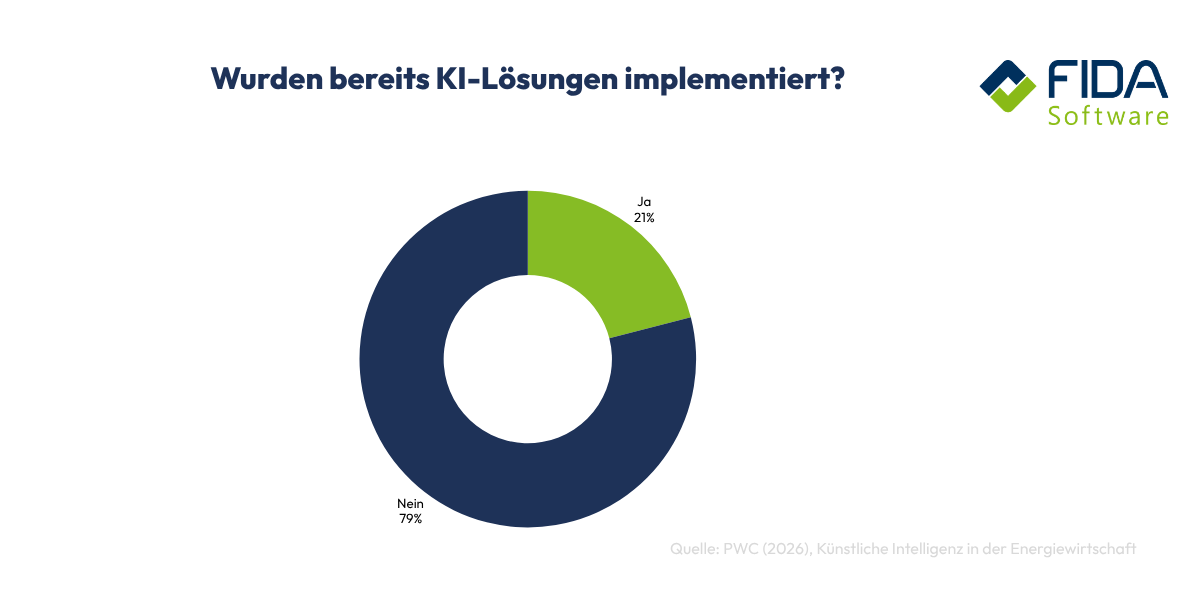
However, by no means have all energy companies already implemented AI solutions. This raises the question: What factors have been delaying the adoption of AI so far? The results of the PwC study show:
No suitable use cases have been identified yet
The data infrastructure is still under development
The necessary expertise is currently being developed
Other projects have had higher priority so far
Pilot projects are currently being evaluated
AI is on the strategic agenda; implementation is proceeding in stages
The Group-wide works council agreement on AI has not yet been approved by the works council
What does artificial intelligence actually mean in the energy sector?
Artificial intelligence refers to systems that learn from large amounts of data, recognize patterns, and use that information to make decisions or generate forecasts—without each individual case having been programmed in advance. In the energy sector, companies primarily use two subfields for this purpose:
Machine Learning: Algorithms learn from historical data—such as weather data or consumption figures—to predict future trends.
Deep learning: Neural networks process particularly complex and large amounts of data, such as image or sensor data from wind turbines.
Data science forms the foundation for this: it encompasses the preparation, analysis, and interpretation of the data generated in power generation, grid operation, and distribution. It is only through this combination of data, algorithms, and computing power that AI solutions can be deployed in the energy sector at all. With our expertise in machine learning and deep learning, we ensure that AI models deliver reliable results.

What are the areas of application for AI in the energy industry?
The use of AI spans the entire value chain—from generation to grid operation to customer service. Let’s take a closer look at the most important use cases.
Use Case 1: Real-Time Grid Control and Grid Stability
AI coordinates decentralized generators and consumers in real time and continuously balances supply and demand. Intelligent grid control detects anomalies in grid data before they lead to overloads, thereby contributing directly to grid stability. For grid operators, this means less expensive balancing energy and greater security of supply.
Use Case 2: Integration of Renewable Energy
Wind and solar energy provide fluctuating amounts of power. AI helps direct this energy more precisely to where it is currently needed, thereby improving the integration of renewable energy into existing power grids. This is a key component of decentralization in the energy system.
Use Case 3: More Precise Forecasts for Generation and Consumption
AI algorithms analyze historical weather data and consumption patterns to more accurately predict energy feed-in from wind and solar plants. Better forecasts not only increase grid stability but also significantly reduce the need for expensive balancing energy.
Use Case 4: Predictive Maintenance of Plants
A real-world example: For wind turbines, maintenance costs often account for 20 to 25 percent of total operating costs over their lifetime. Predictive maintenance uses sensor data and AI models to predict defects before they lead to failure. According to findings by Wavestone, AI can reduce inspection costs by up to 70 %
Use Case 5: Automated Energy Trading
In electricity trading, AI enables automated trading decisions: algorithmic trading analyzes market prices, weather data, and historical patterns and executes transactions in milliseconds. Automated energy trading thus optimizes the purchase and sale of energy and responds more quickly to market changes than would be possible manually.
Use Case 6: Customer Service and Customer Management
AI is also playing an increasingly important role in customer interactions. Chatbots analyze customer behavior and automatically answer standard inquiries. This reduces the workload on service representatives and has a positive impact on customer satisfaction because answers are available more quickly.
What are the benefits of using AI for energy companies?
The benefits of AI in the energy sector can be measured concretely in several areas:
Increased efficiency: Automated processes reduce manual effort in generation, grid operations, and sales.
Cost reduction: Predictive maintenance and optimized energy trading lower operating and maintenance costs.
Greater supply reliability: Real-time anomaly detection prevents grid overloads.
New business models: Data-driven services open up additional revenue streams for energy companies, such as in the field of electric mobility.
Improved customer experience: Faster, more personalized customer service strengthens customer loyalty.
According to the 2026 PwC study, companies currently see the greatest value of AI solutions in efficiency gains, followed by an improved customer experience and higher quality in forecasting and grid stability.

What are the challenges involved in implementing AI?
As great as the opportunities are, the challenges are just as real. The PwC study shows that while many energy providers have introduced initial AI solutions, the majority of these are still in the experimental phase—regardless of company size. So far, only a few have successfully made the leap from individual pilot projects to scaled-up production operations.
Typical hurdles include:
Data quality: AI models require clean, well-structured data sets—many energy providers still work with legacy, fragmented systems.
Skills shortage: Expertise in data science and AI implementation is scarce and highly sought after.
Lack of a roadmap: Only a fraction of companies have an explicit strategic AI roadmap; many projects remain isolated initiatives.
Complexity of integration: AI systems must be integrated into existing IT landscapes, control systems, and processes without jeopardizing day-to-day operations.
However, these hurdles are not unique to companies in the energy sector. In our AI consulting practice, we encounter such challenges time and again. Through measures tailored specifically to each company, we successfully implement AI in a sustainable and profitable manner for our clients.

The EU AI Act: A Legal Framework for AI in the Energy Sector
In addition to technical and organizational issues, regulation is playing an increasingly important role. With the EU AI Act, the European Union has established a uniform legal framework for the use of artificial intelligence. The regulation took effect on August 1, 2024, and classifies safety-critical AI systems in critical infrastructure—which includes parts of the energy supply—as high-risk applications (Verbraucherzentrale).
For energy companies, this means in concrete terms: Those who use AI in safety-critical areas such as grid control must meet requirements regarding roadmaps, technological infrastructure, and targeted training. In Germany, the Federal Network Agency is designated as the central market oversight authority for AI. Companies that address these requirements early on not only reduce regulatory risks but also gain a competitive edge in the responsible use of AI technologies.
Best Practices for Implementing AI Solutions
Based on the experiences of many energy companies to date, several best practices can be identified:
Start small, scale strategically: A single, clearly defined experiment—such as forecasting peak loads in a grid section—delivers reliable results faster than a company-wide AI program.
Data first: Without consistent, well-maintained data, even the best AI model cannot deliver reliable patterns.
Bring IT and business units together: The greatest progress is made when grid operations, sales, and IT jointly define use cases, rather than developing AI projects in isolation within the IT department.
Develop a strategic roadmap: A clear roadmap prevents oversized or value-destroying investments and provides direction for the entire organization.
Consider governance from the start: Integrating the requirements of the EU AI Act into system development earlyon saves you from having to do rework later.
Real-World Example: AI in the Day-to-Day Operations of a Municipal Utility
A real-world example illustrates how these principles play out in day-to-day operations: A medium-sized municipal utility first launches a pilot project for load forecasting to better estimate the utilization of the local distribution grid. To do this, an AI model analyzes weather data, historical consumption figures, and data on electric vehicle charging.
After a few months, it becomes clear that forecasting accuracy has improved significantly, meaning the utility company needs to procure expensive short-term balancing energy less frequently. Based on this experience, the company gradually expands its use of AI to include predictive maintenance of transformer stations and a chatbot for customer service. The key to success was not so much the technology itself as the close collaboration between grid operations, IT, and customer service.
Where is AI headed in the energy sector?
Artificial intelligence has become a productive value driver in the energy sector. The trend is shifting from isolated automation to intelligent, end-to-end orchestration of generation, the grid, and distribution (PwC Study 2026).
For energy suppliers, utilities, and municipal utilities, this means the question is no longer whether to use AI systems, but how to integrate them effectively into existing processes—in a legally compliant, cost-effective manner that delivers clear benefits for grid stability, costs, and customer satisfaction. This is exactly where we come in. We support energy providers on this journey from Day 1!

AI as a Driver of Value in the Energy Transition
AI in the energy sector is no longer a topic for the future, but has long been standard practice—albeit with varying degrees of maturity depending on the company. From grid control and the integration of renewable energy to automated energy trading, artificial intelligence helps energy companies streamline processes, reduce costs, and enhance supply security.
Success, however, does not depend solely on the technology. A solid data foundation, a clear strategic roadmap, and the incorporation of regulatory requirements—such as the EU AI Act—from the very beginning are crucial. Companies that lay this groundwork are well-positioned to harness the long-term potential of AI in the energy sector. We support companies on their journey toward an AI-driven future!
FAQ: AI in the Energy Industry
Artificial intelligence (AI) refers to systems that analyze large amounts of data, recognize patterns, and use them to make predictions or derive recommendations for action. In the energy sector, AI is used in areas such as load forecasting, grid control, the integration of renewable energy, predictive maintenance, energy trading, and customer service.
The energy transition is leading to an increasing decentralization of the energy supply. At the same time, the volume of data is continuously increasing due to smart meters, solar power systems, wind farms, and electric vehicles. AI helps energy providers manage this complexity, automate processes, and operate power grids efficiently and reliably.
Among other things, the use of AI enables:
more accurate generation and consumption forecasts,
greater grid stability,
lower operating and maintenance costs,
more efficient energy trading processes,
automated customer services, and
better decisions based on real-time data.
Key areas of application include smart grid control, forecasting electricity generation and consumption, predictive maintenance for energy systems, automated energy trading, optimization of battery storage systems, and AI-powered chatbots in customer service.
The biggest challenges often include poor data quality, legacy IT systems, a lack of AI expertise, and the integration of new applications into existing processes. Added to this are regulatory requirements such as the EU AI Act, which must be taken into account, particularly for safety-critical applications.
The EU AI Act establishes a uniform legal framework for the use of artificial intelligence in Europe. AI systems used in critical areas of energy supply may be classified as high-risk applications. Companies must therefore comply with requirements regarding transparency, risk management, documentation, and governance.
Yes. Municipal utilities, in particular, often benefit from clearly defined use cases such as load forecasting, predictive maintenance, or AI-powered customer service. A phased approach using pilot projects makes it possible to gain experience and measure the benefits early on.
Successful AI projects begin with a specific use case and a high-quality dataset. Equally important are a clear AI strategy, close collaboration between business units and IT, and early consideration of regulatory requirements. This allows pilot projects to be gradually scaled up into production-ready solutions.
No. AI helps employees complete data-intensive and repetitive tasks more quickly and accurately. Decisions involving a high level of responsibility—such as those related to grid operations or strategic investments—remain in human hands. AI serves as an intelligent tool, not a complete replacement.
As renewable energy, smart grids, and electric mobility continue to expand, the importance of AI will continue to grow. In the future, AI systems will integrate generation, storage, grid operations, and energy trading even more closely, thereby making a significant contribution to a secure, economical, and sustainable energy supply.


